
Journeys & Encounters · Place profile
Sandur: Several early locations
In Brief
Sandur on Sandoy preserves evidence for settlement, burial and exchange across the early history of the Faroe Islands. Its archaeological interest extends beyond the present church and the later houses that define the village today.
On this page
Several early locationsCoins and distant connectionsThe church is not the first churchSourcesPresent-day location: Faroe Islands · North Atlantic
Names and search variants: Sandur · Sandoy · Á Sondum · a Sondum
Browse places by country →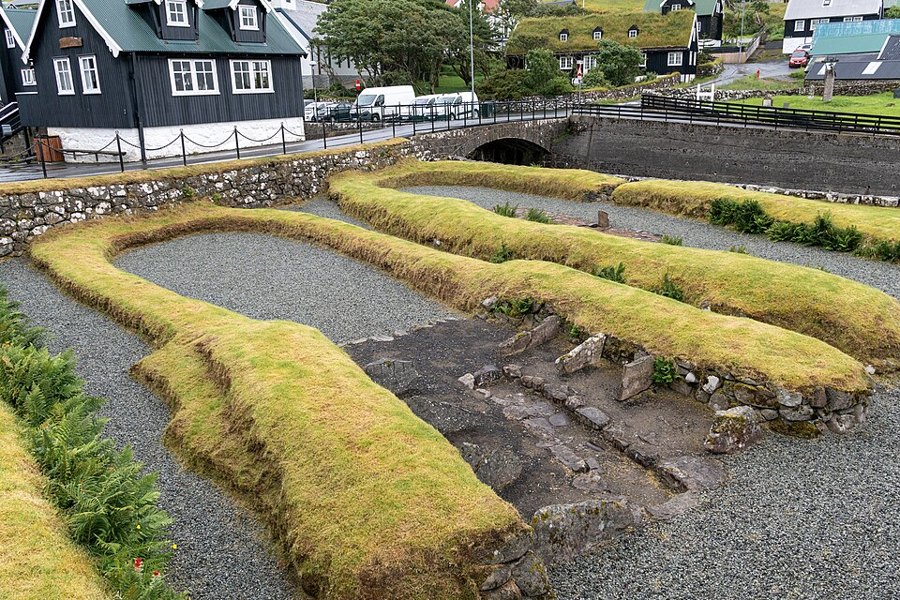

Several early locations
Local heritage interpretation identifies tenth-century occupation through excavations around the graveyard, at á Sondum and at Junkarisfløttur. Remains interpreted as a longhouse and burials with significant objects suggest more than a minor passing stop. Different excavation areas need their own chronology; placing them on one map does not make all the buildings contemporary.
Coins and distant connections
A silver coin hoard found in the nineteenth century is one of Sandur’s best-known discoveries. Imported coins demonstrate the movement of silver across wide networks. They do not prove that the person who buried them personally visited every place of minting. Coins could circulate for considerable periods and change hands repeatedly before reaching an island community.
The church is not the first church
The standing church was inaugurated in 1839 and occupies a location with earlier church phases. The village museum also represents a much later household. These places can enrich a visit when their dates are kept clear. Sandur’s strength is the interaction of successive settlements and institutions, not the survival of a single untouched Viking village. Current excavation areas should be approached through official access guidance rather than entered simply because the landscape appears open.
Explore more Viking-Age places →
Explore this record and its sources in the map collection →
This entry is searchable by place and country. No verified burial-site coordinate is supplied, so it has no map marker or directions.
The Evidence
The sources below support this article. Interpretations and limits are explained in the text; this is not an exhaustive research review.