
Journeys & Encounters · Place profile
Kvívík: Buildings in their landscape
In Brief
Kvívík on Streymoy contains excavated Norse building remains within a living Faroese village. The site offers a direct introduction to household settlement in the islands, beyond the better-known stories of voyages between Norway and Iceland.
On this page
Buildings in their landscapeWhat remains after a house disappearsA village with several historiesSourcesPresent-day location: Faroe Islands · North Atlantic
Names and search variants: Kvívík · Kvivik · Streymoy
Browse places by country →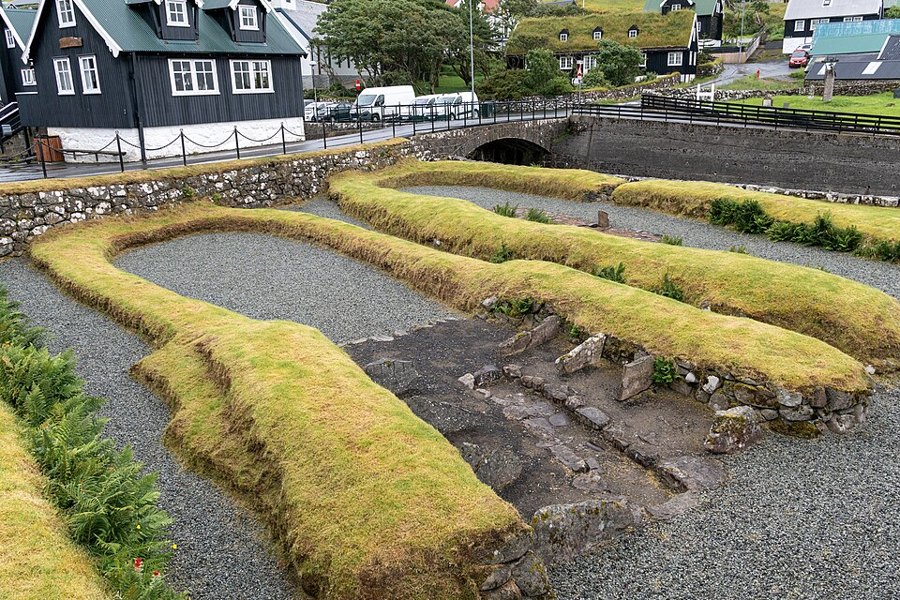

Buildings in their landscape
The archaeological remains include a longhouse and associated farm structures. Their position near the shore makes maritime access an obvious part of interpreting the settlement, but the household also depended on the surrounding land. A coastal farm was not simply a temporary stop for sailors: it required food production, maintenance and repeated decisions about available resources.
What remains after a house disappears
Low walls and foundations reveal layout more readily than roof form, interior furnishings or the number of inhabitants. These missing elements must be reconstructed through evidence and comparison. A photograph of the excavation is therefore especially valuable when it is not presented as a complete picture of the original building. Ask which features are original remains and which have been consolidated for display.
A village with several histories
The attractive houses around the site are much later than the Norse settlement. Their presence does not reduce the archaeology’s value; it demonstrates how occupation and community life continued to reshape the place. Compare Kvívík with Toftanes, where different preservation conditions reveal different materials. Neither site alone can represent every early Faroese household or settle the separate debate about human activity before Norse colonisation.
Explore more Viking-Age places →
The Evidence
The sources below support this article. Interpretations and limits are explained in the text; this is not an exhaustive research review.