
Journeys & Encounters · Place profile
Tuna in Badelunda: Women in boats
In Brief
Tuna in Badelunda is particularly important because its boat burials included women. It broadens a story too often reduced to male warriors and large ships. The excavated cemetery near Västerås forms part of a wider high-status landscape, but the original grave area is not an open-air museum.
On this page
Women in boatsA sewn boat and northern connectionsFinds and findspot are different visitsSourcesPresent-day location: Sweden · Västmanland
Names and search variants: Tuna in Badelunda · Tuna Badelunda · Badelunda boat graves
Browse places by country →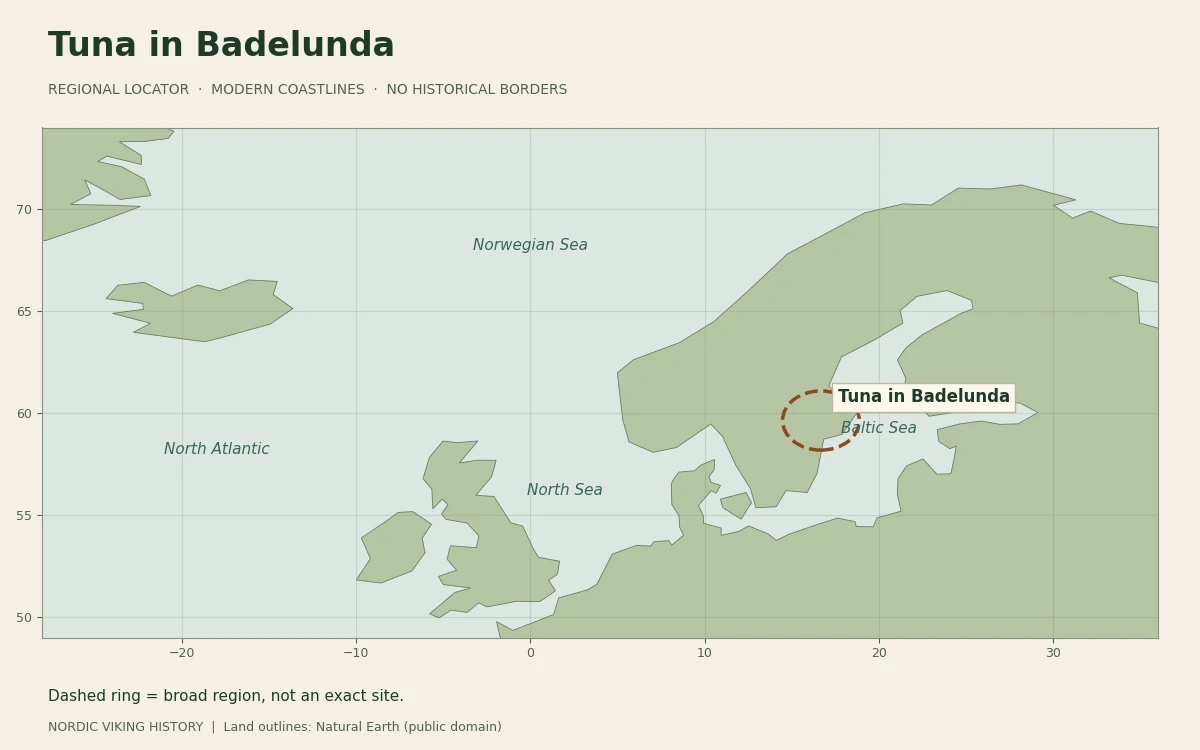
Women in boats
Official archaeological interpretation describes eight boat graves within a larger Iron Age cemetery. The women buried there and their selected furnishings make social position and funerary choices central questions. A boat burial cannot automatically be translated into a warrior biography, and equipment should be considered with the complete burial context.
A sewn boat and northern connections
One Viking-Age vessel was joined with a sewing technique interpreted as consistent with Sámi boatbuilding. This provides an important possibility of craft exchange across cultural boundaries. A construction technique can support an argument about manufacture, but cannot by itself identify the ancestry of the person buried in the boat.
Finds and findspot are different visits
The excavated cemetery was subsequently removed and the site became private residential land. The boat is associated with museum interpretation in Västerås, not a freely accessible ship grave in a garden. This distinction is essential for responsible travel writing: an archaeological location may be historically significant even when the most meaningful encounter is with its preserved material and documentation elsewhere.
Explore more Viking-Age places →
Explore this record and its sources in the map collection →
This entry is searchable by place and country. No verified burial-site coordinate is supplied, so it has no map marker or directions.
The Evidence
The sources below support this article. Interpretations and limits are explained in the text; this is not an exhaustive research review.