
Journeys & Encounters · Deep dive
Dunmore Cave: Bones, Silver, and an Account of Violence
In Brief
Written accounts describe an attack, but disturbed human remains and separately deposited valuables make Dunmore a demanding archaeological case.
On this page
A cave with more than one historyWhat the annal actually saysRecovering evidence during modern worksThe people represented by the bonesRadiocarbon dates and competing explanationsSilver concealed in a rock creviceSourcesA cave with more than one history
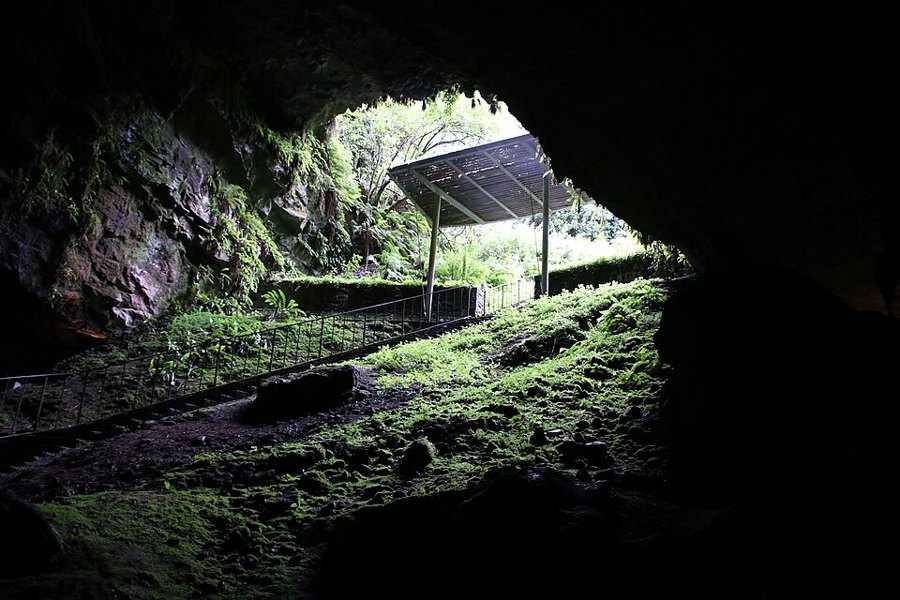
Dunmore Cave in County Kilkenny combines a dramatic natural setting with unusually difficult historical evidence. Its limestone chambers and calcite formations developed over immense spans of time, but its archaeological importance concerns much more recent human visits and deposits. The Office of Public Works notes its appearance in the Triads of Ireland and its association with a recorded Viking attack.
The same heritage authority explicitly distinguishes that written account from archaeological confirmation. Human remains and Viking-period objects demonstrate significant activity, but they have not reliably established the massacre as usually retold. This is the central problem of the site. A cave containing bones can invite an immediate narrative of people trapped underground, yet its deposits may also reflect burial, concealment, repeated visits, and later disturbance. Dunmore rewards close comparison between kinds of evidence precisely because the most memorable explanation is not automatically the best demonstrated one.
Sources for this section: 1
What the annal actually says
Under the year 928, the Annals of the Four Masters attribute the destruction and plundering of Dearc Fearna to Godfrey, grandson of Ímar, and the Dublin foreigners. They give a death toll of one thousand and add a short verse fixing the event to that year. The passage is an explicit account of violence, but it does not describe smoke, fires at an entrance, or the victims' age distribution.
The surrounding entries place the event within a wider landscape of competing fleets. They mention Limerick forces encamping at Magh Roighne and, in the following year, Godfrey moving into Osraige against another descendant of Ímar. Read in this context, the cave attack belongs to regional warfare and rivalry rather than an isolated encounter detached from politics. The annal supplies names and a claimed scale of loss; connecting those statements to particular bones requires additional archaeological evidence.
Sources for this section: 2

Recovering evidence during modern works
In 2004, an upgrade to the cave's lighting system required archaeological supervision of small areas of ground disturbance. Marion Dowd's excavation report records trenches beside the entrance steps and inside the cave. Some followed older cable routes and contained disturbed sediment mixed with builders' material and modern debris. These contexts were far from sealed deposits left untouched since the tenth century.
Even so, careful recovery produced an early medieval ringed-pin fragment, another ringed pin, a blue glass bead, and a shale or lignite bracelet fragment. Exposed clusters of human and animal bones elsewhere in the cave were also recorded and removed after consultation with the relevant authorities. The report illustrates why modern maintenance can generate valuable research while demanding close attention to disturbance. A find recovered beside bones may help characterize activity in the cave without proving that the object and every nearby bone entered it together.
Sources for this section: 3
The people represented by the bones
The Human Remains from Irish Caves Project examined older collections from Dunmore, concentrating particularly on material recovered in the 1940s. Its 2006 publication identified a minimum of eighteen adults and twenty-five juveniles. Seven adults were identified as female and four as male. These are minimum estimates derived from surviving skeletal elements, not a census of everyone who ever died in the cave.
No evidence of violent trauma was observed in the examined bones. The researchers stressed that fatal injuries to soft tissue need not mark a skeleton, so this does not disprove violence. Nevertheless, it weakens claims that the skeletons themselves demonstrate a massacre. Some individuals apparently decomposed on the cave floor, prompting comparison with deliberate burial. Earlier removals had also fragmented the record: substantial assemblages could no longer be located. The history of collecting therefore limits both the number of people that can be recognized and the contexts through which their deaths might be understood.
Sources for this section: 4
Radiocarbon dates and competing explanations
The 2007 study by Dowd, Linda Lynch, and Margaret McCarthy reported the first radiocarbon dates on human remains from Dunmore. Four sampled individuals came from recorded locations: an adult, an adolescent, and two children. The results placed them within the ninth- and tenth-century setting suggested by the artifacts, challenging earlier proposals that the bones belonged to much later conflicts.
The authors considered whether the dates might indicate two episodes, with some deaths centered earlier than others. However, overlapping calibrated ranges prevented a secure division into two events. Nor could the dating identify a single annalistic year. The study also warned against adding newly recovered bones mechanically to previous minimum counts, because disturbed fragments might belong to individuals already represented in older collections. Massacre and burial remained competing interpretations. The dates substantially improved the chronology while leaving the cause of death and the original arrangement of bodies unresolved.
Sources for this section: 5
Silver concealed in a rock crevice
The 2016 volume Underground Archaeology catalogs the separate assemblage discovered in 1999 in a crevice of the Town Hall Chamber. It included coins and other silver, two copper-alloy ingots, and remnants interpreted as a prestigious garment used to contain or wrap the valuables. Textile and leather survived in fragments, with traces of green pigment on the cloth.
Sixteen hollow cones woven from silver wire came in three sizes. They may have functioned as buttons or tassels; describing them merely as coins or generic jewelry loses the unusual evidence for decorated clothing. Fragments of silver braid and a hinged copper-alloy buckle also formed part of the group. Cut ingot fragments and other silver pieces bore nicks, recording their treatment as metal as well as ornament. This carefully concealed collection is a distinct archaeological deposit. Its relationship to the human remains must be investigated, rather than assumed from their shared location within the same large cave.
Sources for this section: 6
The Evidence
The sources below support this article. Interpretations and limits are explained in the text; this is not an exhaustive research review.
- Office of Public Works: Dunmore Cave ↗
- CELT, University College Cork: Annals of the Four Masters, M928–929 ↗
- Dowd: Dunmore Cave archaeological monitoring, 2004 ↗
- Dowd, Fibiger and Lynch 2006: Human Remains from Irish Caves Project ↗
- Dowd, Lynch and McCarthy 2007: Recent archaeological discoveries in Dunmore Cave ↗
- Dowd, editor, 2016: Underground Archaeology, Dunmore finds catalog ↗