
Journeys & Encounters · Deep dive
Emma of Normandy: Making a Royal Past Useful
In Brief
A queen’s commissioned history reveals how family claims, language, performance, and manuscript revision could shape political memory.
On this page
A patron with more than one royal connectionThe presentation imageThe author’s promise of truthA multilingual courtSilence can be a deliberate choiceCeremonies and gestures carry argumentsA different ending for a different kingReading political memory as evidenceSourcesA patron with more than one royal connection
Emma was queen beside Æthelred and later Cnut, and mother of Harthacnut and Edward the Confessor. These relationships made her a link between competing claims rather than a passive ornament to one dynasty. The British Library describes the Encomium Emmae Reginae as a work composed at her request by a Flemish monk. Its commissioning is itself an action: she sought to influence how recent events would be understood. The resulting text is therefore evidence both for the history it narrates and for a political intervention in the early eleventh century. Separating those two uses is the starting point for reading it well.
Sources for this section: 1
The presentation image
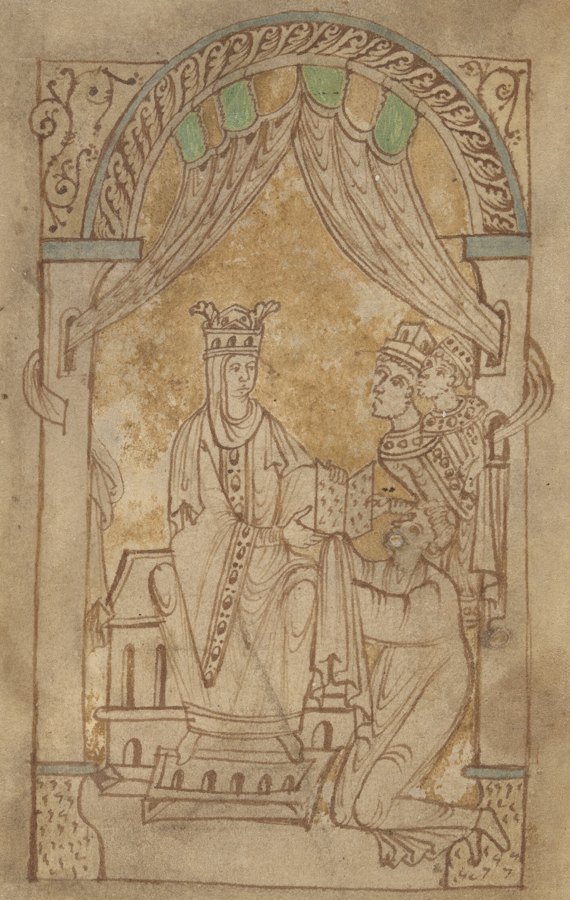
The opening image in the British Library manuscript shows the author offering his work to Emma, with her sons looking on. This is a statement about patronage and the intended relationship between book and family. Emma receives the narrative rather than merely appearing inside it. The visual arrangement makes her a central point through which the past is presented to the next generation. It need not be treated as a literal record of one precisely documented presentation ceremony to be historically valuable. Its composition shows how the manuscript wanted the act of writing, receiving, and witnessing to be understood.
Sources for this section: 1

The author’s promise of truth
In the prologue, the writer declares his loyalty to Emma while insisting that a historian must avoid falsehood. Those commitments sit together inside the text. He worries that excessive detail will invite criticism, while too much brevity will conceal what ought to be revealed. This is not an accidental contradiction to remove before reading. It makes the author’s task visible: he must produce an account worthy of his patron and credible as history. The prologue establishes standards against which the narrative can be assessed. A profession of truthfulness is evidence of an author’s claim to authority, not an independent guarantee that every subsequent episode is accurate.
Sources for this section: 2
A multilingual court
Elizabeth Tyler’s study places the work in the multilingual environment of Harthacnut’s court. English, Norse, French, Flemish, and Latin traditions formed part of that setting, with Emma playing an important role in negotiating between them. The Latin text therefore should not be imagined as belonging to a cultural world sealed off from spoken vernaculars. Its production and reception involved people whose linguistic skills and expectations differed. This context helps explain why literary form mattered politically. A prestigious language could carry a royal argument across audiences, while mediation and performance could make the argument accessible beyond those able to read the manuscript themselves.
Sources for this section: 3
Silence can be a deliberate choice
Research on the text repeatedly notes the absence of Emma’s first marriage from its central presentation of her career. A St Andrews study also considers the silence surrounding her association with Stigand, while warning that the work is selective in other respects. Absence is not enough to prove that a relationship never existed. It can reveal the limits of a narrative’s purpose. For Emma, a straightforward chronological biography would have exposed connections that complicated the image the commissioned work sought to build. Comparing the book with other records therefore identifies both missing events and the political usefulness of leaving them out.
Sources for this section: 4
Ceremonies and gestures carry arguments
Ross Smythe’s Cambridge thesis studies demonstrative behavior in the Encomium: ceremonies, social rituals, and verbal and nonverbal acts. This approach asks what actions are meant to communicate within the narrative and to its audiences. A marriage negotiation, a refusal, or a public act of recognition can do more than advance the plot. It can represent rightful authority or dishonorable conduct in a form that listeners are expected to understand. The thesis also investigates evidence for performance before a live audience. This is an interpretive approach rather than proof of a recoverable single performance, but it usefully expands analysis beyond checking isolated statements against a chronology.
Sources for this section: 5
A different ending for a different king
The discovery of another manuscript witness in 2008 changed the evidence available to scholars. The Manchester discussion identifies the later copy as preserving a version associated with Edward’s accession, while the British Library catalogue notes the significance of the differing endings. A revised conclusion can reposition a historical narrative without rewriting all of its earlier content. That is especially revealing when the earlier body of the work remains awkward for the new political setting. Manuscript variation becomes evidence of adaptation: a text designed to support one arrangement could be made to speak to another, while still carrying traces of its previous purpose.
Sources for this section: 6
Reading political memory as evidence
The Encomium is neither a neutral modern biography nor a source that becomes useless once its partisanship is recognized. Its patronage, prologue, omissions, gestures, and revised ending show how historical writing participated in politics. Those features answer questions different from the question of whether every narrated event happened exactly as described. Emma’s project also places a royal woman at the center of cultural production and dynastic argument. The book lets us study an attempt to organize recent experience into a usable family past. That attempt is itself a historical event, with a patron, author, audiences, and changing conditions of reception.
Sources for this section: 1, 2, 3, 4, 5, 6
The Evidence
The sources below support this article. Interpretations and limits are explained in the text; this is not an exhaustive research review.