
Journeys & Encounters · Focused study
Helgö’s Buddha, Crosier, and Ladle: Objects That Changed Worlds

In Brief
Three objects from Helgö connect central Sweden with distant artistic and religious traditions. Studying them individually reveals more than treating their presence as proof that their original religions were practiced together on the island.
On this page
A Buddha older than the Viking AgeJonah on a bishop’s staffAn eastern Mediterranean ladleOne find area does not mean one storySourcesA Buddha older than the Viking Age
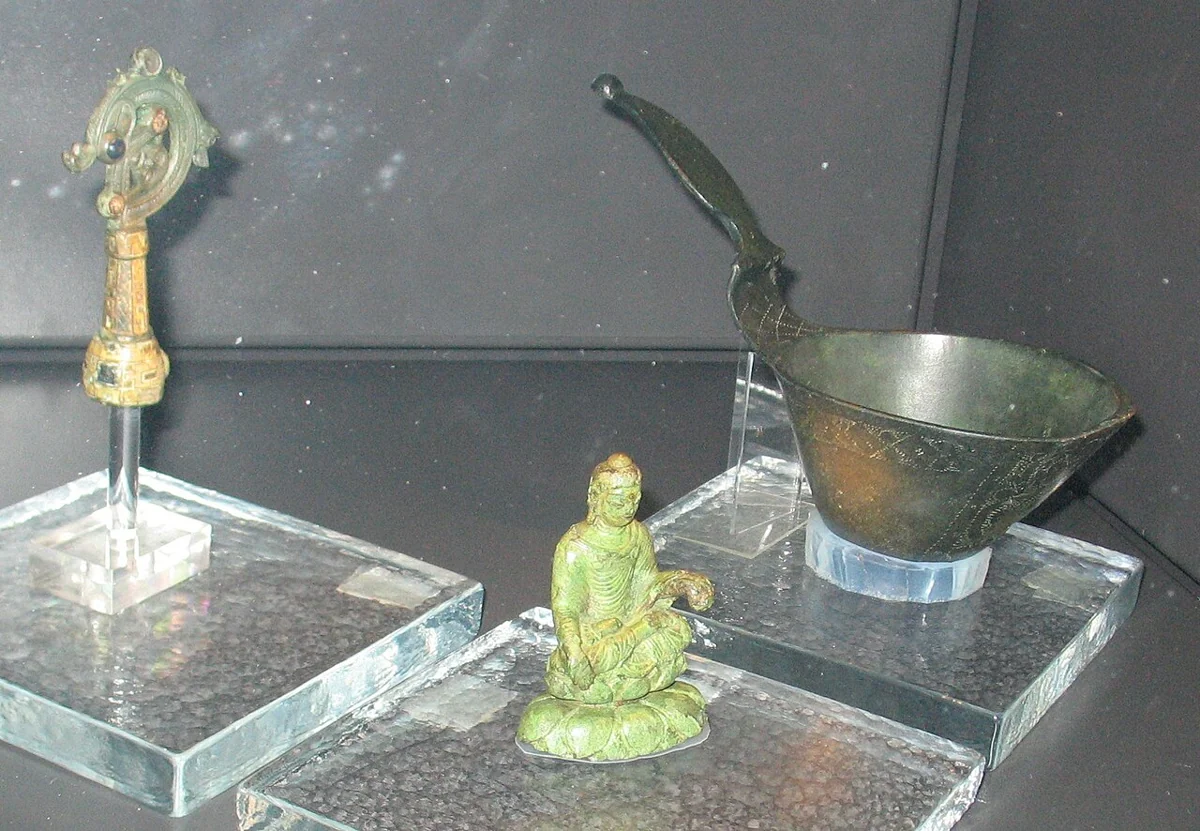
The Swedish History Museum dates the small Buddha to the late fifth or early sixth century and tentatively places its manufacture in Swat, in the region of modern Pakistan and Afghanistan. The figure sits on a double-lotus throne. Surviving traces indicate that color and precious-metal details once enriched its appearance.
This dating means the object was made well before the conventional Viking-Age starting point. Its presence in a collection about the Viking world must not turn it into something manufactured by Vikings. The museum explicitly states that its journey to Scandinavia is unknown, offering movement through Silk Road exchange as a possibility. A suggested network is not a recovered itinerary.
Sources for this section: 1
Jonah on a bishop’s staff
The crosier belongs to a different visual world. The museum describes a bronze staff fitting with gilding and blue glass inlays. Its decoration presents Jonah being swallowed and then released by the great creature of the biblical story. Irish-style ornament points toward the British Isles as its place of origin.
These details let us identify Christian imagery without claiming to know what a later owner at Helgö understood or intended. The original object’s religious function and its subsequent treatment are separate questions. It could retain its imagery while acquiring another value as an unfamiliar, richly decorated possession. That is a possibility to consider, not a documented account of how this particular fitting was used.
Sources for this section: 2
An eastern Mediterranean ladle
The third object is a bronze ladle with a deep bowl and an upward-facing handle. Its decoration includes repeated geometric forms and a tree motif on the damaged front of the bowl. The museum favors manufacture in the eastern Mediterranean, while noting an alternative attribution to Coptic Egypt.
The museum also regards a ceremonial use as probable. Both qualifications should remain visible. Calling it an Egyptian christening scoop without reservation would make the description more definite than the collection interpretation. Its form, decoration, proposed origin, and proposed use are different categories of information, and each can carry a different degree of confidence.
Sources for this section: 3
One find area does not mean one story
All three museum records identify settlement finds from Helgö’s building group 2. That shared context is an important starting point, but it does not establish that the objects arrived together. Nor does it prove a Buddhist community, an Irish bishop’s visit, or an Egyptian religious ceremony on the island.
Our reading is that these objects demonstrate the usefulness of object biographies: begin with production, then ask what can actually be established about movement, reuse, and deposition. Where the sequence is missing, leave it missing. The striking result is not a complete travel story but a collection of material connections whose makers and final users lived in very different settings. Careful uncertainty allows those differences to remain visible.
Sources for this section: 1, 2, 3
The Evidence
The sources below support this article. Interpretations and limits are explained in the text; this is not an exhaustive research review.