
Journeys & Encounters · Deep dive
Ribe’s Cemeteries: Burial Customs and the Making of a Community
In Brief
Scattered graves, a Christian cemetery, and changing burial spaces reveal the inhabitants of Ribe beyond the town’s trading activity.
On this page
A burial landscape outside the early settlementFour graves beneath a modern parking areaA Christian cemetery before the Jelling proclamationBoats could cross a religious boundaryThe cemetery itself changed through timeA reconstructed church is a different kind of evidenceSourcesA burial landscape outside the early settlement
Ribe's earliest cemetery has emerged through scattered investigations rather than the excavation of one intact enclosure. Sarah Skytte Qvistgaard and Morten Søvsø's study describes an eighth-century furnished burial discovered in 1970 during work near the former church of St. Nicholas, followed by a much larger exposure east of Rosen Allé in 1989. Subsequent discoveries showed a burial landscape extending across approximately nine hectares east of the Viking Age road through Ribe.
Both cremation and burial of unburned bodies occurred. Cremated remains could be deposited in an urn or survive as remnants of a pyre left near the ground surface. The latter were especially vulnerable to destruction. The surviving distribution therefore records preservation and later disturbance as well as the choices of those arranging funerals. Its broad extent makes the cemetery an important part of the settlement's social landscape, while the incomplete record prevents a simple count of graves from becoming a reliable total population.
Sources for this section: 1
Four graves beneath a modern parking area
The museum's account of rescue excavation at Seminarievej in 2012 shows how much detail can survive in a heavily disturbed area. Nineteenth- and twentieth-century activity had damaged the site, but four graves remained among the later features. In one, the bones had dissolved and the outlines of major bones survived only as dark staining in the soil. Recognizing that burial led archaeologists to examine similar patches more closely.
Two graves lay north–south, with the deceased on their backs and their heads toward the south. One contained objects near the waist, provisionally identified during excavation as an iron folding knife and tweezers. Another person lay on their side with bent legs. The fourth grave was oriented east–west, with the head toward the west. The excavators explicitly left open whether this last arrangement reflected a Christian burial or influence from Christian practice. Similar orientation does not settle religious identity by itself.
Sources for this section: 2

A Christian cemetery before the Jelling proclamation
Excavation around the cathedral between 2008 and 2013 revealed a different burial setting. The cathedral's account describes eighty-three graves beneath the new Kannikegården, including examples from the ninth and tenth centuries. The burial ground is associated with the church that Ansgar received permission to establish in the middle ninth century. Its location suggests that the earliest church stood approximately where the cathedral stands today, although the cemetery does not supply a complete excavated church plan.
The chronology changes the scale at which religious change is considered. A Christian burial community existed at Ribe before Harald Bluetooth's famous tenth-century statement at Jelling that he had made the Danes Christian. The two pieces of evidence concern different things: repeated local burial practice and a royal proclamation. Ribe's graves bring attention to people and institutions operating across generations, whose history cannot be reduced to the date of a single ruler's public declaration.
Sources for this section: 3
Boats could cross a religious boundary
Bente Grundvad's survey identified sixteen boat burials in the region between Esbjerg and Ribe, spanning the Iron Age and Viking Age. The vessels and vessel parts varied: simple logboats, expanded logboats, and pieces of clinker-built craft all appeared. This material provides evidence about watercraft construction as well as funeral practice. A boat-related burial need not contain a complete seagoing ship, and the preserved structure must be identified before drawing comparisons with monumental ship graves.
A particularly important result was the presence of a small number of boat-related burials in the Viking Age cemetery at Ribe Cathedral. Boat burial is usually associated with pre-Christian practice, but that association is not an exclusive rule. The cathedral examples require consideration of how familiar containers and material practices could continue within a different religious setting. The survey does not demonstrate one universal meaning for boats in graves; it reveals why context and construction matter more than a simple pagan-versus-Christian classification.
Sources for this section: 4
The cemetery itself changed through time
The Lindegården excavation team's September 2012 report described graves lying beneath one of the cemetery's boundary ditches. That relationship means the burials were earlier than that particular boundary arrangement. The ditch had originally been about two and a half meters wide. Elsewhere, graves cut through earlier burials and displayed slightly different orientations, giving the excavators evidence for successive phases within the burial ground's use.
The same investigation recorded timber buildings from around the middle of the eleventh century above the earlier cemetery deposits. The team interpreted this excavated portion as a Christian burial area established in the ninth century and falling out of use around 1050. This was a statement about the investigated locality, not the end of burial everywhere around the church. The sequence demonstrates that an urban religious landscape could change internally: boundaries moved, graves overlapped, and places used for the dead could later accommodate buildings for the living.
Sources for this section: 5
A reconstructed church is a different kind of evidence
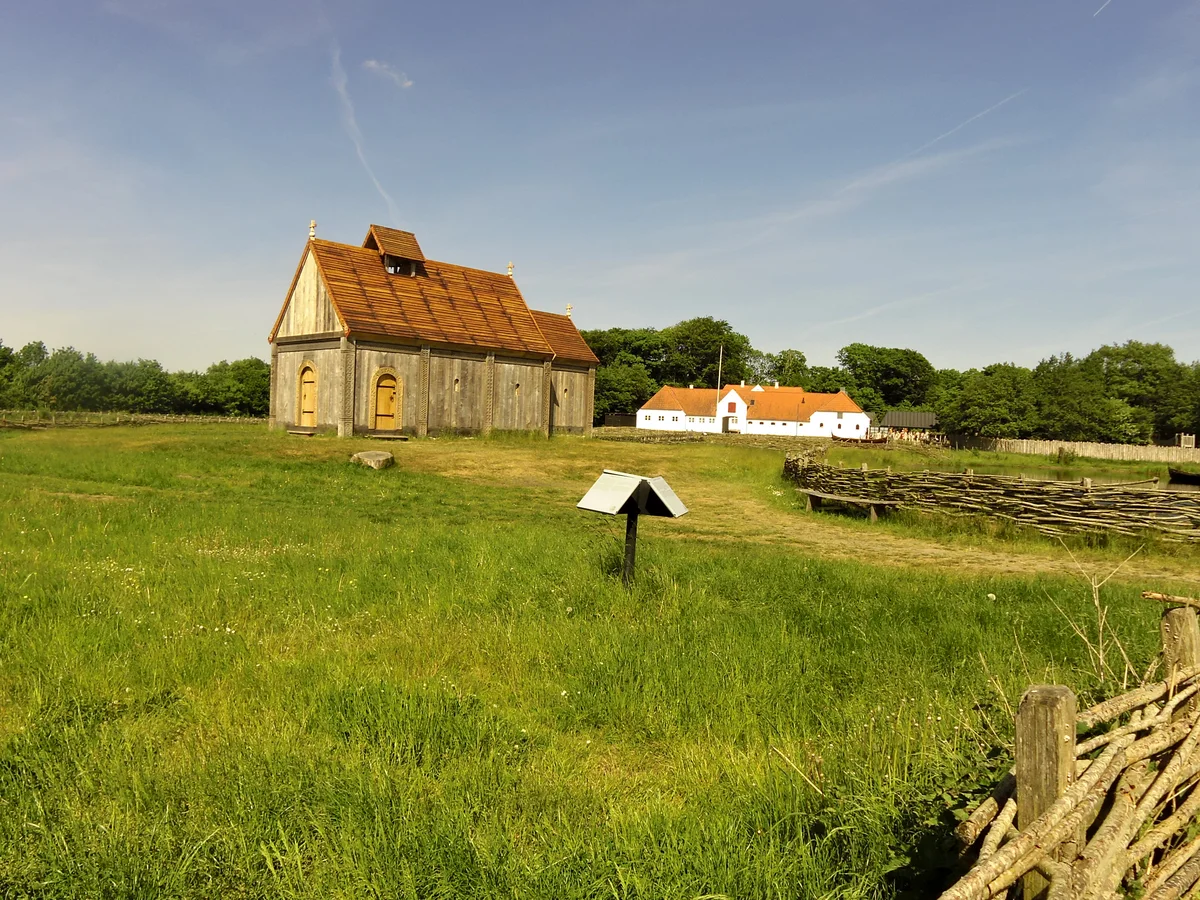
Ribe VikingeCenter's Ansgar Church makes the early Christian setting easier to imagine, but the center clearly describes it as an informed reconstruction. No surviving plan of Ansgar's Ribe church supplied its exact dimensions and construction. Instead, the project drew on evidence for a church at Tostedt near Hamburg, together with broader knowledge of ninth-century building. Its exterior decoration used Viking Age ornamental comparisons, while the interior drew on southern European Christian styles.
That distinction helps keep the cemetery's contribution clear. Excavated graves support the presence and repeated practices of a burial community; the reconstructed building explores one plausible architectural setting for worship. Neither supplies the names or personal convictions of everyone buried nearby. Together, when their different evidential roles remain visible, the graves and reconstruction help explain Ribe as more than a marketplace: it was a place where people lived, died, maintained relationships, and negotiated changing customs over a long period.
Sources for this section: 6
For the introductory context, read Ribe: A Market Before the Famous Raids.
The Evidence
The sources below support this article. Interpretations and limits are explained in the text; this is not an exhaustive research review.
- Qvistgaard and Søvsø: new non-Christian graves from early Ribe, 2018 ↗
- Museum excavation team: graves beneath the new Netto store, 2012 ↗
- Ribe Cathedral: the first Christians ↗
- Bente Grundvad: southwest Jutland boat burials, 2015 ↗
- Lindegården excavation team: fieldwork reports, 2012 ↗
- Ribe VikingeCenter: evidence behind the Ansgar Church reconstruction ↗