
Journeys & Encounters · Deep dive
Fyrkat’s Cemetery: The Community Outside the Rampart
In Brief
The graves reveal a more varied fortress population than a plan of barracks alone can suggest.
On this page
A cemetery beside a planned fortressThe landscape linked several forms of movementBuildings and modern reconstructions need separationGrave 4 attracted attention earlyTextiles survive in unexpectedly small tracesLuxury was not confined to one exceptional burialDaily activity complicates a purely military readingA research collection remains open to new questionsSourcesA cemetery beside a planned fortress
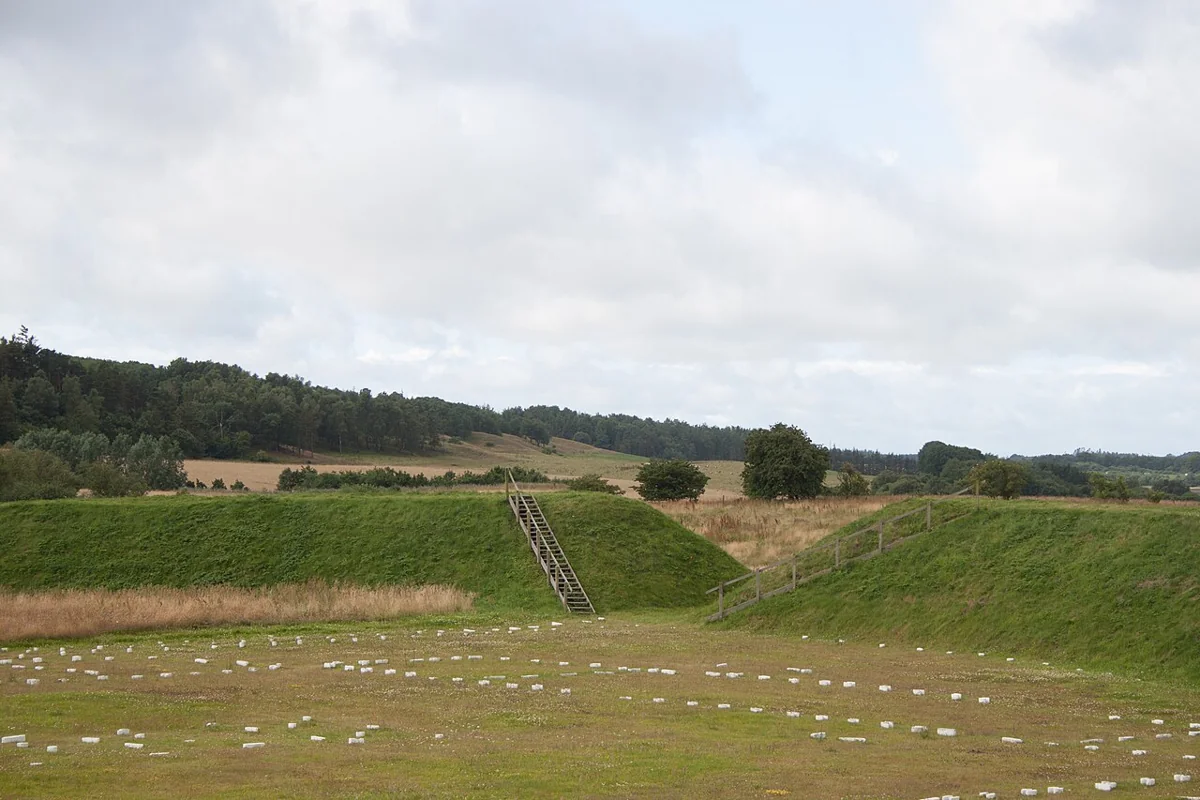
Fyrkat’s burial ground lay about 50 meters northeast of the ring fortress. The archaeological synthesis in Lex identifies approximately 30 graves and relates them to the period when the fortress was occupied. Their sizes and equipment have been used to identify adults and children and to distinguish probable male and female burials. This wording matters: classification rests on particular archaeological evidence rather than a complete surviving register of inhabitants. The cemetery brings people into a monument most often represented through its geometry. It also introduces a different scale of observation, moving from royal construction and standardized buildings to individual acts of burial.
Sources for this section: 1
The landscape linked several forms of movement
The same synthesis places Fyrkat on a promontory near the Onsild River, with wet ground protecting several sides and routes connecting the area to Mariager Fjord and an important north–south land corridor. This setting helps explain why a fortified site could gather people with different responsibilities. Control of movement required more than standing behind a rampart. Transport, provisioning, craft work, and local interaction are relevant possibilities when interpreting the community, although a strategic location cannot assign an occupation to a specific grave. The cemetery and fortress should therefore be read together without assuming that every burial represents a soldier in a permanent garrison.
Sources for this section: 1

Buildings and modern reconstructions need separation
The Viking Ship Museum describes four groups of four halls within the fortress and notes that three groups have been excavated, leaving one for future investigation. It distinguishes the reconstructed hall outside the rampart from a nearby reconstructed estate based on evidence from Vorbasse. This is an important distinction for understanding the cemetery’s setting. Structures visible to visitors do not all reproduce buildings excavated at Fyrkat. The burial ground belongs to the ancient fortress landscape, whereas reconstructed buildings illustrate selected archaeological interpretations. Keeping those layers separate makes a visit more informative: a convincing full-scale house is a teaching resource, but its presence does not establish the exact household associated with a particular burial.
Sources for this section: 2
Grave 4 attracted attention early
Else Roesdahl’s 2023 reconsideration places the excavation of the celebrated grave 4 in 1954–1955 and its major publication in 1977. The burial is approximately contemporary with the fortress around 980. This long research history matters because the familiar identification of a völva, or ritual specialist, is an interpretation developed through study rather than a name supplied by the grave itself. Roesdahl emphasizes that subsequent work has enlarged the available understanding. A burial can therefore remain archaeologically stable while its scholarly interpretation changes. New comparisons and analyses may alter the significance of objects that were recovered many decades earlier.
Sources for this section: 3
Textiles survive in unexpectedly small traces
Ulla Mannering and Charlotte Rimstad’s 2023 textile study explains that most fragments from grave 4 are smaller than a square centimeter and many survive through mineralization beside metal objects. The researchers used digital microscopy and reconsidered fragments within recorded grave positions. Their published discussion carefully distinguishes visual identification from dye and fiber analyses that were not yet ready for publication. This makes the textile evidence more precise than a confident modern costume drawing. A color observed on a fragment, a mineralized weave, and a laboratory identification are different observations. Combining them can support reconstruction, but each contributes a different level of certainty.
Sources for this section: 4
Luxury was not confined to one exceptional burial
The textile researchers also identify gold threads in graves 22a and 22b, showing that some decorative techniques associated with grave 4 were not unique within the cemetery. This comparison is particularly valuable because attention to a single spectacular burial can distort the surrounding community. It does not make all the graves equally wealthy, but it places the famous assemblage within a wider material setting. Gold and silver thread, textile structure, and placement can be compared across burials rather than treated only as illustrations of an unusual individual. The cemetery becomes a field of relationships and differences, not simply the background to one celebrated identity.
Sources for this section: 4
Daily activity complicates a purely military reading
An early scholarly review of the 1977 Fyrkat publications drew attention to the strong evidence for ordinary activities and workshops inside the fortress. It highlighted metalworking and the argument that buildings with similar ground plans could serve different functions. The review also distinguished a fortress’s intended purpose from its actual uses, a debate that remains useful even though chronology and interpretation have developed since then. A military-looking plan does not make every recovered object military. Conversely, domestic and craft material does not erase the significance of fortification. The cemetery adds another reason to examine how households, labor, and authority interacted within this planned setting.
Sources for this section: 5
A research collection remains open to new questions
Nordjyske Museer announced renewed analysis of grave 4 in 2021 as part of collaboration with the National Museum. Its account describes a program concerned with material culture and religious change, rather than treating the older excavation as exhausted evidence. For the cemetery as a whole, the most productive approach follows the same principle: compare all burials, revisit classifications, and keep the fortress’s buildings and activities in view. Fyrkat’s importance lies in connecting these scales. Royal planning shaped the enclosure, while the cemetery preserves differentiated choices about clothing, objects, and commemoration. The resulting community is more complex than either a barracks diagram or one exceptional grave can represent alone.
Sources for this section: 6, 1, 4, 5
For the introductory context, read The Völva: Staffs, Graves, and Seiðr.
Explore this record and its sources in the map collection →
This entry is searchable by place and country. No verified burial-site coordinate is supplied, so it has no map marker or directions.
The Evidence
The sources below support this article. Interpretations and limits are explained in the text; this is not an exhaustive research review.
- Anna-Elisabeth Jensen and Merete Harding: Fyrkat ↗
- Viking Ship Museum: Fyrkat Ring Fortress ↗
- Else Roesdahl: The Fyrkat Völva Revisited ↗
- Ulla Mannering and Charlotte Rimstad: The Textiles from the Fyrkat 4 Grave ↗
- Historisk Tidsskrift: Scholarly review of the 1977 Fyrkat publications ↗
- Nordjyske Museer: Renewed analysis of grave 4 ↗