
Journeys & Encounters · Deep dive
The Tune Ship: Why Incomplete Remains Can Change an Interpretation
In Brief
Tune is less visually complete than Oseberg or Gokstad, but its surviving structure supports important questions about hull form, sailing capability, and the history of archaeological reconstruction.
On this page
An early discovery with lasting consequencesPreservation changed the apparent vesselDigital recording did not replace judgmentA changed view of sailing capabilityThe display also has a historyHow to read the reconstruction criticallySourcesAn early discovery with lasting consequences
The Tune ship was excavated in 1867 at Haugen on Rolvsøy. NIKU’s account of Knut Paasche’s research emphasizes the limited documentation and poor condition associated with this early investigation. The burial included evidence of a high-status setting, but its surviving record does not offer the completeness of a modern excavation.
That history is part of the evidence. What remains today reflects both ancient events and nineteenth-century recovery. A missing component could have disappeared before excavation or been inadequately recorded during it. Interpretation must therefore begin with the history of the find rather than treating the current display as an undisturbed sample of the original ship. Incompleteness does not make Tune unimportant; it makes the reasoning connecting the surviving pieces especially consequential.
Sources for this section: 1
Preservation changed the apparent vessel
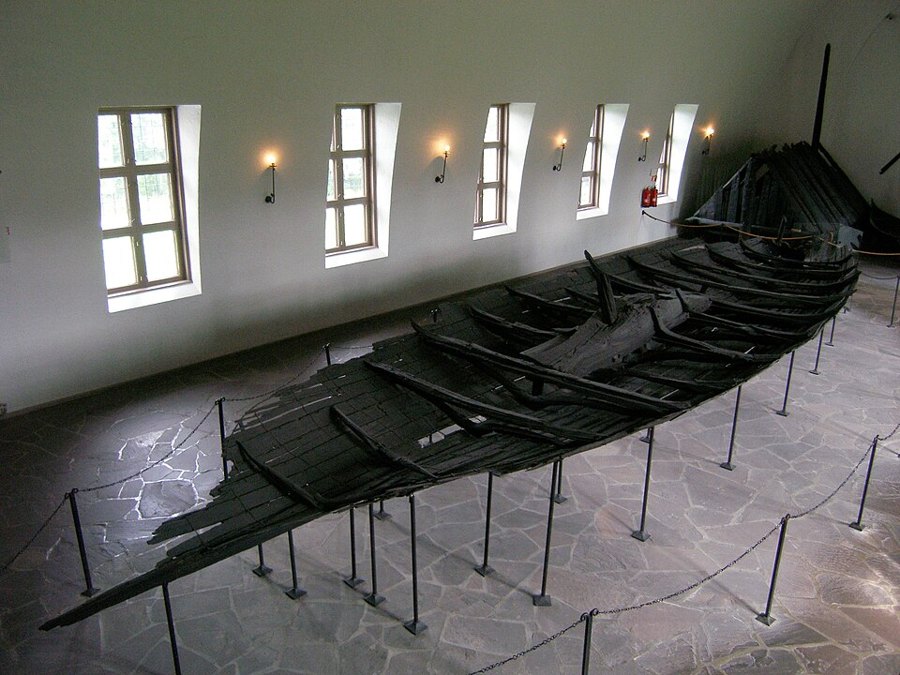
Paasche’s 2020 paper discusses how earlier removal of mound material exposed parts of the burial before formal excavation. Different areas of the ship survived unevenly. Important central structural elements remained, while the ends and upper portions were much less complete.
This has a direct effect on reconstruction. A low surviving side does not necessarily mean the operational ship had equally low freeboard. The original upper structure has to be inferred rather than read directly from the height of the surviving wood. Similarly, deformation in a preserved piece may reflect burial and later history rather than the builder’s intention. The distinction between surviving shape and proposed original shape is not a technical footnote. It can determine the interpretation of the vessel’s intended waters and capability.
Sources for this section: 2

Digital recording did not replace judgment
NIKU describes Paasche’s combination of laser scanning, new drawings, comparison with other ship finds, and traditional boatbuilding knowledge. The digital data supplied a more detailed record of the surviving object. The reconstruction then required decisions about how that object related to its earlier form.
A scan cannot directly recover wood that is no longer present. Nor does a dense point cloud decide which deformation should be corrected. Its strength is that it provides a measurable basis for comparing proposals and makes some assumptions easier to inspect. The historical interpretation remains an argument. This is why the most useful digital reconstruction explains its corrections and comparisons instead of presenting a smooth, complete model as though the scanner had photographed the Viking ship before burial.
Sources for this section: 1, 2
A changed view of sailing capability
The central conclusion of Paasche’s study is a reinterpretation of Tune as a seagoing vessel, challenging the older view that its low reconstructed sides restricted it. NIKU also describes differences in proportions and bottom form compared with Oseberg and Gokstad. These differences matter because Tune should not be rebuilt conceptually as a damaged copy of its more famous neighbors.
The claim concerns a reconstruction supported by the surviving structure. It is not a direct measurement of an ancient crossing, and it should not become an unsupported claim that Tune was certainly the fastest Viking ship. Capability, purpose, and actual use are distinct. A plausible seagoing design does not supply the routes traveled or the identity of its crew. It changes what can reasonably be considered possible, while leaving the ship’s detailed operational biography incomplete.
Sources for this section: 1, 2
The display also has a history
The Museum of the Viking Age’s institutional history records the early temporary housing of the ships and the staged development of the Bygdøy museum. The Tune and Gokstad wings opened in 1932, after the Oseberg wing. The institution’s February 2026 news archive announced a further planned relocation of Tune within the new museum project.
These modern movements should not be confused with ancient repairs or alterations, but they remind us that archaeological objects continue to require interpretation and care after excavation. Their arrangement in a display can influence what visitors notice. A complete-looking reconstruction may seem inherently more informative than incomplete original material, even when the latter preserves stronger evidence for particular details. Tune encourages the reverse question: what can the original pieces establish that a visually satisfying reconstruction cannot?
Sources for this section: 3, 4
How to read the reconstruction critically
A useful examination separates original timber, modern supports, missing components, and the proposed complete outline. It then asks which features constrain the proposal most closely. Connections between pieces may provide a stronger argument than an overall resemblance to another ship. Several modest observations can together narrow the possibilities without producing certainty about every upper plank or fitting.
The result is not an invitation to distrust all reconstruction. It is a way to understand why reconstructions can improve. Tune’s value lies partly in showing that an early find can answer new questions when documentation and comparative reasoning develop. The ship remains incomplete, but the interpretation need not remain fixed at the moment of its discovery. Its fragmentary condition is a challenge that research can address, while still leaving the boundaries of that research visible.
Sources for this section: 1, 2, 3
The Evidence
The sources below support this article. Interpretations and limits are explained in the text; this is not an exhaustive research review.