
Research & Sources · Introduction
Dating Wood: What Tree Rings Actually Tell Us
In Brief
A ship can carry several dates: the growth of its trees, its construction, repairs, and final burial. Tree rings help separate them.
On this page
A pattern, not a ring countSkuldelev 2 connects Ireland and DenmarkWhy the outside edge mattersAsk which event has been datedSourcesA pattern, not a ring count
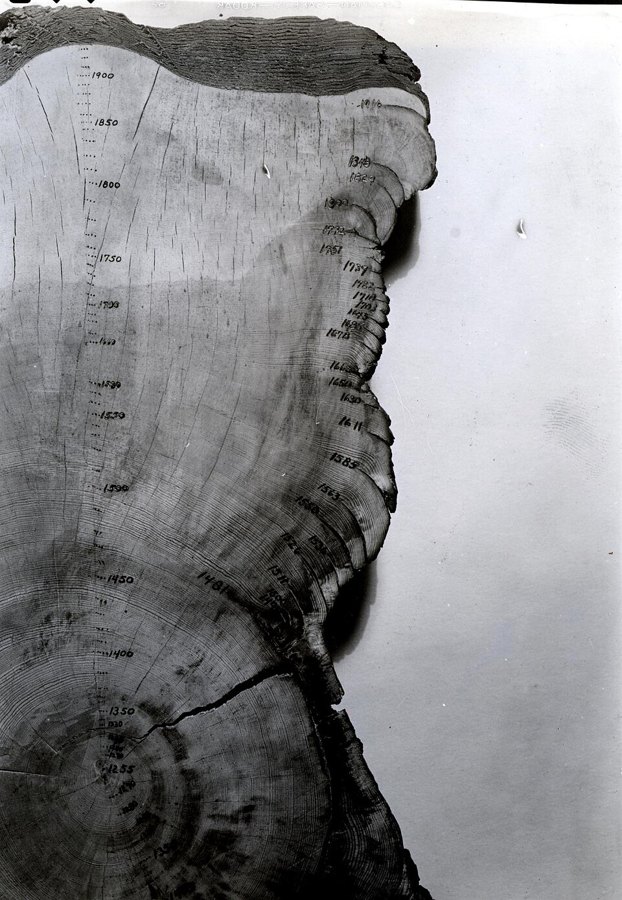
Counting rings tells us how many years of growth survive in a piece of wood. Assigning those rings to calendar years requires another step: matching the sequence of wider and narrower rings against an independently dated reference sequence. Dendrochronology therefore depends on comparison. A short, damaged piece may provide a less secure match than a long sequence supported by several trees. The quality of the wood matters as much as the sophistication of the measurement.
Skuldelev 2 connects Ireland and Denmark
The published timber study of Skuldelev 2 identifies oak felled in 1042, most probably from the Dublin area. The researchers infer that construction took place near the source of that timber, using fresh wood. That is a reasoned reconstruction, rather than a shipyard address recorded in the rings. Repair planks tell a different story: they indicate later work, probably in the 1060s, using timber from somewhere around the Irish Sea. One vessel preserves evidence of more than one episode.

Why the outside edge matters
The youngest surviving ring is especially important. If outer wood has disappeared, it cannot simply be treated as the year the tree was cut down. The Skuldelev study uses surviving sapwood and regional estimates to calculate possible felling ranges. Its repair timber also illustrates a geographical limit: a single tree did not distinguish confidently between Ireland, Wales, and England. Exact-looking numbers should always be read alongside the stated interval and assumptions.
Ask which event has been dated
Skuldelev 5 provides another case: the museum places construction shortly after 1024 through tree-ring analysis. Neither that date nor the 1042 result dates the ships’ eventual deposition in the Roskilde barrier. When reading a museum label, separate tree growth, felling, construction, reuse, and excavation. A timber date becomes historical evidence only when its position and function are understood. Multiple samples can reveal a repair that a single sample would miss.
The Evidence
The sources below support this article. Interpretations and limits are explained in the text; this is not an exhaustive research review.