
Research & Sources · Deep dive
Tree-Ring Provenance: Following Timber Without Inventing a Shipyard
In Brief
Tree rings can connect a vessel to a woodland region. Distinguishing timber growth, transport, building, and repair takes a more careful chain of reasoning.
On this page
Two questions use the same patternA ship is a collection of treesRepairs record another procurement episodeReference timbers have biographies tooThe Karschau comparison is later medievalMore precise geography requires better comparisonsTimber movement and vessel movement differRead the date beside the construction detailSourcesTwo questions use the same pattern
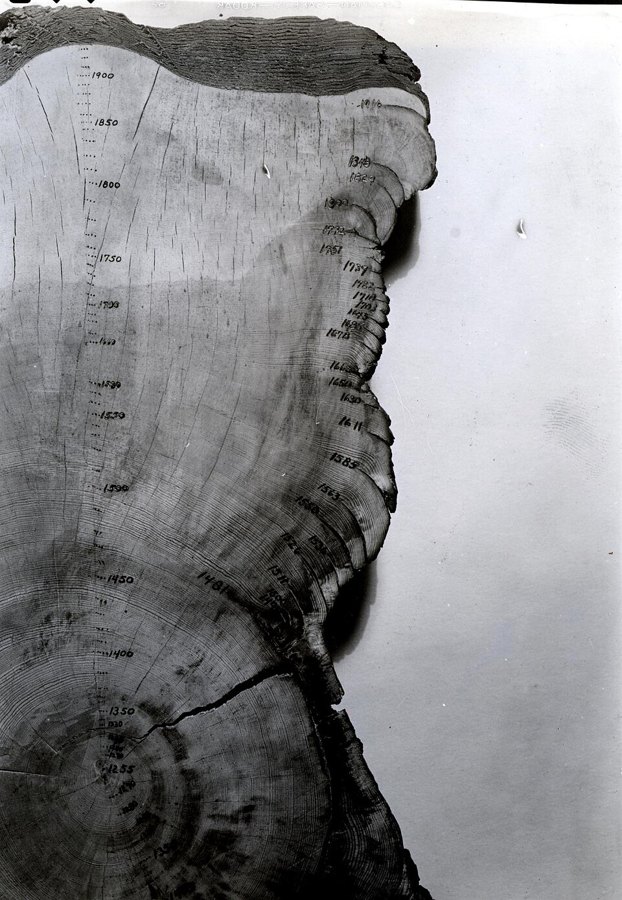
Dendrochronology compares sequences of annual growth rings. Matching a sequence to an independently dated reference can place it in calendar time; comparing its resemblance to regional sequences can also suggest where the tree grew. These are related but different questions. A secure date need not produce an equally secure geographical attribution, and both conclusions deserve their own explanation. The Viking Ship Museum’s explanation of dating methods places tree-ring evidence alongside other chronological techniques, reminding readers that archaeological dating depends on the material available. A short or incomplete sequence may not provide the information supplied by a well-preserved timber with many rings.
Sources for this section: 4
A ship is a collection of trees
The published analysis of Skuldelev 2 combined evidence from multiple oak timbers. It placed the original felling in 1042 and favored southeastern Ireland, particularly the Dublin area, as the source. The researchers then argued that the vessel was probably built near where the wood grew, using fresh timber. The rings support the woodland connection directly; the shipbuilding location requires an additional historical interpretation. That distinction allows future evidence for timber transport or construction practice to refine the conclusion without pretending that the tree-ring match itself contained a written shipyard address.
Sources for this section: 1

Repairs record another procurement episode
Skuldelev 2’s repair material produced a less tightly located result. A sampled tree matched sequences around the Irish Sea without decisively distinguishing Ireland, Wales, and England. The surviving outer wood also required a felling estimate rather than a simple reading of a final complete ring. The study favored repair in the 1060s within a broader possible range. These differences are informative: the hull’s original construction and later maintenance should not be collapsed into one event. A ship could acquire wood from new sources while continuing to circulate through an established maritime region.
Sources for this section: 1
Reference timbers have biographies too
The University of Copenhagen’s TIMBER project emphasizes a complication in provenance research: reference material from buildings or archaeological sites may itself have been moved or reused. A timber excavated in one town is not necessarily a tree grown nearby. Establishing reliable regional comparisons therefore requires attention to the histories of the reference collections. The problem is especially significant when using fixed structures to interpret movable constructions such as ships, barrels, or artworks. A geographical label on a dataset needs archaeological justification, not merely the modern address of the excavation that supplied it.
Sources for this section: 2
The Karschau comparison is later medieval
The Karschau ship provides a useful comparison outside the Viking Age. Its oak was felled around the 1140s, and its ring sequences matched especially well with material from Odense on Funen. The published study discusses the potential for distinguishing smaller source regions through improved reference coverage. Because this vessel is later, it should not be inserted into a list of Viking ships without qualification. Its methodological value is comparative: it demonstrates how regional matching can become more informative while still requiring a distinction between timber origin and the larger history of a vessel.
Sources for this section: 3
More precise geography requires better comparisons
A regional match becomes meaningful when alternative regions have been sampled adequately. If one area has a strong reference sequence and its neighbors have sparse coverage, the best available match may be more geographically specific in appearance than the evidence warrants. The Karschau study’s emphasis on developing finer regional distinctions points toward this issue. Provenance is a comparative inference, so the reference network forms part of the result. A report should make clear whether it identifies a broad zone, favors one region over several plausible alternatives, or supports a narrower attribution through multiple consistent timbers.
Sources for this section: 2, 3
Timber movement and vessel movement differ
A tree can travel as a log, a worked plank, a barrel stave, or part of a completed ship. A nonlocal timber proves movement of material more directly than the route by which it moved. Copenhagen’s project explicitly investigates the distinction between local and traded wood across long periods. For a Viking ship, the historical question is therefore a sequence: where did the tree grow, when was it cut, where was it worked, and when did the finished vessel arrive at its final archaeological location? Evidence for one stage should not silently answer all the others.
Sources for this section: 2
Read the date beside the construction detail
The most useful report identifies each sampled piece’s structural role and whether it belongs to original construction or repair. It explains the outer rings that survive, the reference comparisons, and the reason for any estimated felling interval. Consider an illustrative replacement plank: even an excellent date for its tree cannot date the first launching of the hull. Conversely, an early timber reused in a later structure supplies a lower limit rather than an exact construction year. Keeping the object’s physical history beside its ring sequence turns a laboratory result into a historical argument that other researchers can scrutinize.
Sources for this section: 1, 4
For the introductory context, read Dating Wood: What Tree Rings Actually Tell Us.
The Evidence
The sources below support this article. Interpretations and limits are explained in the text; this is not an exhaustive research review.