
Viking crafts · An illustrated deep exploration
Precious metalwork.
Gold & silver.
Hammer sheet, raise relief, twist fine wire, attach granules, join separate plates and use surface treatments to make a small object visually complex.
01 · Precious metal is not always the whole object
Look beneath the gold colour.
Viking-Age jewellery may be solid gold or silver, but spectacular surfaces can also be built on bronze or silver and then gilded, plated, inlaid or covered with applied gold elements. Colour alone does not identify the metal underneath.
A box-shaped brooch from Nygårds on Gotland demonstrates that complexity. Historiska museet describes a gilded bronze body with silver plating, niello and soldered gold plates carrying filigree and granulation, plus a red garnet. One object therefore combines base metal, precious metal, dark inlay and stone.
Source: Historiska museet, box-shaped brooch 449147_HST. Sources ↓
02 · Thin metal can become structure
Sheet can be cut, folded, hammered and layered.
Thin gold and silver sheet allows a craftsperson to create a visually large surface with relatively little precious metal. A back plate can provide structure while a thinner front plate carries decoration.
A Viking-Age gold pendant fragment from Fyrkat is described by the National Museum of Denmark as having a smooth back plate and a pressed front plate decorated with filigree and granulation. Another gold pendant from Fæsted is hollow and made from two plates, with twisted filigree wire and dense granulation on the front.
Sources: National Museum of Denmark collections, Fyrkat D514/1966 and Fæsted C 42700-related pendant. Sources ↓
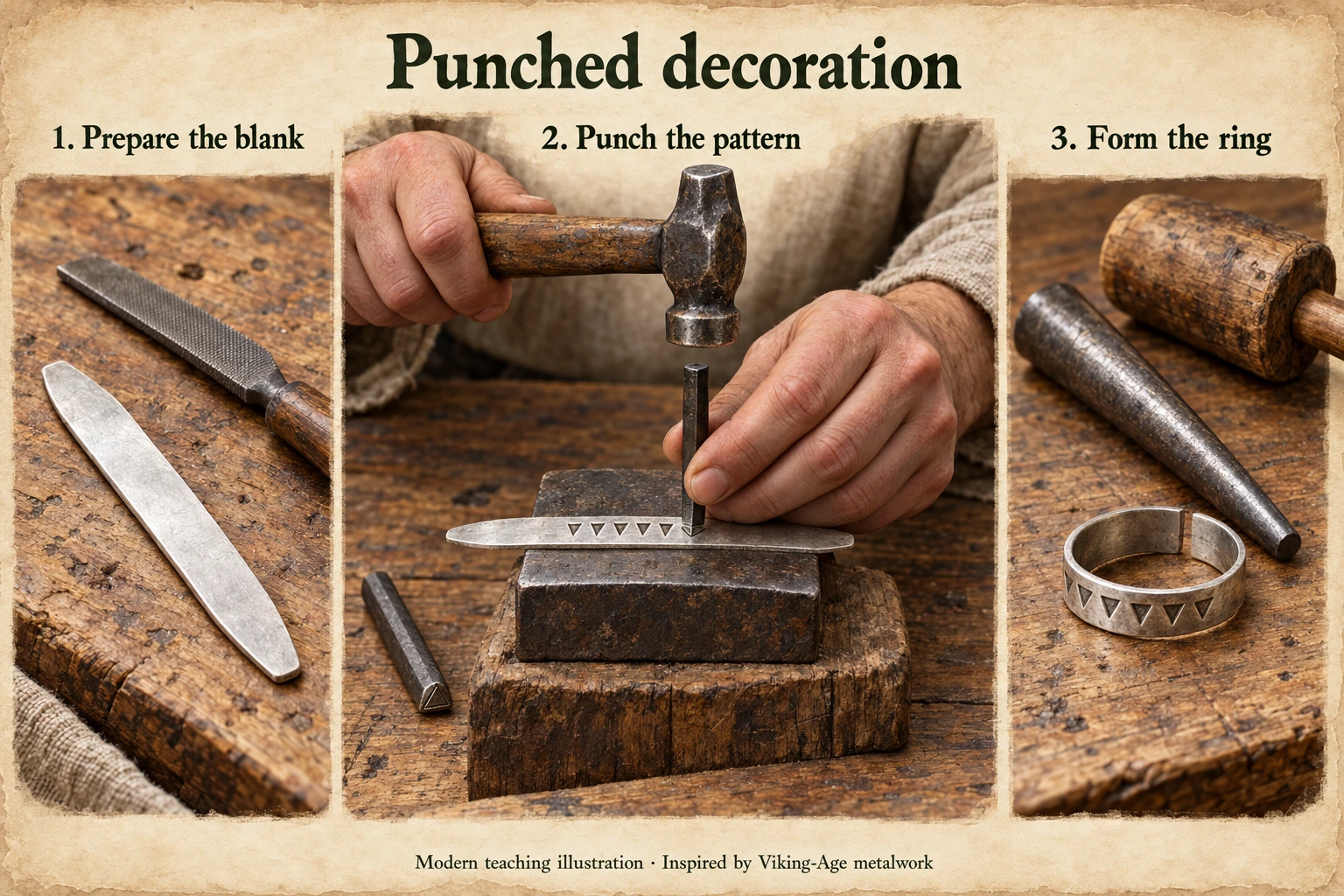
Punched decoration
03 · Relief without carving away metal
Hornelund shows sheet hammered over a matrix.
The two famous clothes brooches from the Hornelund hoard near Varde are among the finest Danish Viking-Age brooches. The National Museum states that their relief was hammered out over a matrix. Their surfaces were then decorated with wire filigree and granulation.
The museum dates their production to the second half of the tenth century and identifies the combination of Christian vine and foliage imagery with Norse animal heads as work by a Danish goldsmith.
A matrix allows repeated relief forms to be produced by forcing thin metal into or over a shaped support. The exact sequence, thickness and tools used on a particular object still have to be studied from the original piece.
Source: National Museum of Denmark, Hornelund hoard. Sources ↓
04 · Draw with metal wire
Filigree turns wire into surface ornament.
Filigree uses fine metal wire laid onto a supporting surface in lines, loops and twisted patterns. It can outline forms, divide fields or create the ornament itself.
Historiska museet explains that gold wire could be produced by rolling or twisting thin strips of gold sheet into thread-like forms. That manufacturing tradition is older than the Viking Age, so it is useful for understanding the technique rather than proving one universal Viking wire-making method.
On Viking-Age finds, the object record matters most. The Fyrkat pendant uses filigree bands to define eyes, beak-like features and empty fields. Vårby silver beads also carry filigree ornament.
Sources: Historiska museet, gold objects with foreign inspiration; National Museum of Denmark, Fyrkat pendant; Vårby beads. Sources ↓
05 · Decoration made from tiny spheres
Granulation builds pattern from metal beads.
Granulation places small metal granules on a surface to create lines, borders or filled motifs. The visual effect can be extremely precise even when the individual units are tiny.
Hornelund combines granulation with wire filigree. The Gotland box brooch uses gold granulation for moustached face masks. The Vårby hoard contains silver beads decorated either with filigree or granulation.
The Vårby beads are especially useful because Historiska museet distinguishes likely origins: the filigree beads are probably Scandinavian craftwork, while the granulated beads are interpreted as imports from the west Slavic region. A technique therefore cannot, by itself, identify where an object was made.
Sources: Historiska museet, Vårby beads and Gotland box brooch; National Museum of Denmark, Hornelund. Sources ↓
06 · Separate parts must become one object
Soldering and mechanical assembly disappear into the finished surface.
The Nygårds box brooch is described as having soldered gold plates on a gilded bronze body. The Fyrkat pendant consists of front and back plates pressed together, while its loop is integrated with the decorative system. Finished jewellery may therefore hide several distinct assembly operations.
A reconstruction should separate three questions: which parts were made independently, how they were aligned, and how they were finally joined. Soldering, folding, riveting and mechanical locking are different solutions and should not be substituted for one another without evidence.
Sources: Historiska museet, Nygårds box brooch; National Museum of Denmark, Fyrkat pendant. Sources ↓
07 · Colour can come from a surface layer
Gilding, plating and niello create contrast.
A thin gold surface can make bronze or silver appear golden while preserving a different metal underneath. Silver plating can create another bright layer. Niello produces dark decorative contrast in recesses or fields.
The Nygårds brooch combines all three visual systems: gilded bronze, silver plating and niello, alongside actual applied gold plates. The result is a reminder that a photograph of a shiny object can conceal a complex stack of materials.
Solid metal
The body itself is gold or silver. Scratches expose the same metal below.
Surface metal
Gilding or plating places a thin precious-metal layer over another material.
Dark inlay
Niello creates dark contrast against brighter metal and may occupy cut or formed recesses.
Do not assume one Viking-Age gilding chemistry for every object. The museum description tells us that an object is gilded; laboratory analysis is needed before naming the precise process used on a particular piece.
Source: Historiska museet, box-shaped brooch 449147_HST. Sources ↓
08 · Read a composite object
Explore five layers of precious-metal work.
Interactive teaching model
One object, several techniques
Choose one layer. Follow the highlights to compare the object’s structure and surface.
09 · Old metal can acquire a new life
Reworking is part of Viking-Age craftsmanship.
Two horse-shaped silver objects from Birka grave Bj 854 were originally made as fittings in the seventh century. Historiska museet states that they were later equipped with pin fittings and turned into brooches during the Viking Age.
Another Birka ring-headed pin incorporates components with several cultural histories: a ball from an Irish thistle brooch, eastern or eastern-European silver filigree beads, and Scandinavian reworking into a new object.
Sources: Historiska museet, Birka Bj 854 brooches and Bj 832 ring-headed pin. Sources ↓
10 · Technique travels with objects and craftspeople
Local style does not mean local material—or local manufacture.
Viking-Age precious-metal objects combine Scandinavian, western European, Slavic and eastern traditions. The Vårby hoard is particularly useful because several origins are represented in one assemblage.
Historiska museet interprets the Vårby filigree beads as probably Scandinavian craftwork, while the granulated beads are understood as imports from the west Slavic region. A Scandinavian animal motif on another object can coexist with an imported component or foreign technique.
The Hornelund brooches provide the reverse lesson: their vine and foliage ornament derives from Christian art, while Norse animal heads support the museum’s interpretation that they were made by a Danish goldsmith.
Sources: Historiska museet, Vårby hoard; National Museum of Denmark, Hornelund. Sources ↓
11 · Precious metal can be ornament, wealth and raw material
A hoard can contain finished jewellery and metal ready for another future.
Viking-Age silver hoards can include jewellery, coins, ingots and cut or broken silver. Their contents reflect more than one system: display, exchange, storage, recycling and the movement of metal across long-distance networks.
The Vårby hoard weighed about 1.5 kilograms and contained a large brooch, ring-headed pins, 42 decorated beads, belt fittings and pendants made from Islamic coins or imitations. Its youngest coin was struck in AD 937–938, supporting burial around the middle of the tenth century.
Broken or reused components remind us that a goldsmith or silversmith could work with old objects as material. The line between treasure and raw material can change when an object is clipped, melted, reassembled or converted to a new function.
Source: Historiska museet, Vårby hoard. Sources ↓
12 · Try the layered logic safely
Build a foil-and-wire model.
This is a modern low-risk teaching activity. It demonstrates layers and surface techniques without melting, soldering, gilding chemicals or hot metal.
- Cut a card base with child-safe scissors; younger children should have adult help. Make a circular or rectangular support that represents the structural plate.
- Add relief. Place shapes beneath household aluminium foil and gently press the foil over them to simulate raised sheet.
- Add filigree. Use twisted paper cord, or soft craft wire with adult help to draw loops and borders.
- Add granulation. Glue small paper or clay beads in a controlled pattern.
- Create contrast. Use paper in gold, silver and dark grey to represent gilding, plating and niello without imitating hazardous processes.
- Label every layer. Mark which features are inspired by Hornelund, Vårby, Fyrkat or the Nygårds brooch and which are invented for the exercise.
Follow the evidence
Sources & further reading
- National Museum of Denmark — The hoard find from Hornelund
Hammered matrix relief, filigree, granulation and late tenth-century Danish production.
- Historiska museet — Box-shaped brooch 449147_HST
Gilded bronze, silver plating, niello, soldered gold plates, filigree, granulation and garnet.
- National Museum of Denmark collections — Fyrkat gold pendant D514/1966
Double plate construction, pressed front, filigree and granulation.
- National Museum of Denmark collections — Fæsted gold pendant fragment
Hollow two-plate construction, twisted filigree wire, granulation and relation to a Lackalänga set.
- Historiska museet — Gold objects with foreign inspiration
Background on filigree, granulation and wire made from thin gold strips.
- Historiska museet — Vårby silver beads
42 beads with filigree or granulation; differing likely origins.
- Historiska museet — Glittering golden hoard of silver
Vårby hoard contents, gilding and mid-tenth-century deposition.
- Historiska museet — Birka Bj 854 horse-shaped brooches
Seventh-century fittings converted to brooches during the Viking Age.
- Historiska museet — Birka Bj 832 ring-headed pin
Reworked Irish and eastern components within a Scandinavian object biography.
- Historiska museet — Vårby ring-headed pin 106693_HST
Silver ring, gilded terminals and gold filigree; probably eastern Scandinavian craftwork.
- Historiska museet — High-class goldsmithing
Overview of Viking-Age gold and silver craftsmanship including forging, gilding and filigree.
- Historiska museet — Iron Age gold hoards
Viking-Age gold objects including the Frustuna filigree-and-granulation pendant.