
Creatures
Fenrir
The bound wolf and Odin’s final enemy
Fenrir is the enormous wolf whom the gods raise and then bind because they fear the destruction foretold through him. Snorri names Loki and Angrboda as his parents, with Hel and the Midgard Serpent as his siblings.
Explore the stories ↓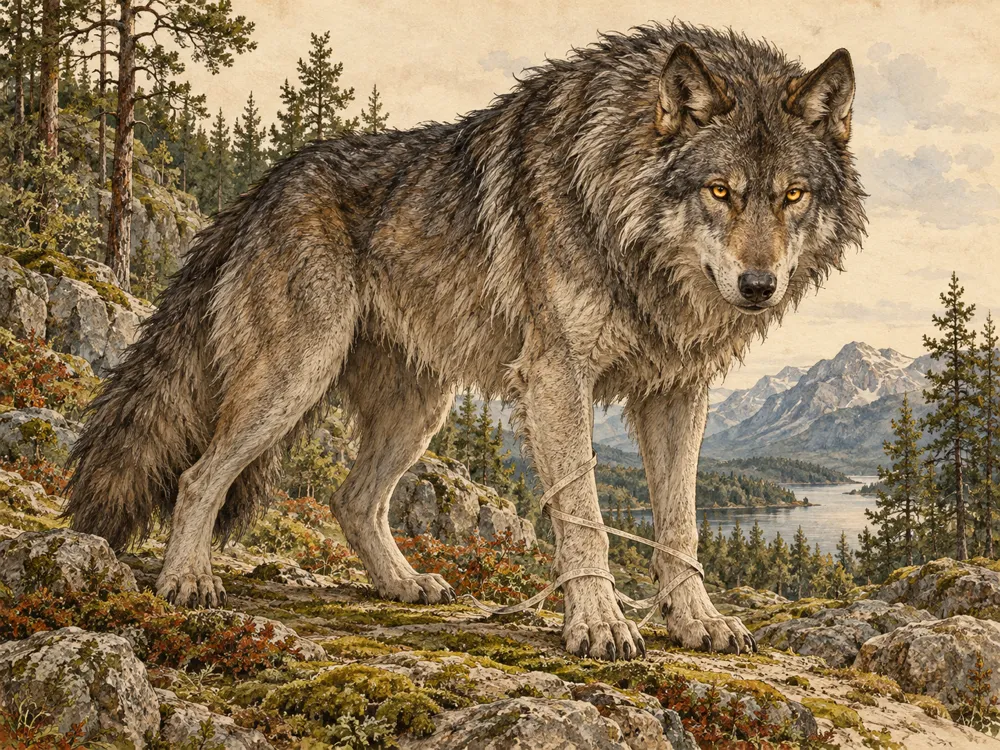
The price of a promise
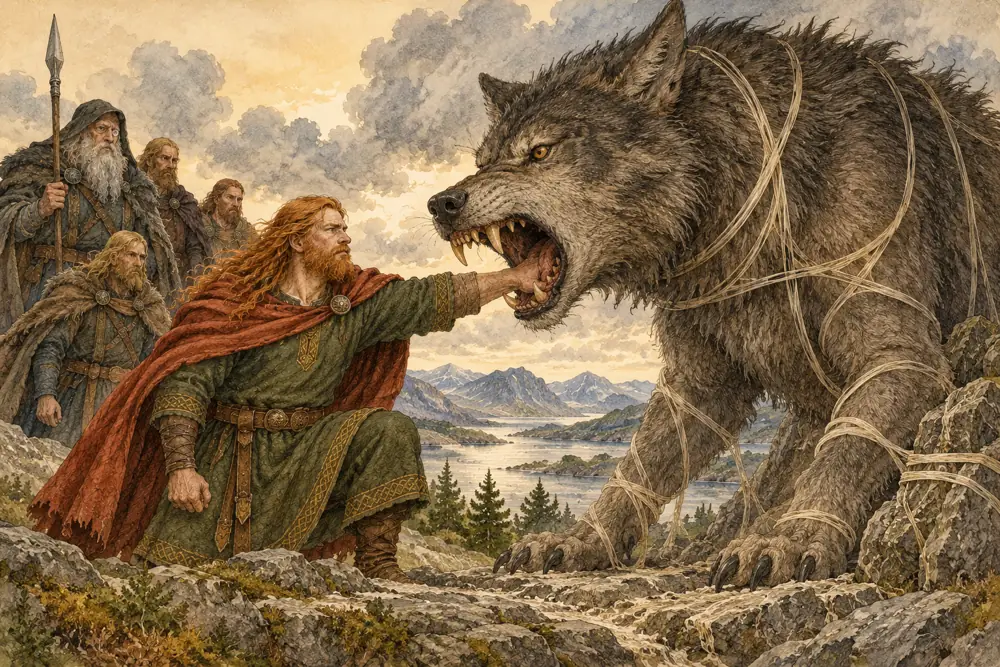
The wolf breaks two strong restraints. The gods then produce Gleipnir, a seemingly delicate band made by dwarfs from impossible ingredients. Fenrir suspects a trap and demands a hand as a pledge. Tyr accepts. When the band holds and the gods refuse to release him, Fenrir bites off Tyr’s hand. The episode gives both sides reasons for distrust: the gods fear a future catastrophe, while the wolf discovers that their assurance is false.
The last battle
At Ragnarök Fenrir escapes and devours Odin. Vidar avenges his father by killing the wolf. The precise action differs between poetic and prose accounts; Snorri describes Vidar forcing the jaws apart. Fenrir is therefore a central figure in stories of binding, broken trust and the limits of divine power.
Two broken fetters before Gleipnir
Snorri gives the first restraints names. Lædingr breaks as soon as Fenrir tests himself against it. The gods make a stronger fetter, Drómi, and encourage the wolf to prove that his strength has grown too. Fenrir agrees because another escape promises greater renown. He shakes himself, strains against the binding and scatters its pieces. The gods therefore abandon a simple contest of strength. Skírnir is sent to the dwarfs for Gleipnir: a soft-looking restraint made from such impossible materials as a cat’s footfall, a woman’s beard and a bird’s spittle. Its innocent appearance is precisely what makes Fenrir suspicious.
The island and the river from the wolf’s mouth
The final test takes place on the island Lyngvi in Lake Ámsvartnir. After Tyr loses his hand, the gods anchor the binding through a great stone and drive another stone down over it. Fenrir opens his jaws to attack, but they wedge a sword between them, with the point against his upper mouth. His saliva becomes the river Ván. He remains there until the final breaking of bonds. Snorri’s questioner asks why the gods did not simply kill him. The answer invokes the sanctity of their dwelling: they will not stain it with his blood, even though prophecy has announced the danger.
Read behind the retelling
Sources & limits
Do not automatically identify every wolf in the poems with Fenrir; the texts also name other wolves.
- Prose Edda: Gylfaginning (Brodeur, 1916)
- Poetic Edda: Völuspá (Bellows, 1923)
- Prose Edda: Gylfaginning, Brodeur translation (1916)
Retold in contemporary English. Dialogue is summarized, not presented as a translation. How to read our sources and versions.
Follow the thread
Stories & related reading: Fenrir
2 min read
The binding of Fenrir
The gods fear Fenrir’s future strength. Tyr places his hand in the wolf’s mouth while they test a restraint they never intend to remove.
Read the story ↗
3 min read
Ragnarok: the breaking of the world
The end approaches through broken human bonds and broken cosmic restraints. The surviving texts also imagine a world that rises after the disaster.
Read the story ↗