
A Norse story · 2 min read
The binding of Fenrir
A silk-like bond and the price of a promise
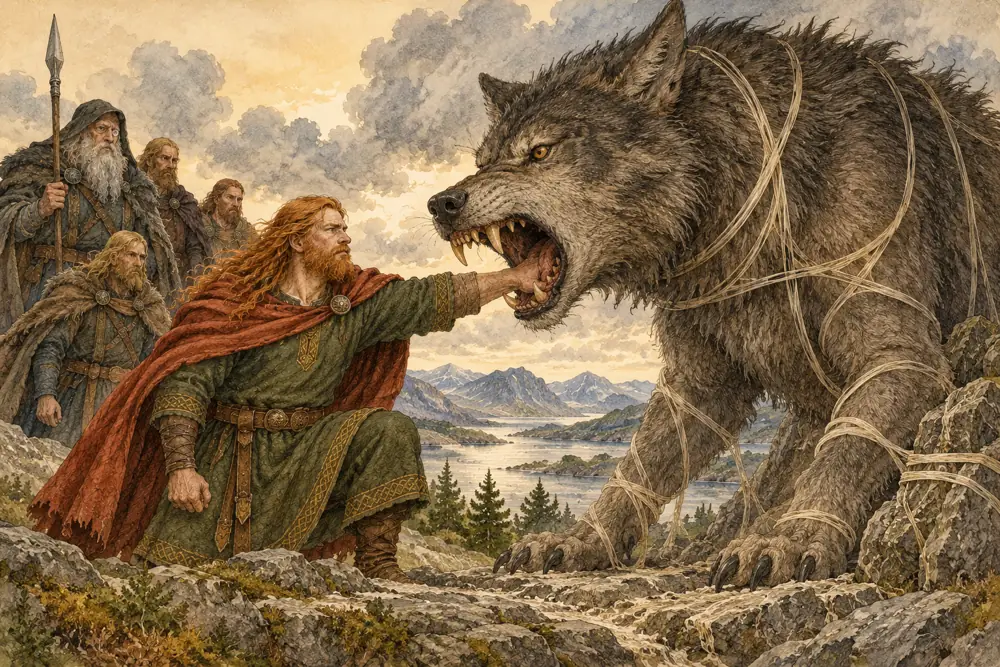
The gods fear Fenrir’s future strength. Tyr places his hand in the wolf’s mouth while they test a restraint they never intend to remove.
A growing danger
Fenrir is one of the children of Loki and Angrboda in Snorri’s account. The gods bring the children into their power after learning of prophecies about the harm associated with them. The wolf grows so large that only Tyr dares to approach and feed him. The gods decide to bind him. They present a strong fetter as a challenge, appealing to the wolf’s confidence in his strength. Fenrir breaks it. They make a stronger restraint, and he breaks that as well. Physical force has failed, and each failed test demonstrates how much more formidable he has become.
Something that should not hold
Odin sends Skirnir to the dwarves for another kind of restraint. They make Gleipnir from six impossible ingredients: a cat’s footfall, a woman’s beard, a mountain’s roots, a bear’s sinews, a fish’s breath, and a bird’s spittle. The finished bond looks smooth and soft. This time Fenrir is suspicious. Breaking a fine ribbon would win little glory, while its delicate appearance suggests hidden magic. The gods insist that, if he cannot break it, he will hardly be dangerous enough to keep imprisoned. They offer the promise of release as reassurance, although their purpose is precisely to restrain him.
Tyr’s pledge
Fenrir demands that one of them place a hand in his mouth as a pledge of good faith. None is willing until Tyr steps forward. The bond is fastened. The harder Fenrir struggles, the tighter it holds. The gods laugh at their success, but Tyr loses his hand when the wolf realises that he will not be released. They secure the bond to rock and prop the wolf’s jaws apart with a sword. His imprisonment lasts until the breaking of restraints at Ragnarok. The victory therefore delays the catastrophe; it does not remove it from the future.
Courage within a broken promise
Tyr’s willingness to pay the bodily price is the memorable act at the centre of the story. Yet the setting is not a straightforward contest between honesty and evil. The gods use deception, and Fenrir correctly recognises the possibility of a trap. Their fear of prophecy helps produce a relationship defined by hostility and betrayal. That tension is in the narrative itself, although readers disagree about how to judge it. It is also worth distinguishing Tyr’s bravery from the group’s conduct: his sacrifice does not make the promise of release true. The story gives both the gods’ defensive purpose and the wolf’s reason for anger.
Read behind the retelling
Sources & limits
This follows Snorri’s connected narrative. The wolf’s future role and the gods’ deception should both remain visible.
Retold in contemporary English. Dialogue is summarized, not presented as a translation. How to read our sources and versions.
Another thread to follow

3 min read
Ragnarok: the breaking of the world
The end approaches through broken human bonds and broken cosmic restraints. The surviving texts also imagine a world that rises after the disaster.
Read the story ↗
2 min read
Loki’s quarrel at Ægir’s feast
Loki enters the gods’ feast and attacks one guest after another in a formal exchange of insults.
Read the story ↗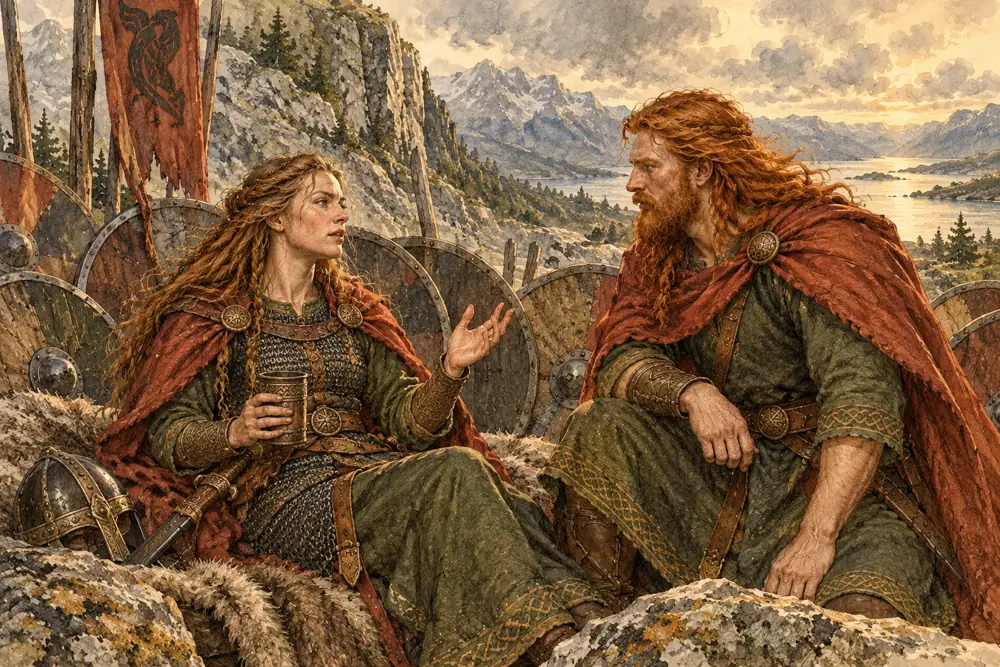
2 min read
Sigrdrifa defies Odin and wakes from enchanted sleep
Sigrdrifa chooses a battle’s outcome against Odin’s wishes. When Sigurd wakes her, she explains the punishment and offers him knowledge rather than remaining a silent rescued figure.
Read the story ↗