
A Norse story · 2 min read
Sigrdrifa defies Odin and wakes from enchanted sleep
A punished valkyrie becomes the hero’s teacher.
Sigrdrifa chooses a battle’s outcome against Odin’s wishes. When Sigurd wakes her, she explains the punishment and offers him knowledge rather than remaining a silent rescued figure.
A bright place on the mountain
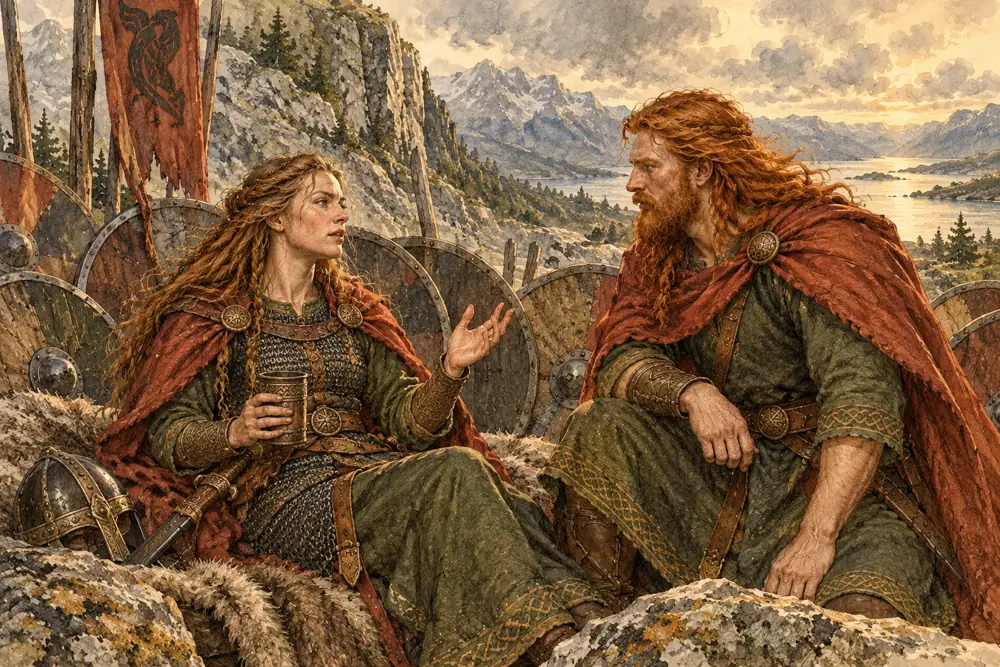
In the prose framing Sigrdrífumál, Sigurd sees a great light on Hindarfjall and approaches an enclosure of shields beneath a banner. Inside lies an armed sleeper. Removing the helmet, he discovers a woman; the mail coat seems attached to her body until he cuts it open. She wakes and asks who has broken her sleep. Sigurd identifies himself, and their encounter becomes a conversation. The source does not require adding a kiss to explain the awakening, however familiar that device may be from other enchanted-sleeper stories.
The battle she chose to change
The woman is called Sigrdrifa in the Eddic prose. She explains that two kings had fought, the older Hjalmgunnar and his opponent Agnar. Odin had promised victory to Hjalmgunnar, but she killed him instead. The god punished her with a sleep-thorn, declared that she would no longer award victory in battle and required that she marry. She answered with a condition of her own: she would not marry a man who knew fear. Her resistance is part of the account. Retelling the episode solely as a reward waiting for the right hero erases the conflict over her earlier choice.
A greeting to the world
When awake, she offers a drink and speaks a greeting to day, night, gods, goddesses and the generous earth. She asks for wisdom, good speech and healing hands. These poetic addresses enlarge the scene beyond the relationship between a man and a woman: awakening means reentering a world of powers and forms of knowledge. They also provide links to Dagr and Nott and to the personified earth without turning each phrase into a separate adventure. The prayer is preserved poetry, not proof that every Norse household used precisely these words in a daily ceremony.
Knowledge after punishment
Sigurd asks her to teach him. The following verses discuss runes and practical counsel, including victory-runes associated with invoking Tyr. This does not make the whole sequence a modern, reliable manual of magical effects. Its categories and images belong to the transmitted poem, which mixes advice, mythical associations and remembered lore. The prose saga connects this awakening with Brynhild, while the Eddic framing calls the woman Sigrdrifa; the relation between name, epithet and character should be explained rather than smoothed into one unproblematic biography. The encounter’s central movement remains clear: a figure punished for acting against Odin becomes a source of knowledge for Sigurd. A contextual portrait of Odin illustrates the authority she defied, not the appearance of Sigrdrifa or a historically recorded costume. Her speech deserves at least as much attention as the dramatic sleep.
Read behind the retelling
Sources & limits
The Eddic prose uses Sigrdrifa; Völsunga saga connects the awakening with Brynhild. Do not turn editorial attempts to reconcile them into a single certain ancient biography, or present poetic rune advice as guaranteed practical magic.
- Sigrdrífumál, prose introduction and stanzas 1–6 — Bellows translation, 1923
- Völsunga saga, chapters 20–21 — Morris and Magnússon translation
Retold in contemporary English. Dialogue is summarized, not presented as a translation. How to read our sources and versions.
Another thread to follow

2 min read
Loki’s quarrel at Ægir’s feast
Loki enters the gods’ feast and attacks one guest after another in a formal exchange of insults.
Read the story ↗
2 min read
The binding of Fenrir
The gods fear Fenrir’s future strength. Tyr places his hand in the wolf’s mouth while they test a restraint they never intend to remove.
Read the story ↗
3 min read
Ragnarok: the breaking of the world
The end approaches through broken human bonds and broken cosmic restraints. The surviving texts also imagine a world that rises after the disaster.
Read the story ↗