
Gods & companions
Tyr
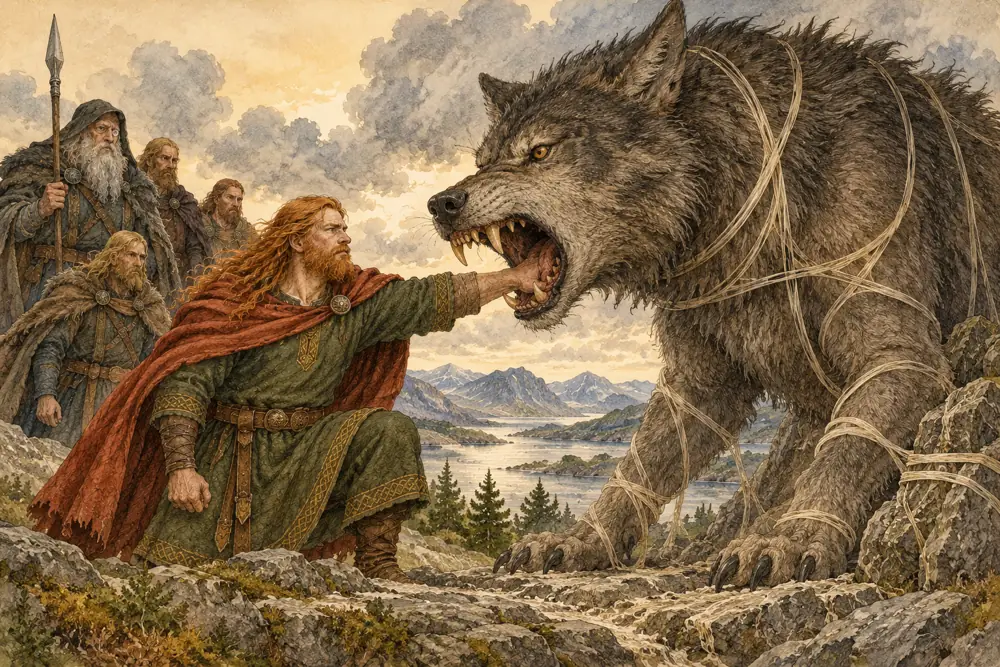
The hand placed in the wolf’s mouth
Tyr’s most memorable act is a pledge that he knows will cost him his hand. His courage makes the binding of Fenrir possible, but the story also exposes the gods’ use of deception.
Explore the stories ↓
Courage rather than a simple label
Snorri praises Tyr for courage and for a role in victory, presenting him as a figure warriors may invoke. Modern descriptions often call him the god of law or justice. Such associations can be useful starting points, but the surviving stories do not show him presiding over a complete divine legal system. His clearest episode concerns the value—and the deliberate breaking—of a pledge. Reading that scene closely is more revealing than treating a modern list of divine job titles as the ancient source itself.
The wolf whom Tyr feeds
When the gods bring Fenrir into their own community, Tyr alone is willing to feed him. The wolf grows alarmingly, and prophecies connect him with the gods’ eventual destruction. Two heavy fetters fail. A third, Gleipnir, looks deceptively slight but has been made through extraordinary craft. Fenrir suspects a trick and insists that someone put a hand in his mouth as security before he allows the gods to try the bond. The others hesitate. Tyr supplies the pledge.
What the loss means
Gleipnir holds, and the gods do not release Fenrir. The wolf takes Tyr’s hand. Snorri’s narrative makes the result painfully concrete: the others laugh at their success, while Tyr does not. His willingness to lose a hand is brave, but it is not an honest agreement fulfilled. The tale holds courage, collective safety and betrayal together. It can therefore support questions about difficult obligations without being reduced to a reassuring moral in which the divine side has done everything rightly.
Other glimpses and the final opponent
Tyr accompanies Thor in Hymiskviða, the poem that includes the search for Hymir’s enormous brewing kettle and the fishing encounter with Jörmungandr. That poem gives Tyr a family connection to Hymir which does not neatly match every later genealogical tradition. At Ragnarök, Snorri pairs Tyr with the hound Garm; each kills the other. Garm and Fenrir should not automatically be treated as the same creature in this version. The binding of Fenrir remains Tyr’s defining story, but it is not the full extent of his appearances.
Tyr knows where to find the impossible kettle
Hymiskviða begins with the gods needing a vessel large enough for Ægir to brew their drink. Tyr knows where one can be found: Hymir, whom this poem calls his father, owns a prodigious kettle. He takes Thor to the household. There Tyr encounters a fearsome many-headed grandmother and a much more welcoming mother, who brings drink and helps the visitors. Hymir's return is dangerous, and the guests shelter behind a pillar before being discovered. This family scene gives Tyr a role very different from his lonely courage before Fenrir. He is the guide whose knowledge opens the way, while Thor must perform the extraordinary feats. The poem's parentage should remain visible rather than being silently rewritten to match Snorri's description of Tyr as Odin's son.
The task that his strength cannot finish
After Thor's fishing expedition and further tests in Hymir's hall, the visitors still have to carry the great kettle away. Tyr tries to move it and fails; Thor lifts it over his head and departs with it. The episode makes room for cooperation without giving both gods identical powers. Tyr knows the destination and belongs to the household's complicated network of kinship, but Thor supplies the strength required to finish the errand. In Lokasenna, Tyr again speaks on behalf of another god, defending Freyr when Loki attacks the company. Loki answers with the loss of Tyr's hand, and Tyr replies that the wolf too has suffered by being bound. Even in an insult contest, the bargain with Fenrir remains an injury for which no easy verbal victory can compensate.
Read behind the retelling
Sources & limits
Tyr’s ancestry varies between sources. “God of justice” is a modern summary, not a complete ancient description of his duties.
Retold in contemporary English. Dialogue is summarized, not presented as a translation. How to read our sources and versions.
Follow the thread
Stories & related reading: Tyr
2 min read
The binding of Fenrir
The gods fear Fenrir’s future strength. Tyr places his hand in the wolf’s mouth while they test a restraint they never intend to remove.
Read the story ↗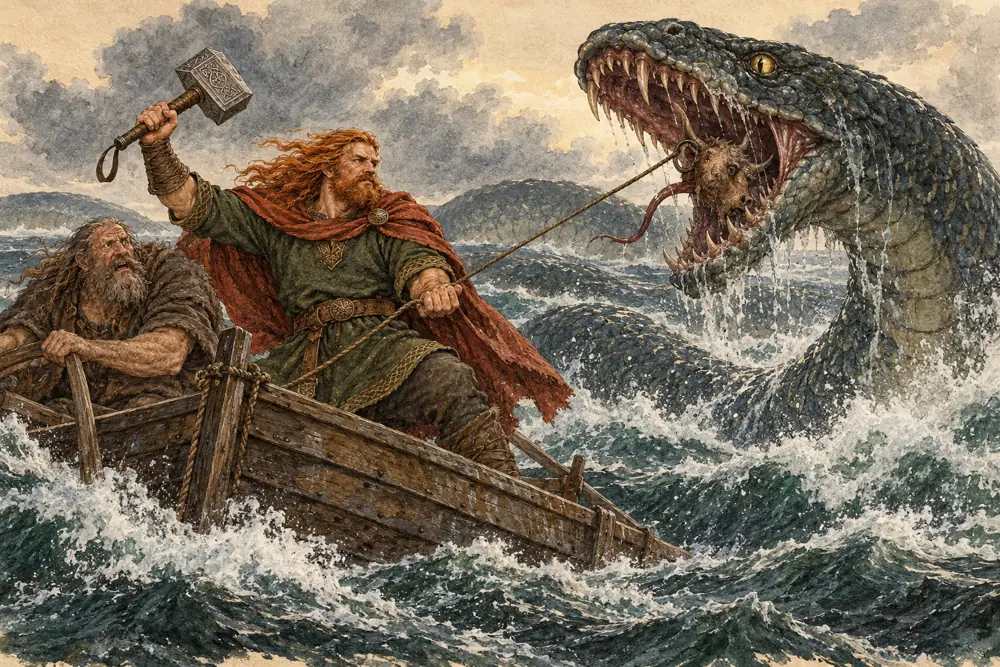
4 min read
Thor’s fishing expedition
Thor rows beyond the usual fishing grounds with Hymir and hooks Jörmungandr. The surviving accounts do not agree on every detail.
Read the story ↗
2 min read
Loki’s quarrel at Ægir’s feast
Loki enters the gods’ feast and attacks one guest after another in a formal exchange of insults.
Read the story ↗
3 min read
Ragnarok: the breaking of the world
The end approaches through broken human bonds and broken cosmic restraints. The surviving texts also imagine a world that rises after the disaster.
Read the story ↗
2 min read
Sigrdrifa defies Odin and wakes from enchanted sleep
Sigrdrifa chooses a battle’s outcome against Odin’s wishes. When Sigurd wakes her, she explains the punishment and offers him knowledge rather than remaining a silent rescued figure.
Read the story ↗