
A Norse story · 4 min read
Thor’s fishing expedition
An ox-head, a small boat and the serpent around the world.
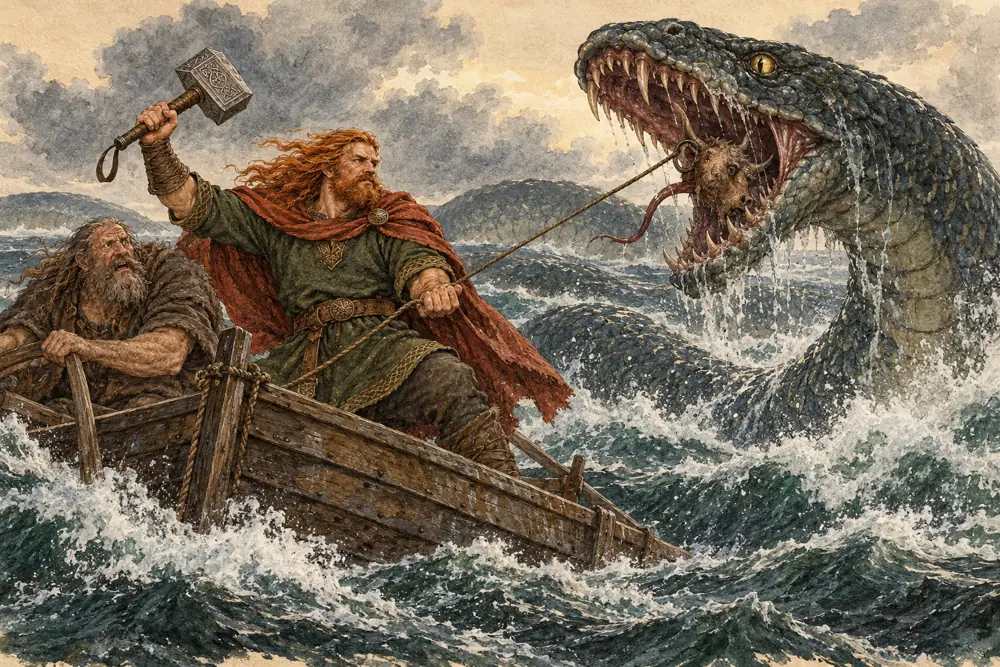
Thor rows beyond the usual fishing grounds with Hymir and hooks Jörmungandr. The surviving accounts do not agree on every detail.
Two tellings of one extraordinary catch
Imagine a fishing boat carrying a guest who refuses to turn back. His companion knows the sea and its dangers, but the guest keeps rowing. Beneath them waits an enemy large enough to encircle the inhabited world. Thor’s encounter with the Midgard Serpent survives in both the Eddic poem Hymiskviða and Snorri’s Gylfaginning. The following central scene follows Snorri; the poem’s different setting and ending are explained separately below. Keeping them apart matters: there was no single surviving Norse mythology handbook that every storyteller followed.
Hymir’s unexpected passenger
In Snorri’s account, Thor travels without his goats, chariot or usual company. He appears as a young man and spends the night with the giant Hymir. When Hymir prepares to fish, Thor asks to come. Hymir doubts that such a small companion can endure a long, cold day offshore. Thor insists. Asked to find his own bait, he goes to Hymir’s cattle and takes the head of the largest ox. This is not ordinary bait, and Thor is not looking for an ordinary fish. Hymir launches the boat, and Thor joins him with the ox-head. The two begin to row, the seemingly insignificant passenger supplying considerably more strength than his host expected.
Beyond the safe fishing grounds
They soon reach the grounds where Hymir normally fishes, but Thor wants to continue. Hymir warns that farther out they risk meeting the Midgard Serpent. Thor keeps going. Jörmungandr is not simply a large sea animal: in Snorri’s account of the world, Odin has cast this offspring of Loki into the ocean, where it has grown until it surrounds the land. Thor prepares a powerful line and hook, fixes the ox-head to it and lowers it into the sea. The serpent bites. Once caught, it pulls so violently that Thor’s hands strike the side of the boat. Thor braces himself with such force that his feet break through its bottom and press against the seabed. The tiny vessel has become the meeting point of two immense powers.
Face to face at the gunwale
Thor hauls the serpent upward until its head reaches the boat. The god and the monster stare at one another; venom issues from the serpent, while Hymir watches in terror. Just as Thor raises his hammer, Hymir cuts the fishing line. The serpent drops back into the water. Thor throws the hammer after it, and Snorri’s speaker acknowledges a version in which the blow takes off its head. But the speaker then states his own belief that the serpent remains alive in the sea. Furious with Hymir, Thor strikes him and sends him overboard, then wades ashore. The account deliberately preserves disagreement rather than giving readers a completely seamless ending.
How Hymiskviða tells it differently
In Hymiskviða, Thor travels with Tyr to obtain Hymir’s enormous brewing cauldron for Ægir’s feast. The poem calls Hymir Tyr’s father, a relationship that differs from other descriptions of Tyr. After Thor eats an astonishing quantity of food, the fishing excursion provides a way to obtain more. Hymir catches whales; Thor catches the world-serpent. The poem describes Thor striking its head and the monster sinking into the sea. It does not narrate Hymir cutting the line. Afterward the cauldron quest continues: Thor carries the boat and catch, breaks a seemingly unbreakable cup against Hymir’s head after receiving advice, and finally carries away the cauldron. Tyr has failed to lift it. These events belong to the poem’s larger adventure and should not be silently inserted into Snorri’s shorter expedition.
Why the unfinished struggle matters
Thor and Jörmungandr meet again in accounts of Ragnarök, when Thor kills the serpent but dies after moving away from its venom. That final confrontation gives the fishing expedition a powerful sense of anticipation for readers familiar with both stories. Yet it would be misleading to rewrite every earlier version merely to make the chronology tidy. The surviving texts preserve poetry, prose explanation and competing narrative details. The fishing story can be read as a contest between the defender of the human world and a threatening boundary of that world. That is an interpretation of its imagery, not a recorded explanation from every Viking Age listener.
Read behind the retelling
Sources & limits
The line-cutting belongs to Snorri’s version, not the surviving text of Hymiskviða. The poem’s wording about the serpent’s fate should not be forced into one certain outcome.
- Gylfaginning, chapter 48 — Arthur Gilchrist Brodeur translation (1916)
- Hymiskviða, especially stanzas 17–27 and the cauldron conclusion — Henry Adams Bellows translation (1923)
Retold in contemporary English. Dialogue is summarized, not presented as a translation. How to read our sources and versions.
Another thread to follow

2 min read
Loki’s quarrel at Ægir’s feast
Loki enters the gods’ feast and attacks one guest after another in a formal exchange of insults.
Read the story ↗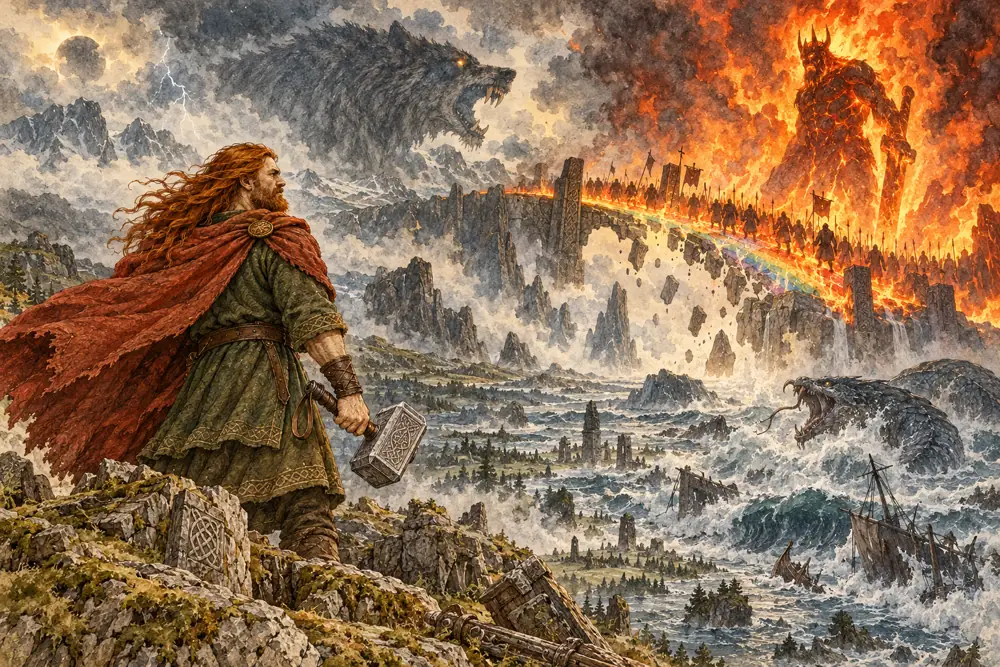
3 min read
Ragnarok: the breaking of the world
The end approaches through broken human bonds and broken cosmic restraints. The surviving texts also imagine a world that rises after the disaster.
Read the story ↗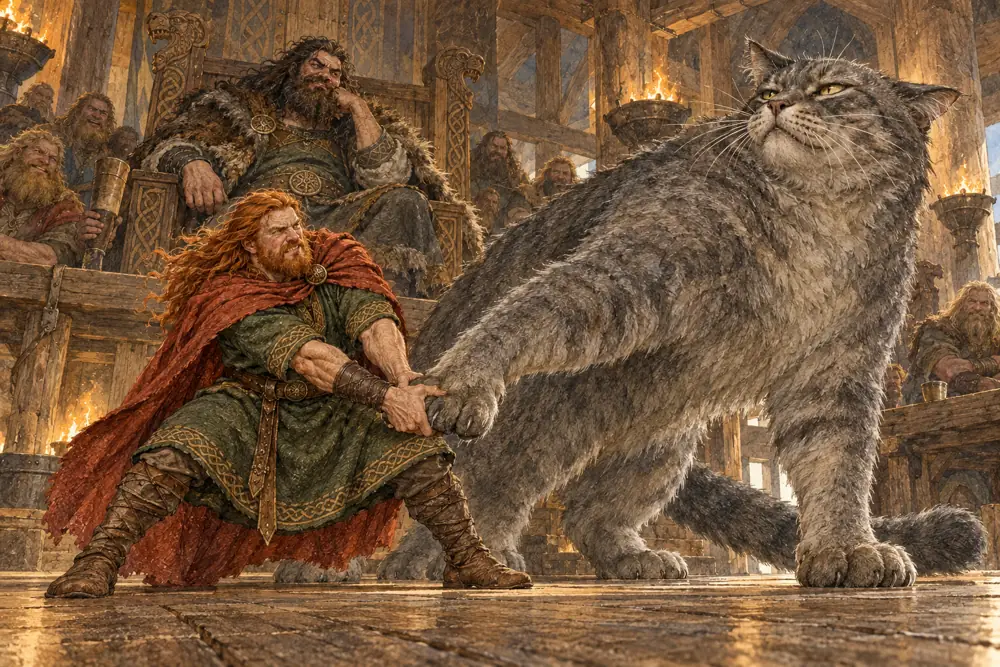
4 min read
Thor at Útgarða-Loki’s hall
Thor and his companions fail a series of apparently simple tests—until their host reveals what they were really facing.
Read the story ↗