
A Norse story · 4 min read
Thor at Útgarða-Loki’s hall
The contests that no ordinary strength could win.
Thor and his companions fail a series of apparently simple tests—until their host reveals what they were really facing.
A journey begins with broken bones
In Gylfaginning, Thor travels with Loki and spends a night at a farmer’s home. Thor kills his two goats to feed the household and asks that their bones be placed on the skins. The farmer’s son Thjálfi breaks a thigh-bone to reach its marrow. Next morning Thor hallows the remains with his hammer and the goats rise again, but one is lame. Thor is angry; the family is terrified. He accepts Thjálfi and his sister Röskva as servants in settlement. It is a harsh beginning, reflecting the unequal power of god and household in this story. The travellers leave the goats behind and continue toward the land of giants.
A house that turns out to be a glove
After crossing into unfamiliar country, they shelter in an enormous building. At night the ground shakes and a terrible noise surrounds them. They retreat into a side chamber while Thor guards the entrance. Morning reveals the explanation: the building is a giant’s glove, the side chamber its thumb, and the noise the sleeping giant’s snoring. His name is Skrýmir. He offers to travel with them and combines their food in a single bag. Later Thor cannot loosen its fastening. Angry and hungry, he strikes the sleeping giant with Mjölnir. Skrýmir wakes and wonders whether a leaf fell on him. Two more blows receive equally infuriating responses. At dawn Skrýmir departs, warning them against boasting at Útgarða-Loki’s hall.
Eating against fire, running against thought
The enormous hall has an enormous host. Útgarða-Loki is a separate figure from the Loki travelling with Thor; their similar names should not merge them into one character. He challenges the visitors to demonstrate a skill. Loki offers to eat faster than anyone. A trough of meat is set between him and Logi. They meet in the middle, but Logi has eaten bones and trough as well as meat, so Loki loses. Thjálfi next races against Hugi. Despite his remarkable speed he is repeatedly outdistanced. These defeats seem humiliating because the visitors think they are taking part in ordinary contests. The host has concealed the nature of their opponents.
A horn, a cat and an elderly wrestler
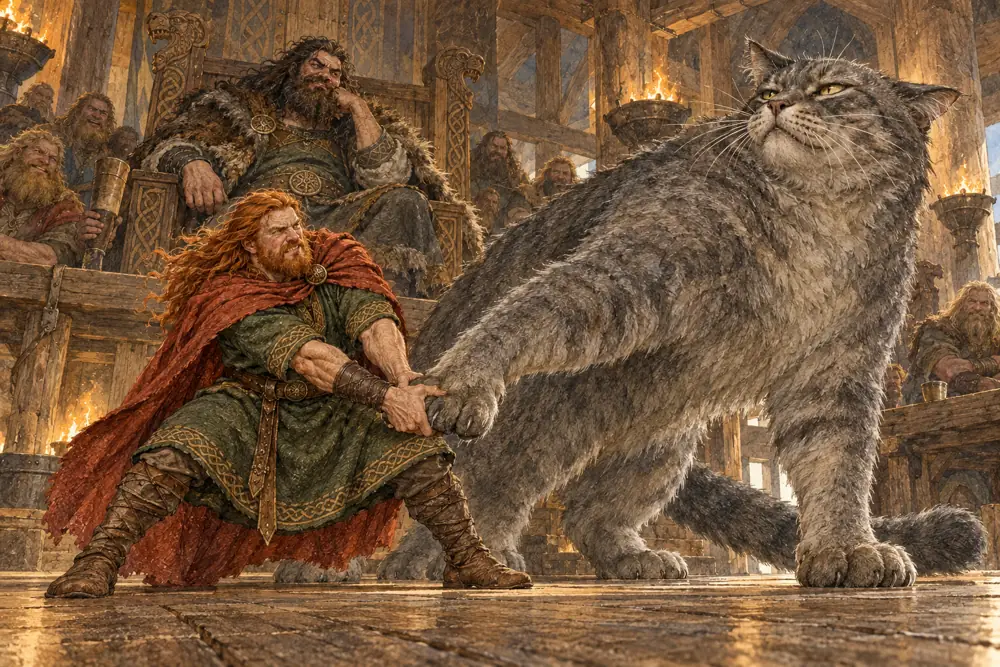
Thor chooses drinking. His host produces a long horn and says that competent drinkers empty it quickly. Thor drinks three times, each time using all his strength, but can only lower its contents. Next he is challenged to lift a cat. He raises it as high as he can, yet the animal arches its body so that only one paw leaves the ground. Thor demands a wrestling opponent. Instead of a formidable warrior, the host calls for his elderly foster-mother Elli. Thor cannot throw her. She wrestles him down onto one knee before the contest is stopped. After these failures, the visitors nevertheless receive hospitality and stay the night.
The truth outside the walls
When they leave, Útgarða-Loki explains. He was the Skrýmir they met on the road. The provision bag had been secured with iron, and Thor’s hammer blows had struck mountains placed between hammer and target, carving deep valleys. Logi was fire, which consumes everything; Hugi was the host’s thought, which no runner could overtake. The end of the drinking horn reached the sea. Thor had lowered it enough to produce an extraordinary ebb. The cat was Jörmungandr, the world-serpent, and lifting even one paw had alarmed everyone watching. Elli was old age. No one who lives long enough can finally defeat her, and Thor’s resistance had been astonishing. What looked like small failures had been enormous achievements.
Victory, humiliation and vanished walls
Thor reaches for his hammer, but the host disappears. He turns toward the fortress and finds only an open plain. There is nothing left to strike. The tale does more than tell us that Thor is strong: it changes the meaning of everything we have just watched. He has been measured against fire, thought, the ocean, the encircling serpent and age itself. Reading the story as an exploration of the limits of physical force is reasonable, but that remains interpretation. The surviving prose also revels in tricks, exaggeration and a reversal of expectations. Snorri’s storyteller follows it with Thor’s fishing expedition, linking his desire for another encounter with the serpent to this disturbing journey. That literary sequence need not be treated as a universal timeline shared by every Norse tradition.
Read behind the retelling
Sources & limits
Útgarða-Loki is not Thor’s travelling companion Loki. Logi means fire in the explanation of the contest; this does not make Loki a fire god.
Retold in contemporary English. Dialogue is summarized, not presented as a translation. How to read our sources and versions.
Another thread to follow
2 min read
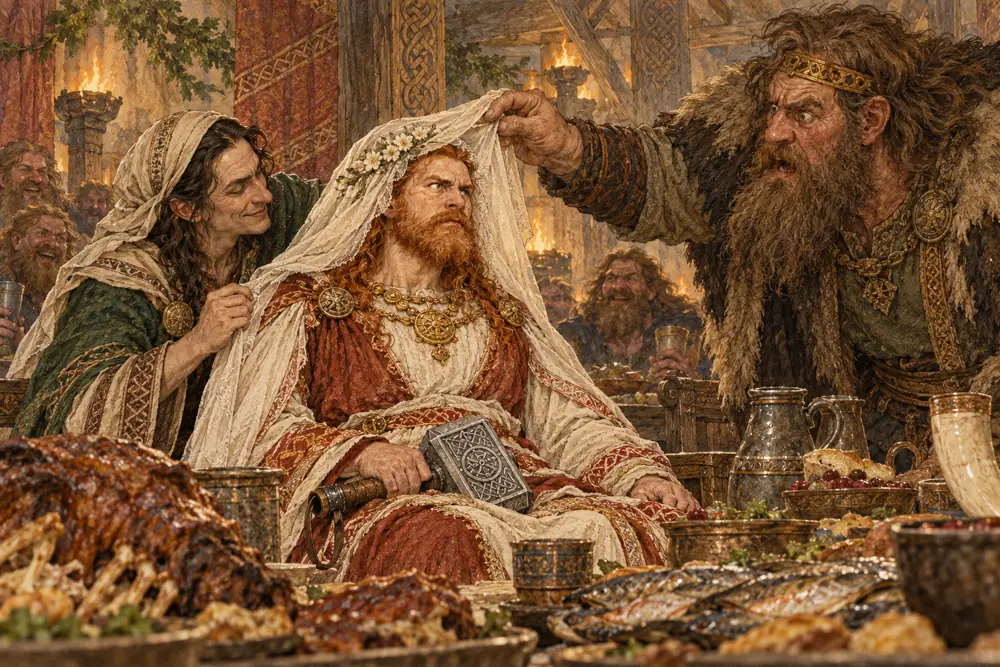
Thor’s extraordinary wedding
When Thrym demands Freyja in exchange for Mjölnir, the gods send a very different bride.
Read the story ↗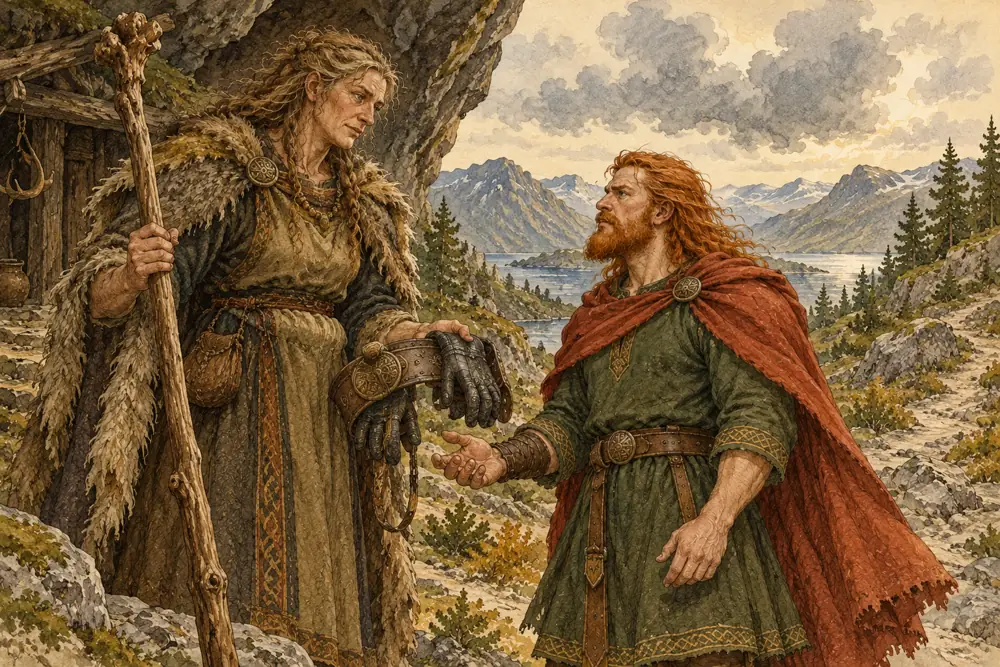
2 min read
Thor in Geirröd’s hall
Loki’s bargain sends Thor toward a deadly host without his usual equipment. The giantess Gríðr gives him the tools to survive.
Read the story ↗
2 min read
The death of Baldr
Frigg tries to protect Baldr from every danger, but Loki finds the one promise she did not obtain.
Read the story ↗