
A Norse story · 2 min read
Thor in Geirröd’s hall
A dangerous invitation and help from an unexpected ally.
Loki’s bargain sends Thor toward a deadly host without his usual equipment. The giantess Gríðr gives him the tools to survive.
An invitation bought with captivity
In the prose account in Skáldskaparmál, Loki explores Geirröd’s home in a borrowed feather garment belonging to Frigg. He delays his escape while mocking a servant’s difficult climb, only to find himself caught. Geirröd recognises that the strange bird is no ordinary animal and imprisons him. To gain release, Loki promises to bring Thor to the giant’s home without his hammer or strength-belt. Thor therefore sets out disadvantaged through his companion’s bargain, not because the journey is safe. The story begins by making Loki both the source of danger and the link between otherwise separated worlds.
Gríðr equips the traveller
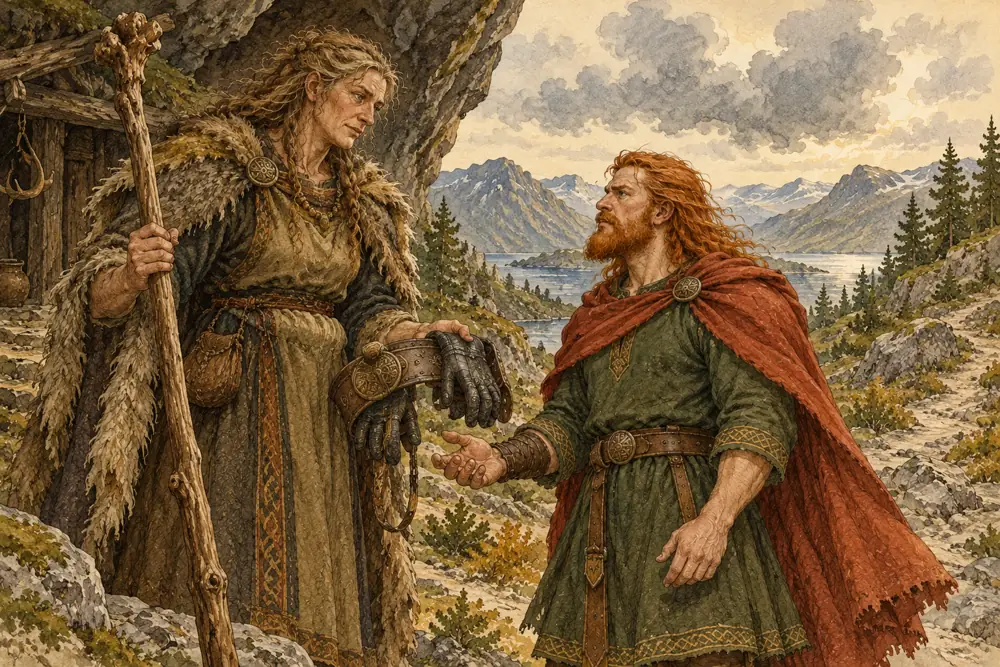
On his way, Thor visits the giantess Gríðr, mother of Víðarr. She warns him about Geirröd and lends him a strength-belt, iron gloves and her staff, Gríðarvölr. Her assistance is essential. It also disrupts any simple division between good gods and uniformly wicked giants: a giantess provides the knowledge and equipment that save Thor. At the river Vimur the water rises threateningly. Thor sees Geirröd’s daughter Gjálp upstream causing the flood, throws a stone at her, and reaches the bank with the help of a rowan. The prose connects this escape with the saying that rowan is Thor’s rescue.
The seat and the iron missile
At Geirröd’s home, Thor sits on the available chair and discovers it rising toward the roof. He pushes against the rafters with Gríðr’s staff. Beneath the chair are Geirröd’s daughters Gjálp and Greip, whose attempt to crush him ends with their own backs broken. The host then invites Thor into a hall with fires. Geirröd throws a glowing piece of iron at him. Protected by the borrowed gloves, Thor catches it. Geirröd hides behind an iron pillar, but Thor throws the missile back with enough force to pierce pillar, giant and wall.
A prose story and an older poem
Skáldskaparmál connects the tale with Eilífr Goðrúnarson’s Þórsdrápa, a densely allusive poem that also describes the expedition. The poem and prose are not identical accounts: Thjálfi figures in the poetic journey, while the prose foregrounds Loki. A responsible retelling should say which account it follows rather than splice every detail into one smooth adventure. Here the main narrative follows the prose explanation. The victory belongs to Thor’s strength, but also to borrowed equipment, warning and timely help. Calling it simply a tale of a god who needs nobody would miss what actually allows him to survive.
Read behind the retelling
Sources & limits
The prose account and Þórsdrápa differ, including the travelling companions. Gríðr’s help is part of the story; she is not an enemy defeated by Thor.
Retold in contemporary English. Dialogue is summarized, not presented as a translation. How to read our sources and versions.
Another thread to follow

3 min read
Ragnarok: the breaking of the world
The end approaches through broken human bonds and broken cosmic restraints. The surviving texts also imagine a world that rises after the disaster.
Read the story ↗
4 min read
Thor at Útgarða-Loki’s hall
Thor and his companions fail a series of apparently simple tests—until their host reveals what they were really facing.
Read the story ↗
2 min read
Thor’s extraordinary wedding
When Thrym demands Freyja in exchange for Mjölnir, the gods send a very different bride.
Read the story ↗