
Gods & companions
Vidar
The silent son who avenges Odin
Vidar survives the destruction that kills Odin and confronts Fenrir after the wolf’s victory. His great shoe is one of the most memorable objects in Snorri’s account of Ragnarök.
Explore the stories ↓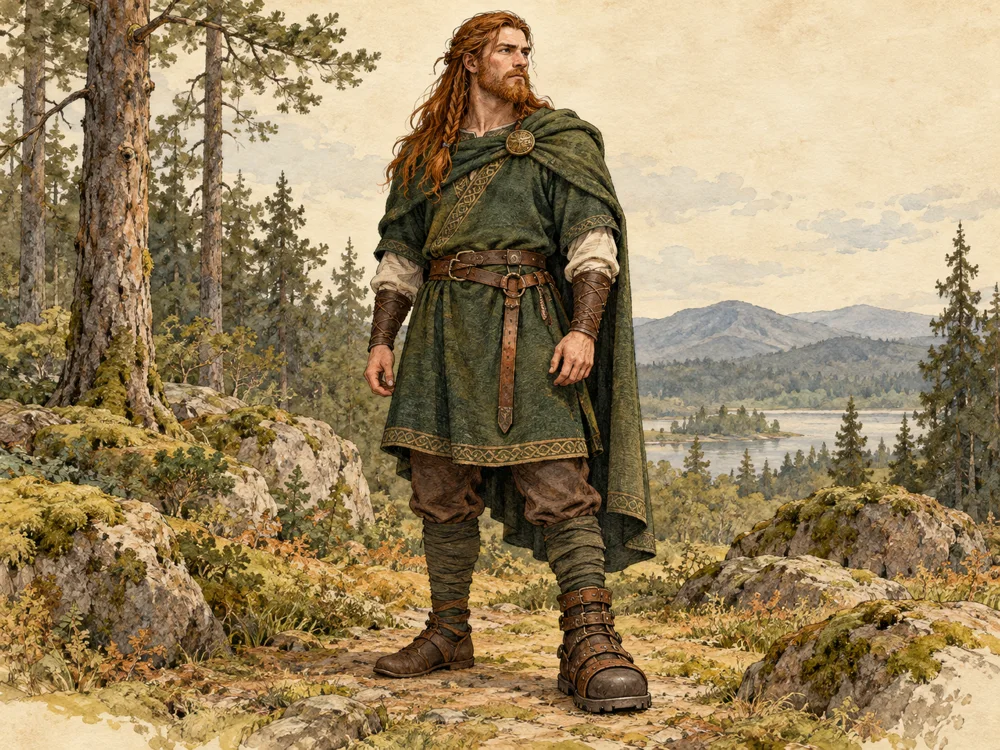
Strength held in reserve
Gylfaginning calls Vidar a silent god, nearly as strong as Thor, in whom the gods trust. Skáldskaparmál identifies his mother as the giantess Gríd, who also helps Thor on the journey to Geirröd. This is another example of giant kinship running through the divine families. Silence is a description attached to Vidar, not an explanation of every thought or motive he has.
The wolf and the shoe
At Ragnarök, after Fenrir swallows Odin, Vidar steps into the wolf’s lower jaw and tears its mouth apart in Snorri’s version. His protective shoe is made from pieces cut from footwear, and the account encourages people to discard such scraps. Völuspá describes the vengeance with different imagery involving a blade. The two presentations should remain visible rather than being blended into a single cinematic sequence.
A survivor
Vidar belongs among the gods who remain after the destruction. Together with other surviving and returning figures, he connects the old divine world with the new one. The surviving stories do not provide a long independent career between his introduction and that final act. His importance lies in a concentrated role: avenging Odin and continuing beyond him.
The quiet action before Loki's quarrel
Vidar makes a brief appearance near the beginning of Lokasenna. When Loki invokes his old agreement with Odin and demands a place at the feast, Odin tells Vidar to rise and make room for him. Vidar obeys and pours a drink. The prose gives him an action rather than a speech. The moment is striking in light of his better-known future: the god who will avenge Odin upon Fenrir now serves the wolf's father at Odin's request. The poem does not explain that contrast, but both relationships are present in its scene.
A green dwelling before the final battle
Grímnismál describes Vidar's land through growing trees and tall grass, then connects the place with the son who goes to avenge his father. Vafþrúðnismál looks beyond that act and names Vidar and Vali among those inhabiting the divine home after Surtr's fires. These are compact poetic glimpses, not a long sequence of adventures. Together they give Vidar a place before destruction and a future after it, while leaving most of the intervening life untold.
Read behind the retelling
Sources & limits
Vidar’s killing of Fenrir is described differently in verse and prose. A combined version should be labelled a modern synthesis.
- Gylfaginning, chapters 29, 51 and 53
- Skáldskaparmál, Thor’s visit to Gríd
- Völuspá, Vidar’s vengeance
- Lokasenna 9–11 and prose; Henry Adams Bellows, 1923
- Grímnismál 17; Henry Adams Bellows, 1923
- Vafþrúðnismál 50–53; Henry Adams Bellows, 1923
Retold in contemporary English. Dialogue is summarized, not presented as a translation. How to read our sources and versions.
Follow the thread
Stories & related reading: Vidar
2 min read
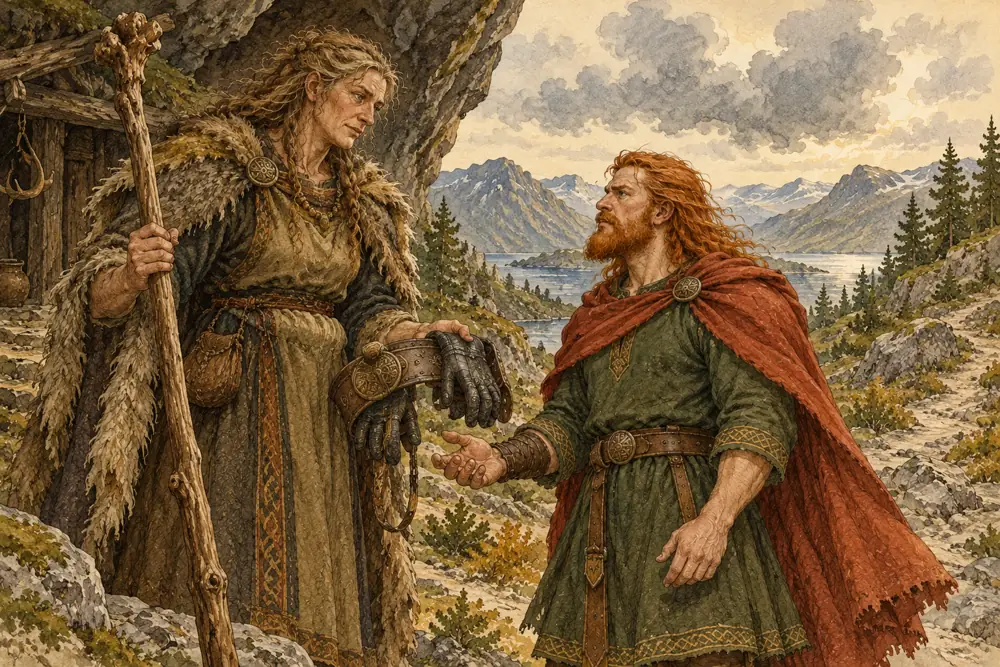
Thor in Geirröd’s hall
Loki’s bargain sends Thor toward a deadly host without his usual equipment. The giantess Gríðr gives him the tools to survive.
Read the story ↗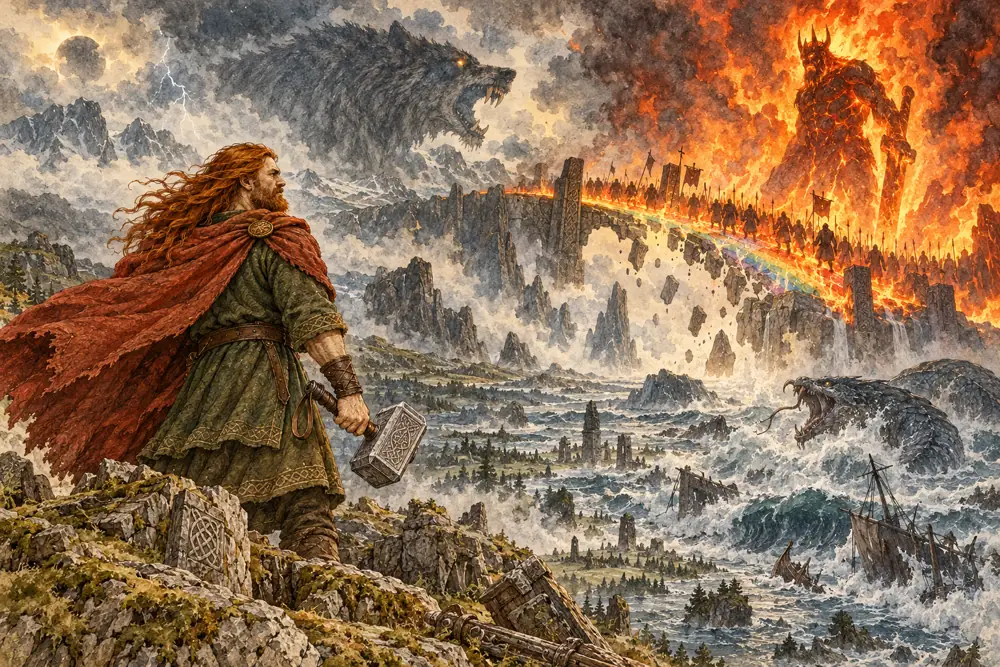
3 min read
Ragnarok: the breaking of the world
The end approaches through broken human bonds and broken cosmic restraints. The surviving texts also imagine a world that rises after the disaster.
Read the story ↗
2 min read
Loki’s quarrel at Ægir’s feast
Loki enters the gods’ feast and attacks one guest after another in a formal exchange of insults.
Read the story ↗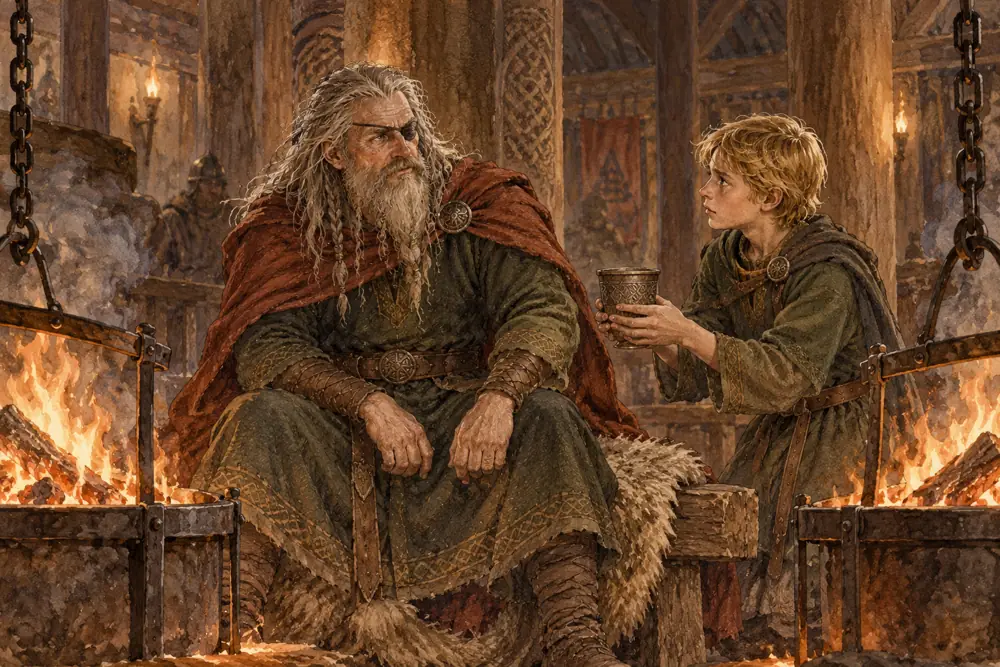
2 min read
Odin between the fires
Frigg’s warning, a cruel interrogation and a child’s kindness turn a royal hall into a place of revelation.
Read the story ↗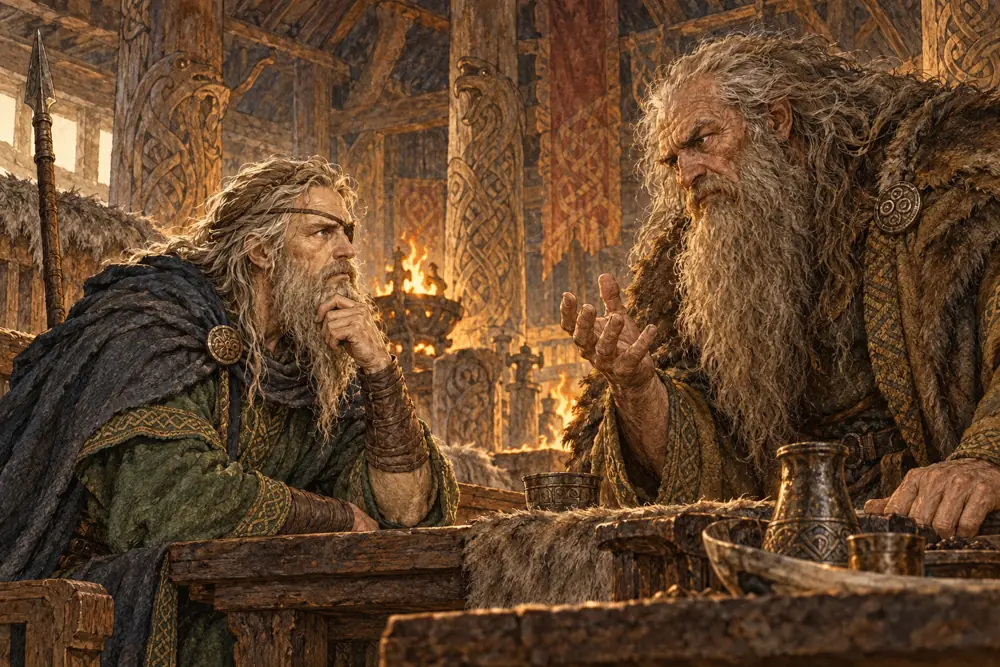
2 min read
Odin’s contest of wisdom
Odin tests Vafthrúðnir in a contest that moves from the structure of the cosmos to a secret only Odin can know.
Read the story ↗