
A Norse story · 2 min read
Odin’s contest of wisdom
A guest named Gagnráðr asks one question too many.
Odin tests Vafthrúðnir in a contest that moves from the structure of the cosmos to a secret only Odin can know.
Frigg advises against the journey
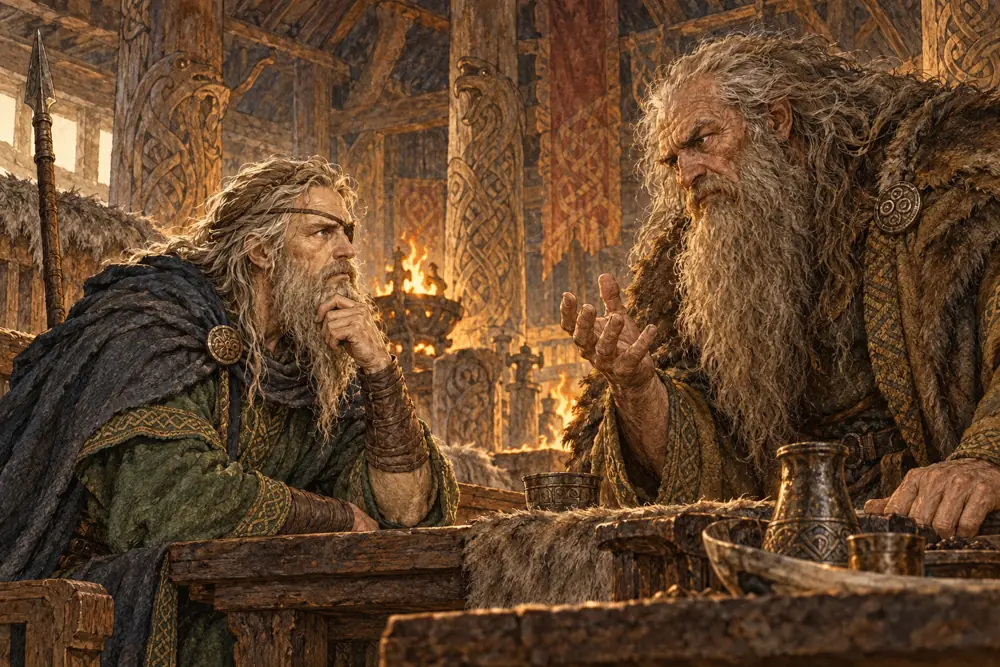
Vafþrúðnismál opens with Odin asking Frigg about visiting the wise giant Vafthrúðnir. She warns him against the undertaking. Odin goes anyway, taking the name Gagnráðr. Arriving as an apparently ordinary traveller, he asks to test the giant’s knowledge. Vafthrúðnir first questions his guest about the world: the horses associated with day and night, the river dividing divine and giant territory, and the field on which the last battle will occur. Odin answers successfully. The guest has earned a place in the contest, but the stakes will be much more serious than a display of learning.
A world explained through questions
The speakers exchange knowledge about origins, cosmic order and the future. Vafthrúðnir tells of the creation of the world from Ymir’s body and of beings from the earliest times. He describes what will survive the catastrophe of Ragnarök: human survivors, a renewed sun and gods who remain after the destruction. Odin asks about his own death and hears that the wolf will kill him, while Víðarr will avenge him. The poem delivers much of its mythology through this dialogue. It is not necessary to invent a narrator who explains every contradiction with other works; the poem is one witness among several.
The question no opponent can answer
Finally Odin asks what he whispered into his son’s ear before the son was laid on the funeral pyre. Vafthrúðnir realises that only Odin could ask this and know the answer. He recognises his opponent and concedes defeat. The poem does not reveal the whispered words to its audience. Modern suggestions about resurrection, reassurance or secret wisdom remain suggestions. Giving a confident quotation of what Odin said would turn an intentional silence into fabricated evidence. The head wager makes the recognition ominous, but the poem ends with the giant’s acknowledgement rather than a narrated execution.
Not the same story as Grímnismál
Odin also speaks cosmic knowledge in Grímnismál, but that is a different setting: a disguised guest is mistreated at King Geirröd’s court and speaks while held between fires. Joining those scenes into the contest with Vafthrúðnir would erase the structure of both works. In this poem, the decisive weapon is a private memory rather than a fact about the universe. The giant knows extraordinarily much and loses to a question that knowledge alone cannot answer. Whether readers admire Odin’s cunning or question the fairness of his victory, the ending is deliberately sharper than a simple schoolroom quiz.
Read behind the retelling
Sources & limits
Odin’s whisper to Baldr is not disclosed. The wager implies a deadly consequence, but the poem does not narrate Vafthrúðnir’s execution.
Retold in contemporary English. Dialogue is summarized, not presented as a translation. How to read our sources and versions.
Another thread to follow

3 min read
Ragnarok: the breaking of the world
The end approaches through broken human bonds and broken cosmic restraints. The surviving texts also imagine a world that rises after the disaster.
Read the story ↗
2 min read
The death of Baldr
Frigg tries to protect Baldr from every danger, but Loki finds the one promise she did not obtain.
Read the story ↗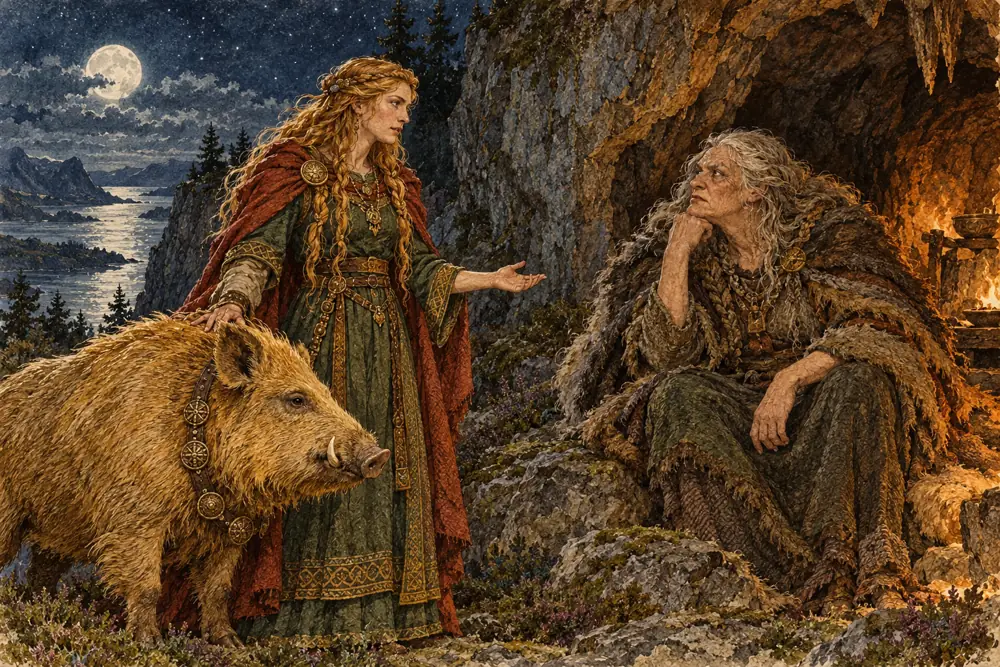
2 min read
Freyja, Hyndla, and Ottar’s ancestry
Freyja seeks a genealogy for her devotee Ottar. The encounter becomes a dispute about ancestry, memory, and the price of knowledge.
Read the story ↗