
Gods & companions
Frigg
Foreknowledge, protection and the grief of a mother
Frigg is Odin’s wife and Baldr’s mother. Her attempt to protect her son turns a vast, powerful divine household into the setting for one of mythology’s most intimate losses.
Explore the stories ↓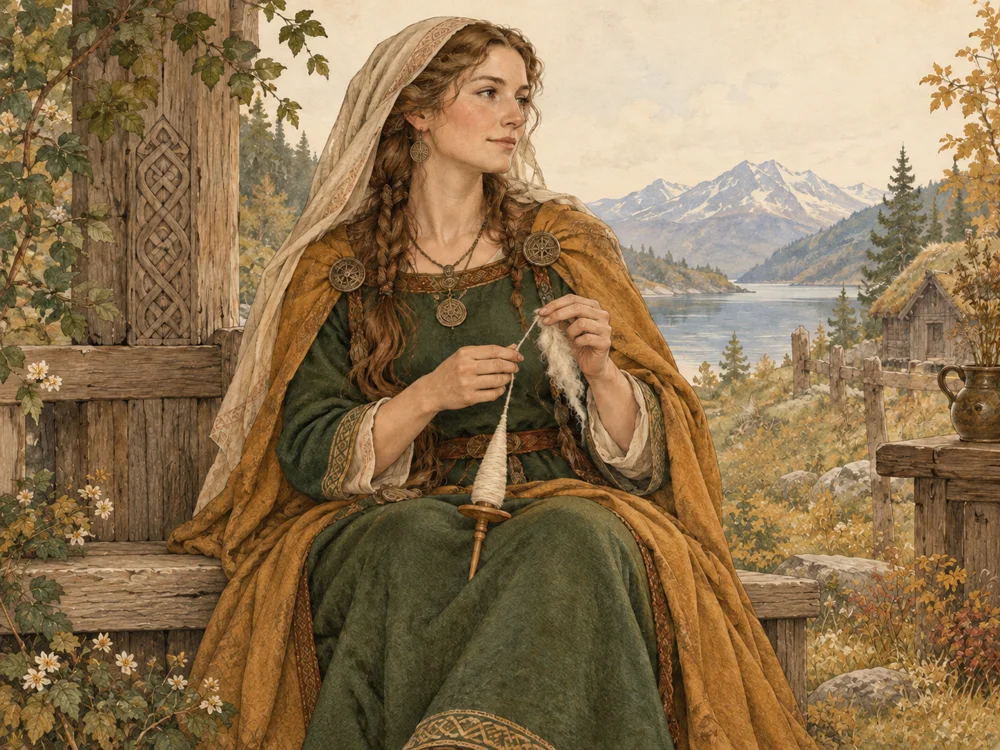
A leading goddess with her own household
Gylfaginning places Frigg foremost among the goddesses and names her dwelling Fensalir. It also credits her with knowledge of fate while saying that she does not speak it. Fulla knows her confidential plans and tends her possessions; Gná travels on her errands. These glimpses suggest a divine household and a sphere of authority, although they do not preserve a continuous collection of Frigg’s independent adventures. The shortage of surviving stories should not be confused with proof that she was unimportant.
The oaths that almost save Baldr
When Baldr suffers ominous dreams, Frigg seeks promises from the things of the world that they will not harm him. The gods then turn his apparent invulnerability into a game, throwing or striking objects at him. Loki, disguised as a woman in Snorri’s version, learns from Frigg that she did not demand an oath from mistletoe because it seemed too young. He obtains it and guides the blind Höd into using it against Baldr. Frigg’s near-complete protection has left one opening.
An appeal beyond the world of the living
After the death, Frigg asks for someone to ride to Hel and seek Baldr’s return. Hermod undertakes the journey. The condition imposed by Hel—that everything must weep for Baldr—repeats the earlier search through the whole world, now for expressions of mourning rather than oaths of protection. One refusal defeats the effort. Snorri’s narrative thus places Frigg at the centre of two attempts to mobilise universal agreement, and both fail because universality proves impossible to secure.
What her story does and does not explain
Frigg’s knowledge of fate sits uneasily beside her efforts to change Baldr’s outcome. That tension is part of the story; the sources do not resolve it by laying out a consistent theory of predestination. She is often presented today as a goddess of marriage and motherhood, associations that fit aspects of her position but cannot substitute for the actual evidence. Freyja is a separate character in these narratives. Similarities between the goddesses are a subject for interpretation, not permission to exchange their names whenever convenient.
The wager that she turns against Odin
The prose introduction to Grímnismál gives Frigg an active and unsettling role. She and Odin have fostered two brothers after the boys were driven off course while fishing. Years later, Odin praises the worldly success of his fosterling Geirröd, now a king, and mocks Frigg's fosterling Agnar. Frigg answers that Geirröd mistreats guests. Odin disputes it, and they wager on the matter. Before he visits the king in disguise, Frigg sends Fulla to warn Geirröd about a magician whom dogs will not attack. The warning causes the king to arrest Odin and torture him between fires. Frigg does not merely foresee what happens: her intervention helps bring it about. The narrative explicitly indicates that the original charge against the king's hospitality was unfair, making her victory more morally complicated than simply exposing an already wicked host.
A gift comes back from the dead
Frigg's effort to recover Baldr fails, but Hermod does not return from Hel empty-handed. In Snorri's account Nanna sends her a linen garment and other gifts, and sends Fulla a golden finger-ring. Baldr sends Odin back the ring Draupnir that had been placed on his funeral pyre. These small exchanges give the journey a domestic dimension alongside its cosmic loss. The dead are not portrayed merely as distant shadows: they recognize members of the living household and choose things for them. Frigg receives a material message from a place she cannot make release her son. Fulla's inclusion also gives substance to her place within the goddess's circle, rather than leaving her only as an entry in a list of attendants.
Read behind the retelling
Sources & limits
The sources say Frigg knows fate but do not explain exactly what she knows in every scene. Do not fill that gap with invented rules.
- Gylfaginning, chapters 20, 35 and 49
- Lokasenna, exchanges involving Frigg
- Grímnismál, prose introduction
Retold in contemporary English. Dialogue is summarized, not presented as a translation. How to read our sources and versions.
Follow the thread
Stories & related reading: Frigg

2 min read
The death of Baldr
Frigg tries to protect Baldr from every danger, but Loki finds the one promise she did not obtain.
Read the story ↗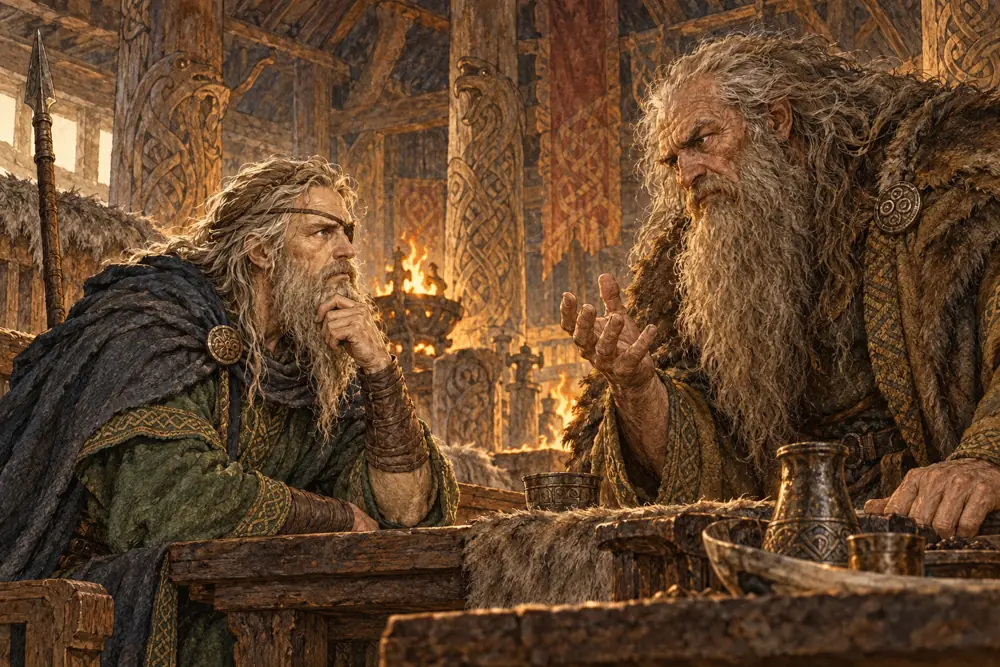
2 min read
Odin’s contest of wisdom
Odin tests Vafthrúðnir in a contest that moves from the structure of the cosmos to a secret only Odin can know.
Read the story ↗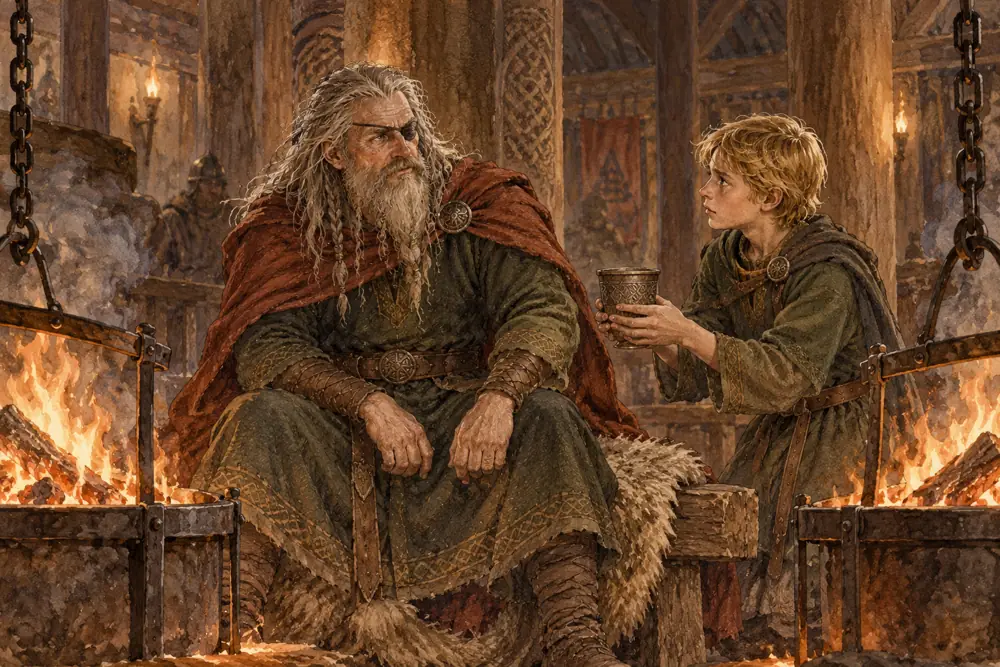
2 min read
Odin between the fires
Frigg’s warning, a cruel interrogation and a child’s kindness turn a royal hall into a place of revelation.
Read the story ↗
2 min read
Loki’s quarrel at Ægir’s feast
Loki enters the gods’ feast and attacks one guest after another in a formal exchange of insults.
Read the story ↗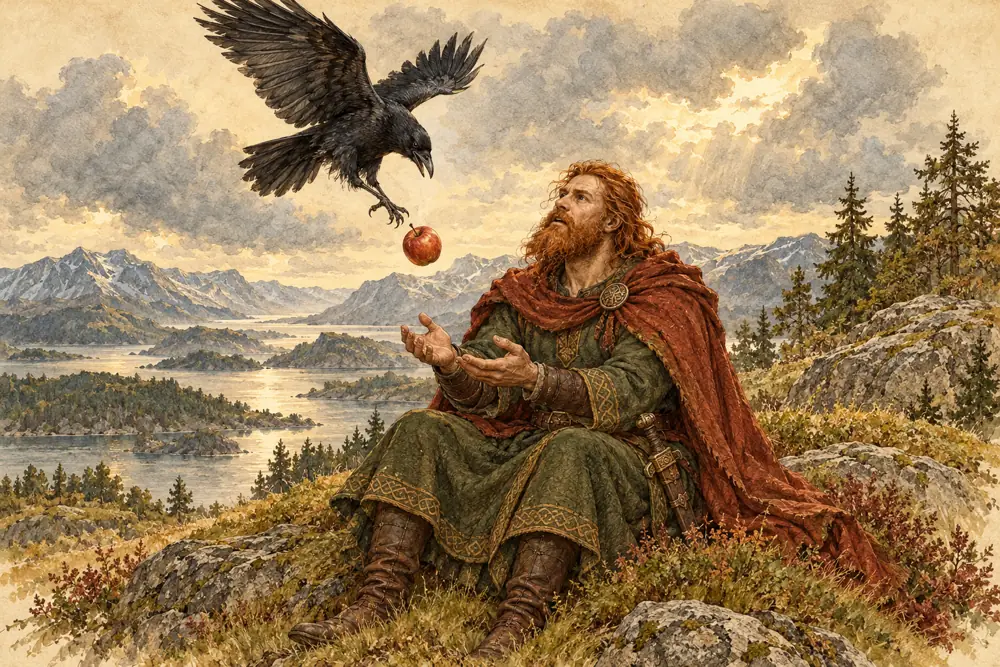
2 min read
Frigg, Odin and the apple sent to Rerir
Frigg hears the prayers of a childless royal couple, and Odin sends an apple through a bird-shaped messenger. The miraculous conception leads to a birth that is remarkable but far from painless.
Read the story ↗