
A Norse story · 2 min read
Odin between the fires
The visitor whom a king failed to recognise
Frigg’s warning, a cruel interrogation and a child’s kindness turn a royal hall into a place of revelation.
Two brothers and a wager
The prose introduction to Grímnismál begins with the brothers Agnar and Geirröd, who are driven off course while fishing. They spend a winter with a couple who are really Odin and Frigg: Odin fosters Geirröd, Frigg Agnar. Returning home, Geirröd pushes his brother’s boat back out to sea and takes the kingship after their father’s death. Later Odin praises his successful foster-son. Frigg calls the king a bad host, and they wager over his hospitality.
A warning changes the welcome
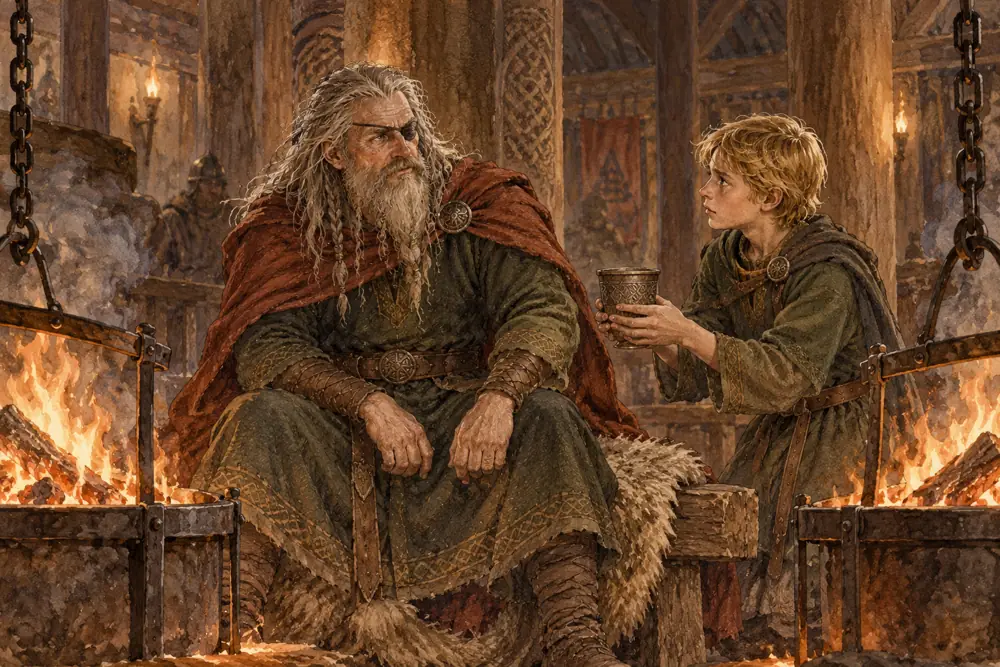
Frigg sends Fulla to warn Geirröd against a dangerous stranger whom dogs will not attack. When Odin arrives under the name Grímnir, the king arrests him and places him between fires to force him to speak. The narrator expressly says the original accusation of habitual inhospitality was false. Frigg’s intervention helps produce the behaviour she alleged; the story is more complicated than a simple inspection of an already wicked household.
The younger Agnar
For eight nights the stranger suffers. The king’s young son, also named Agnar, brings him a drink and objects to his treatment. Odin rewards the boy with knowledge: the poem unfolds descriptions of divine homes, animals, rivers, the world-tree and the ordering of the cosmos. The narrative slows while the disguised prisoner becomes a teacher. The child’s small act of hospitality matters more than the king’s wealth or power.
Recognition comes too late
As the speech reaches its end, the stranger reveals his many names and finally his identity. Geirröd rises to release him, but falls on his own sword and dies. Odin disappears and the younger Agnar becomes king. The closing prose makes the death an accident occurring during the king’s attempt to act, rather than a scene in which Odin visibly strikes him down. The dramatic frame and the long catalogue belong together: wisdom is spoken in a place that has failed to recognise its guest.
Read behind the retelling
Sources & limits
The human king Geirröd in this poem is not the giant Geirröd encountered by Thor. The prose frame is distinct from the verse it accompanies.
Retold in contemporary English. Dialogue is summarized, not presented as a translation. How to read our sources and versions.
Another thread to follow

2 min read
The death of Baldr
Frigg tries to protect Baldr from every danger, but Loki finds the one promise she did not obtain.
Read the story ↗
2 min read
Odin’s contest of wisdom
Odin tests Vafthrúðnir in a contest that moves from the structure of the cosmos to a secret only Odin can know.
Read the story ↗
2 min read
Loki’s quarrel at Ægir’s feast
Loki enters the gods’ feast and attacks one guest after another in a formal exchange of insults.
Read the story ↗