
A Norse story · 2 min read
Frigg, Odin and the apple sent to Rerir
A prayer for a child begins the extraordinary history of the Volsungs.
Frigg hears the prayers of a childless royal couple, and Odin sends an apple through a bird-shaped messenger. The miraculous conception leads to a birth that is remarkable but far from painless.
A kingdom without an heir
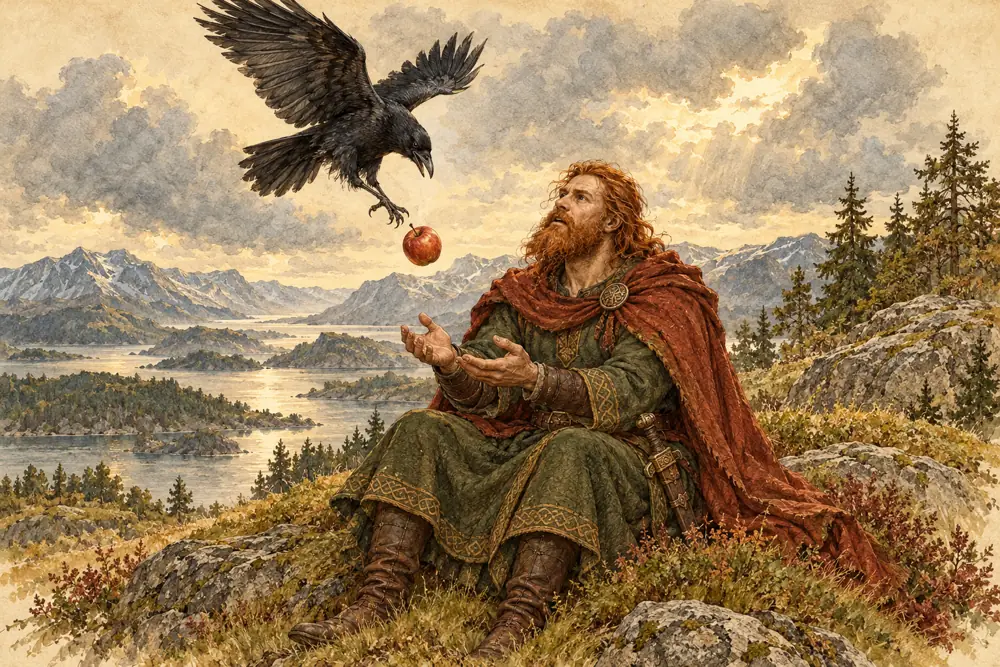
Rerir has secured his father’s kingdom through violent conflict and acquired wealth, but he and his wife have no child. They pray intensely to the gods. In the Old Norse text of Völsunga saga, Frigg hears their request and tells Odin about it. This division of action is worth preserving: the episode gives Frigg a listening and mediating role, while Odin arranges the response. It is also a useful reminder that the legendary family’s story begins with dependence and vulnerability, not only with weapons, victories and the strength of famous men.
The messenger in crow-shape
Odin gives an apple to his messenger, the daughter of the giant Hrimnir. She takes the shape of a crow and flies to Rerir, who is sitting on a mound. Dropping the fruit into his lap, she completes a delivery that crosses boundaries between divine, giant and human households. Rerir understands that the apple has a purpose and carries it home to his wife. The narrative moves directly from this encounter to her pregnancy. It does not identify the fruit as one of Idunn’s apples or say that it grants the couple immortality.
An extraordinary and difficult birth
The hoped-for pregnancy does not lead quickly to a happy birth. Rerir dies of sickness while away, and his wife remains pregnant for six years in the saga’s marvelous chronology. Finally, believing that she cannot live much longer, she orders the child to be cut from her body. The boy is exceptionally large and is said to kiss his mother before she dies. He receives the name Volsung. These are features of heroic birth legend, not evidence for a medically possible pregnancy or a historical account of obstetric practice.
The messenger returns to the family
When Volsung grows up, Hrimnir sends him the same daughter who carried the apple, named Hljod in modern transliteration. She becomes his wife, and their children include the twins Sigmund and Signy. The supernatural messenger is therefore woven into the lineage she helped make possible. A further caution concerns the accessible nineteenth-century English translation: Morris and Magnússon print Freyja where the Old Norse text names Frigg, and also distribute the sending differently. This retelling follows the Old Norse naming and sequence at that point rather than silently repeating the older English wording. The mismatch is a translation problem to make visible, not grounds to invent a separate adventure for two goddesses. The episode gives the family a divine beginning while refusing an uncomplicated promise that answered prayer removes suffering. Rerir’s queen obtains the child she wanted, yet the narrative does not spare either parent.
Read behind the retelling
Sources & limits
The Old Norse text names Frigg, who tells Odin; the Morris–Magnússon translation prints Freyja in this passage. This account follows the Old Norse. The prolonged pregnancy is legendary, not medical information, and the apple is not identified as Idunn’s.
- Völsunga saga, chapter 2 — Old Norse text
- Völsunga saga, chapter 2 — Morris and Magnússon translation, with its differing goddess-name noted
Retold in contemporary English. Dialogue is summarized, not presented as a translation. How to read our sources and versions.
Another thread to follow
2 min read
Odin’s contest of wisdom
Odin tests Vafthrúðnir in a contest that moves from the structure of the cosmos to a secret only Odin can know.
Read the story ↗
2 min read
The death of Baldr
Frigg tries to protect Baldr from every danger, but Loki finds the one promise she did not obtain.
Read the story ↗
2 min read
Loki’s quarrel at Ægir’s feast
Loki enters the gods’ feast and attacks one guest after another in a formal exchange of insults.
Read the story ↗