
Creatures
Jörmungandr
The serpent encircling Midgard
Jörmungandr, also called the Midgard Serpent, is one of Loki and Angrboda’s children in Snorri’s account. Odin casts the serpent into the ocean, where it grows until it surrounds the inhabited world and grasps its own tail.
Explore the stories ↓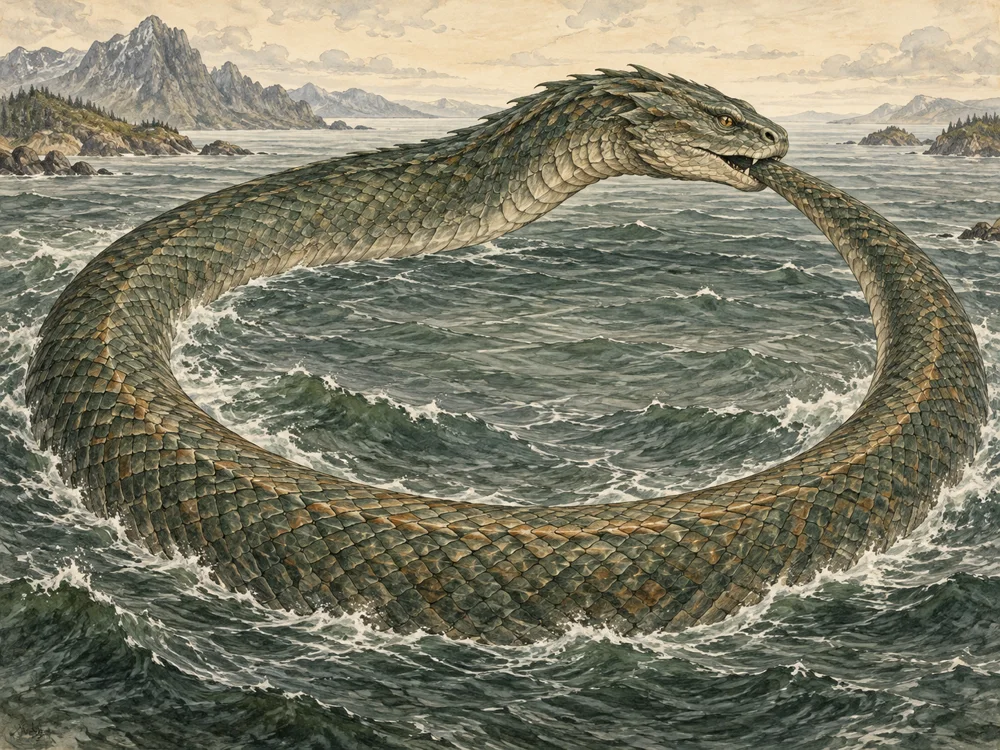
Three encounters with Thor
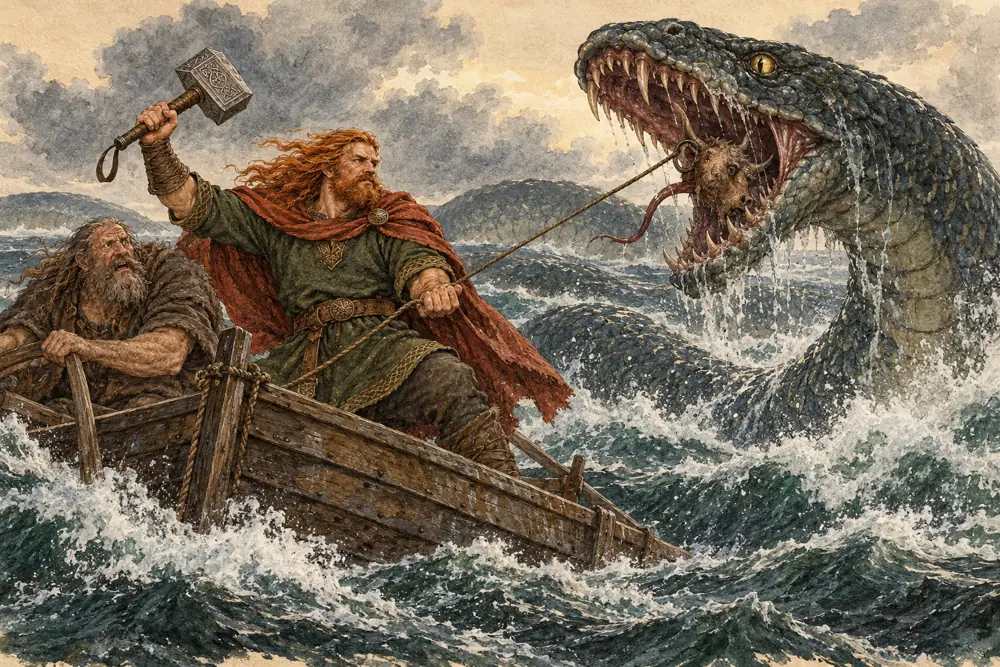
The serpent appears disguised as a cat in the tests arranged by Utgarda-Loki. Thor manages to raise one paw, a frightening achievement once the animal’s true identity is revealed. On the fishing expedition with Hymir, Thor uses an ox’s head as bait and draws the serpent towards the surface. The surviving accounts do not tell the ending in exactly the same way.
The end of the enclosure
At Ragnarök the serpent leaves the sea, disturbing the waters and spreading venom. Thor kills it, but walks only nine steps before dying from its poison. This mutual destruction is one of the clearest examples of a divine victory that cannot save its victor. The serpent belongs to the mythic geography of the world as well as to Thor’s adventures.
The cat that almost reached the sky
At Útgarða-Loki’s court, Thor is asked to lift what appears to be an ordinary cat. He gets only one paw off the ground and seems to have failed a humiliatingly simple task. Outside the stronghold, his host explains the deception: the cat was the Midgard Serpent. Thor had raised it so high that its body almost reached the sky. The spectators were frightened, not amused. This scene gives Jörmungandr a role before the final battle: its immense body can become a measure of Thor’s astonishing strength, even when the contest is disguised and the achievement goes unrecognized.
Two accounts of the fishing expedition
The serpent’s fishing encounter survives in more than one form. In Hymiskviða, Thor strikes it with his hammer and the creature sinks back into the sea. Snorri tells a more elaborate story in which Hymir cuts the line at the crucial moment; he also acknowledges disagreement over whether Thor’s hammer struck the serpent’s head. These are not details that should be silently combined into one supposedly definitive ending. Both versions make the sea itself a dangerous meeting place between Thor and an enemy larger than the human world. Snorri maintains that the serpent remains alive, allowing the final mutual destruction at Ragnarök to follow.
Read behind the retelling
Sources & limits
The fishing story has variants; do not present one ending as the only surviving account.
- Prose Edda: Gylfaginning (Brodeur, 1916)
- Poetic Edda: Hymiskviða (Bellows, 1923)
- Poetic Edda: Völuspá (Bellows, 1923)
- Prose Edda: Gylfaginning, Brodeur translation (1916)
- Poetic Edda: Hymiskviða, public-domain Bellows translation
Retold in contemporary English. Dialogue is summarized, not presented as a translation. How to read our sources and versions.
Follow the thread
Stories & related reading: Jörmungandr
4 min read
Thor’s fishing expedition
Thor rows beyond the usual fishing grounds with Hymir and hooks Jörmungandr. The surviving accounts do not agree on every detail.
Read the story ↗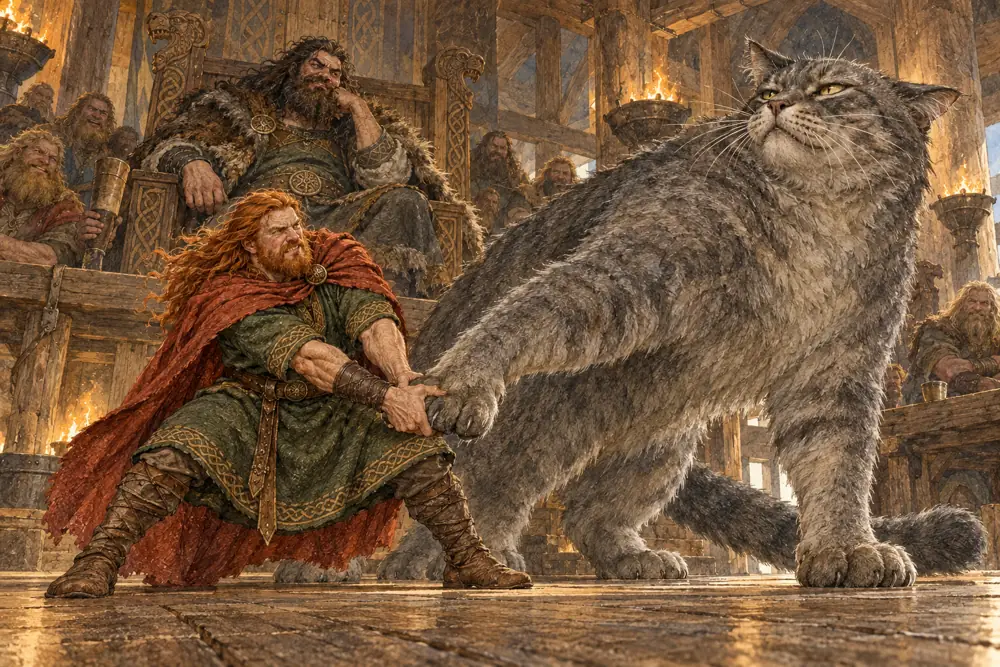
4 min read
Thor at Útgarða-Loki’s hall
Thor and his companions fail a series of apparently simple tests—until their host reveals what they were really facing.
Read the story ↗
3 min read
Ragnarok: the breaking of the world
The end approaches through broken human bonds and broken cosmic restraints. The surviving texts also imagine a world that rises after the disaster.
Read the story ↗