
Jötnar & kin
Aegir
A sea figure whose hall hosts the gods
Aegir is linked with the sea, wonderful feasts and the telling of myth. He is closely connected with the gods without fitting tidily into every list of the Æsir.
Explore the stories ↓
The guest who becomes a host
In Skáldskaparmál, Aegir visits the gods and hears Bragi explain the stories behind poetic language. Elsewhere he hosts a feast whose hall is lit by bright gold rather than ordinary fire. The narrative turns a magnificent setting into an explanation for poetic expressions that call gold the fire of the sea.
Hospitality under pressure
Hymiskviða centres on obtaining a huge kettle for brewing, while Lokasenna places Loki’s destructive verbal contest at Aegir’s feast. His wife is Rán, and their nine daughters are associated with waves. The family shows how the sea can be imagined as both a place of abundance and a dangerous power. Calling Aegir simply a friendly party god would lose that wider association, while calling him merely an enemy giant would lose his repeated hospitality.
The enormous kettle that makes a feast possible
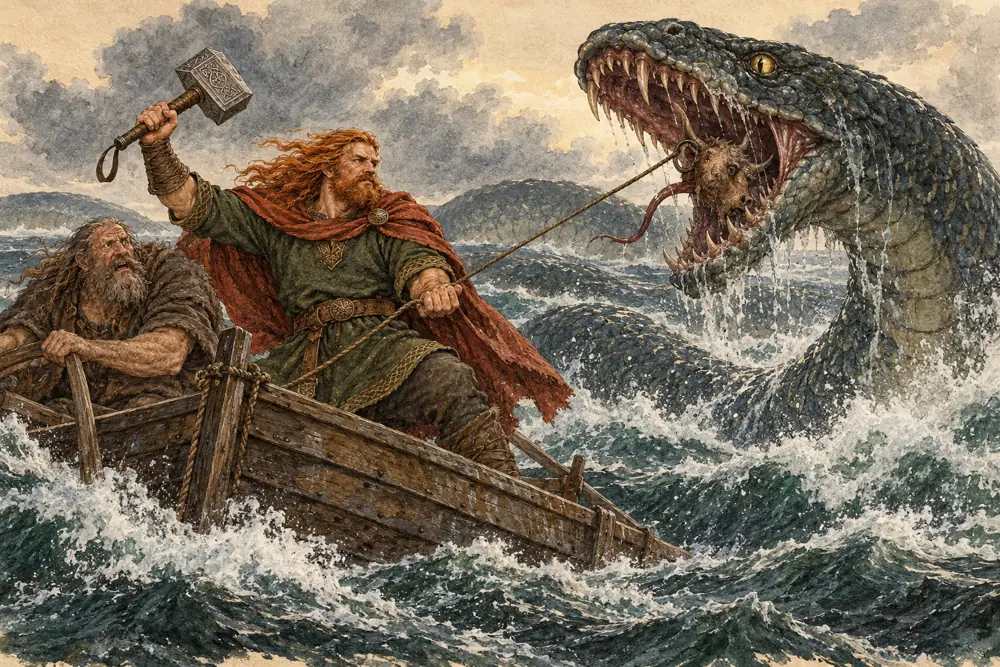
In Hymiskviða, the gods expect Ægir to provide a feast, but the preparations become an enormous undertaking. Thor demands ale, and Ægir requires a kettle large enough for the company. Tyr knows of such a vessel in Hymir’s possession, so he and Thor set out to obtain it. The journey leads to Thor’s fishing encounter with the Midgard Serpent and further tests in Hymir’s hall. Thor finally carries the kettle away despite pursuit. Ægir is therefore the reason for the expedition even though Hymir and Thor occupy most of the poem’s action: hospitality depends on an object that must first be won.
The servant killed before the insults
Lokasenna begins by praising Ægir’s capable servants, Fimafeng and Eldir. Loki cannot tolerate the admiration directed at them and kills Fimafeng. The gods drive him away, but he returns, questions Eldir outside and then forces his way back into the gathering. The famous insults are thus not a harmless drinking game that suddenly becomes impolite. A killing has already broken the peace of the host’s household. Ægir’s brilliant hall, effortless service and abundant drink form a setting of order that Loki deliberately damages. Reading the opening makes the hostility inside the feast far easier to understand.
Read behind the retelling
Sources & limits
Aegir’s relationship to divine and giant categories is not captured by one rigid label. He is not another name for Njord.
- Skáldskaparmál, opening dialogue and chapter 33
- Hymiskviða
- Lokasenna, prose introduction
- Hymiskviða; Bellows
- Lokasenna, prose introduction and opening dialogue
Retold in contemporary English. Dialogue is summarized, not presented as a translation. How to read our sources and versions.
Follow the thread
Stories & related reading: Aegir
4 min read
Thor’s fishing expedition
Thor rows beyond the usual fishing grounds with Hymir and hooks Jörmungandr. The surviving accounts do not agree on every detail.
Read the story ↗
2 min read
Loki’s quarrel at Ægir’s feast
Loki enters the gods’ feast and attacks one guest after another in a formal exchange of insults.
Read the story ↗
2 min read
The mead of poetry
The blood of Kvasir passes through murder, bargaining and deception before the poetic mead reaches the gods.
Read the story ↗