
Gods & companions
Gefjon
The plough that draws an island from the land
Gefjon’s best-known story explains the formation of Zealand through a colossal act of ploughing. It joins a king’s promise, transformed sons and the reshaping of geography.
Explore the stories ↓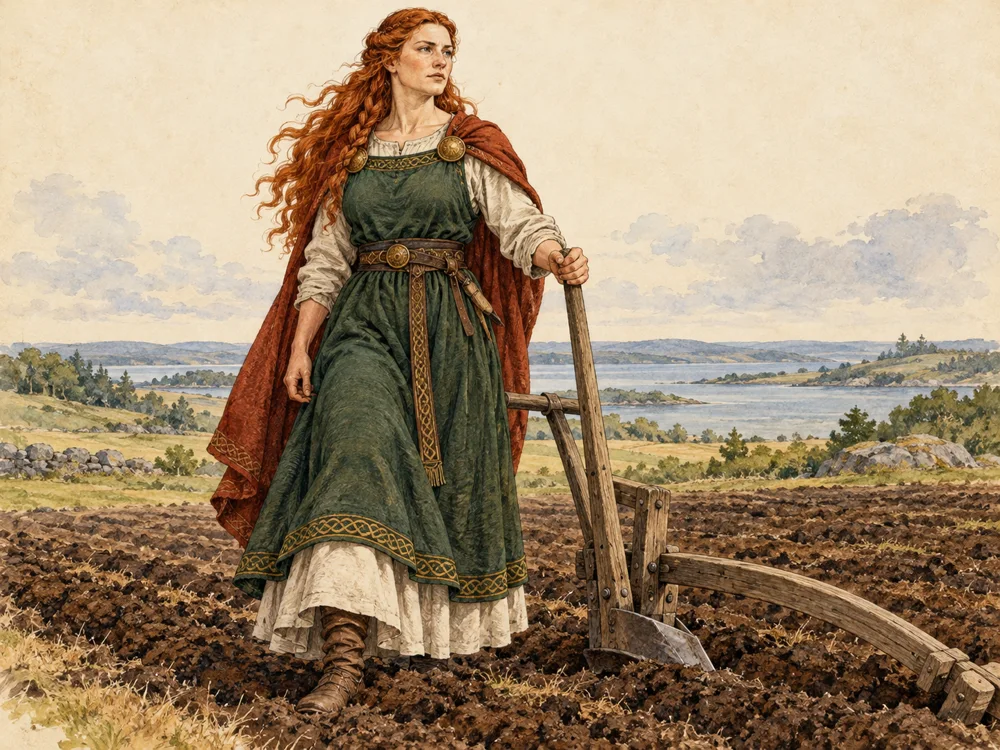
A gift measured by a day’s work
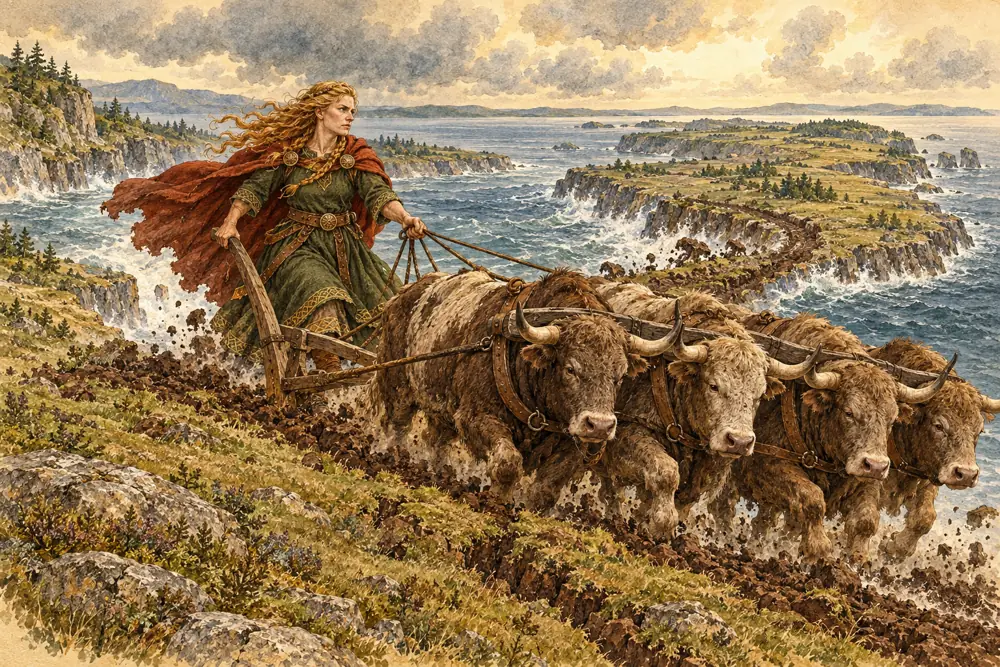
At the opening of Gylfaginning, King Gylfi gives a travelling woman as much land as four oxen can plough in a day and a night. She is Gefjon. Her oxen are her sons by a giant, and their strength makes the gift far larger than the king could have expected. They pull the land away into the sea, where it becomes the island called Selund, Zealand.
A landscape remembered through myth
The place left behind becomes a lake in Sweden. The story links the shapes of land and water through a memorable physical action rather than a geological explanation. Snorri quotes a verse attributed to Bragi, showing how a prose account can preserve and interpret older poetry. The event belongs to mythic geography, not documented engineering or historical migration.
An unresolved contrast
Later in Gylfaginning, Gefjon is described as a maiden attended by women who die unmarried. That description does not fit neatly with the four sons in the opening narrative. It is better to acknowledge the difference than invent an explanation that the source never gives. Her surviving profile is an example of why mythology should not be forced into a perfectly consistent encyclopedia.
A new island becomes a royal home
Ynglinga saga places Gefjon’s great ploughing feat within Odin’s legendary movement toward the north. He sends her across the sound to seek land. After obtaining Gylfi’s grant, she goes to Jötunheim, bears four sons to a giant and changes them into oxen. They pull the land into the sea, and Gefjon settles on the resulting island. The saga then supplies a continuation absent from the opening scene of Gylfaginning: she marries Odin’s son Skjöld, and they live at Lejre. The island-making story thus becomes connected with Danish royal origins. This is legendary genealogy and geography, not a documentary account of Denmark’s foundation.
She tries to stop the quarrel
At Ægir’s feast in Lokasenna, Gefjon intervenes when bitter words threaten the company’s peace. Her attempt brings Loki’s attack upon herself: he alleges an encounter involving a handsome youth and a necklace. Odin then warns Loki against provoking her, saying that she knows people’s destinies as he does. The exchange gives Gefjon a speaking role and an association with knowledge beyond her ploughing story. It does not preserve the full episode behind Loki’s allegation. His hostile words should therefore remain an accusation inside a quarrel, not become a newly invented romance or a proven account of her behavior.
Read behind the retelling
Sources & limits
The land-ploughing story and the later description of Gefjon as a maiden do not fit neatly together. The source does not resolve the tension.
Retold in contemporary English. Dialogue is summarized, not presented as a translation. How to read our sources and versions.
Follow the thread
Stories & related reading: Gefjon
2 min read
Gefjon ploughs an island
A king offers land for one day’s ploughing, and Gefjon arrives with a team capable of moving a country.
Read the story ↗
2 min read
Loki’s quarrel at Ægir’s feast
Loki enters the gods’ feast and attacks one guest after another in a formal exchange of insults.
Read the story ↗