
A Norse story · 2 min read
Gefjon ploughs an island
The furrow that became Zealand
A king offers land for one day’s ploughing, and Gefjon arrives with a team capable of moving a country.
A measured gift
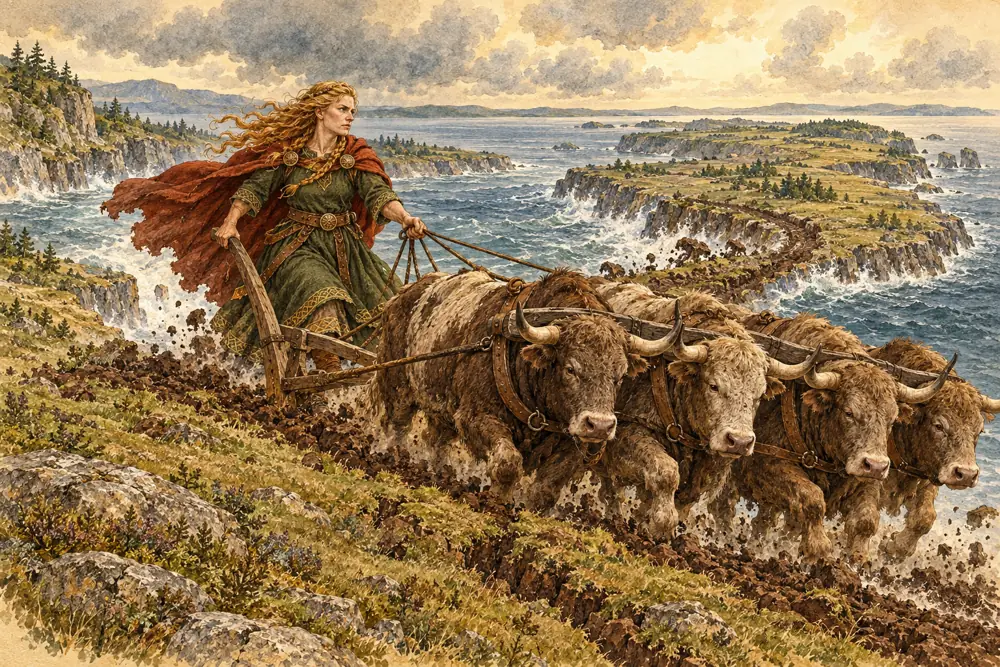
Gylfaginning opens with King Gylfi of Sweden giving a wandering woman as much land as four oxen can plough in a day and a night. She is Gefjon, a member of the divine company. At first the bargain sounds like a generous but limited grant. Its measure is ordinary agricultural work: a team, a plough and a fixed amount of time. The surprise lies in the power concealed within those familiar terms.
Four extraordinary oxen
Gefjon brings four oxen from Jotunheim. They are her own sons by a giant, taking the form of the animals needed for the task. The plough cuts so deeply that it separates a huge piece of the land itself. The team drags that land out to sea and westward, where Gefjon settles it as the island called Selund, modern Zealand in Denmark. This is the large Danish island, not the similarly named country New Zealand.
A lake where the island stood
Water fills the place from which the land was removed. The text calls the resulting Swedish lake Lögr and explains its bays as matching the island’s headlands. Snorri reinforces the account with a verse attributed to Bragi the Old, describing the labour of the four-headed, eight-eyed team. The verse and prose together make geography memorable through an image of immense physical work. They are mythic explanations of the landscape, not evidence that the island actually broke away from Sweden.
Two settings for the same feat
Ynglinga saga tells a related version in its account of Odin’s movement north. There Gefjon is sent to seek land, and her later association with Skjöld and Lejre places the episode within a royal origin story. Gylfaginning instead uses it to lead into Gylfi’s curiosity about the gods and their powers. The feat remains recognisable, but its literary purpose changes with its setting. Neither version requires us to invent a complete series of Gefjon adventures: this unusually vivid surviving story is already substantial in its own right.
Read behind the retelling
Sources & limits
The lake and island belong to a mythic landscape explanation. Do not treat the story as geological history or assume every detail has a single geographical identification.
Retold in contemporary English. Dialogue is summarized, not presented as a translation. How to read our sources and versions.
