
A Norse story · 2 min read
Groa’s spells and Svipdag’s journey
Two linked poems at the border of myth and romance
A son calls on his dead mother for protection before a difficult journey. A companion poem brings him to the guarded home of Menglod.
A call at the grave
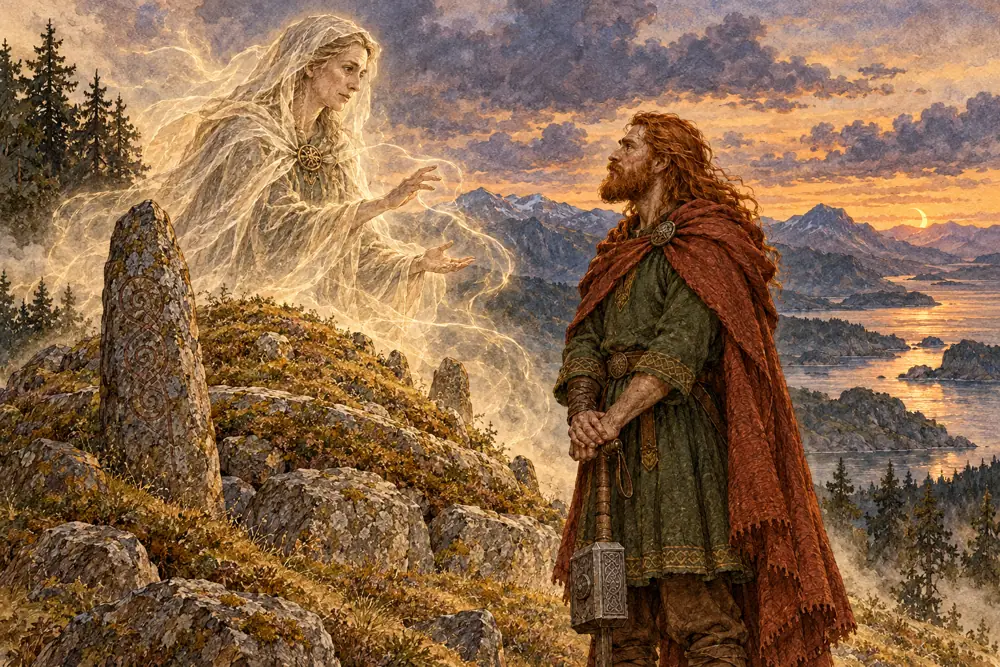
In Grógaldr, a young man calls to his dead mother, Groa, at her burial place. His stepmother has set him the daunting task of seeking Menglod. Before her death, Groa told him to ask for help if he needed it; he now does so. She answers and gives him a sequence of protective spells. They address the hazards of a journey: loss of direction, dangerous waters, enemies, imprisonment, cold, darkness, and a contest of words. The poem’s emotional centre is the help a mother can still offer after death. It does not narrate every stage of the journey that follows.
Questions at a guarded entrance
Fjölsvinnsmál opens with a traveller confronting a watchman at a remarkable enclosure. The traveller initially gives a disguised name and asks questions about gates, guardians, a great tree, a bird, and the difficult means of passing the defences. The answers create an elaborate landscape through dialogue rather than continuous action. He learns about Menglod and the women attending her, including a figure named Eir. The presence of that name does not by itself prove that every detail describes the same Eir whom Snorri lists among goddesses. Similar names and possible connections are not identical to secure identification.
The name that opens the way
After the exchange has established that ordinary force or cunning cannot easily enter, the traveller asks who may come to Menglod. The answer is Svipdag. He reveals that this is his own name, and the situation changes. Menglod welcomes him; their long separation gives way to reunion. The resolution depends less on winning a battle than on finally declaring the identity for which the place has been waiting. The poem offers the meeting, but not a detailed account of every adventure between the mother’s spells and the guarded gate.
Why the pairing needs a label
Editors commonly bring Grógaldr and Fjölsvinnsmál together under the title Svipdagsmál because their figures and situations fit a connected story. They survive in later paper manuscripts, and their dates, relationship, and interpretation require caution. It would be misleading to advertise this as an intact Viking Age adventure recovered scene by scene. Nor should Groa’s role here be casually combined with the different episode in which a woman of that name chants over Thor’s injured head. The paired poems are worth reading as a distinctive mythic romance, with a powerful mother-and-son opening and a question-driven reunion, while leaving the uncertain connections explicitly uncertain.
Read behind the retelling
Sources & limits
Mythic romance preserved in later manuscripts. The editorial pairing and identities of overlapping figures are not wholly secure; this is not Thor’s whetstone story.
Retold in contemporary English. Dialogue is summarized, not presented as a translation. How to read our sources and versions.