
A Norse story · 2 min read
The Norns at Helgi’s birth
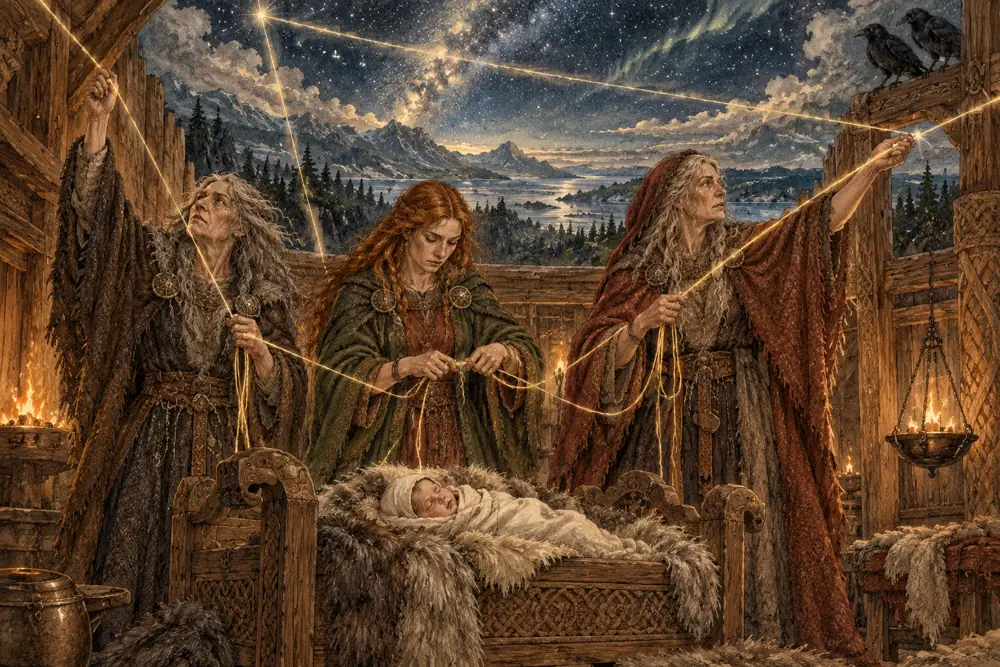
Golden strands stretch from a newborn’s house into the sky.
The First Lay of Helgi Hundingsbane opens with the Norns shaping a child’s future. Its brilliant promises of greatness are accompanied by ravens already anticipating the violence of his career.
A birth described on a heroic scale
Helgi is born to Borghild and Sigmund in a place the poem calls Bralund. The opening does not offer the quiet domestic details of an ordinary birth account. Eagles cry, streams descend from heavenly heights and supernatural visitors arrive during the night. The Norns shape the newborn’s life, declaring that he will become an exceptionally celebrated fighter and prince. This is the opening of heroic poetry: its enlarged landscape and promises tell the audience what sort of story is beginning, not what a chronicler observed beside a historical cradle.
The golden strands
The poem imagines the Norns making powerful strands of fate, fixing golden threads in the sky and extending their ends east and west. The hero’s land lies between them, while a Norn described through a kinship expression casts a strand toward the north and commands it to remain firm. The details turn an invisible future into something almost architectural, stretched and secured around the child. Translators differ in how they render this compressed textile and spatial imagery. The scene does not provide a complete diagram of destiny or tell us how to reproduce its work.
Ravens hear a different promise
Immediately after the Norns’ activity, ravens speak about the new child. They see sharp eyes and imagine a warrior already equipped for battle when scarcely born. Their enthusiasm casts a shadow across the magnificent prophecy: a future friend of wolves will provide food for scavenging creatures. The poem then gives the child his name, possessions and a place among his people. He grows into the generosity and violence expected of a heroic ruler, eventually fighting Hunding and the men who seek vengeance afterward. The promised greatness is inseparable from the deaths that make such renown possible.
What this tells us about the Norns
This episode is valuable because it shows Norns acting at a particular person’s birth rather than simply listing three familiar names beneath the world-tree. The poem does not identify the visitors here as a neat, individually named trio corresponding to past, present and future. Importing that arrangement would make the scene look more systematic than it is. Nor should a later painting of three women be treated as an eyewitness illustration of the poem’s setting. The story presents fate through poetic action: visitors arrive, threads are extended and a human future is assigned. Yet the verses do not require readers to admire that future without reservation. Beside the splendor of golden strands, the waiting birds remind us that one person’s fame may mean another household’s grief. Helgi’s beginning is triumphant and ominous at the same time.
Read behind the retelling
Sources & limits
This follows Helgakviða Hundingsbana I, especially stanzas 1–10. The birth-scene Norns are not individually identified as Urðr, Verðandi and Skuld; do not impose a fixed three-person cast on the passage.
Retold in contemporary English. Dialogue is summarized, not presented as a translation. How to read our sources and versions.