
Journeys & Encounters · Introduction
Norse Orkney: Houses, Earlier Neighbors, and a Boat Grave
In Brief
Birsay and Scar offer two different views of settlement in an already inhabited island world.
Orkney, Scotland · Ninth–eleventh centuries, with Pictish context
On this page
A landscape with an earlier populationReading rebuilt housesThe boat burial at ScarObjects arranged around the deadSourcesA landscape with an earlier population
At the Brough of Birsay, Norse settlement followed a Pictish community. Historic Environment Scotland dates the earlier remains to the seventh and eighth centuries and Norse buildings to the ninth through eleventh. The site’s later church belongs to another phase. Keeping these layers separate prevents the whole visible ruin from becoming one imagined Viking village. It also makes clear that newcomers entered an inhabited landscape with existing centers of status and craft activity.
Reading rebuilt houses
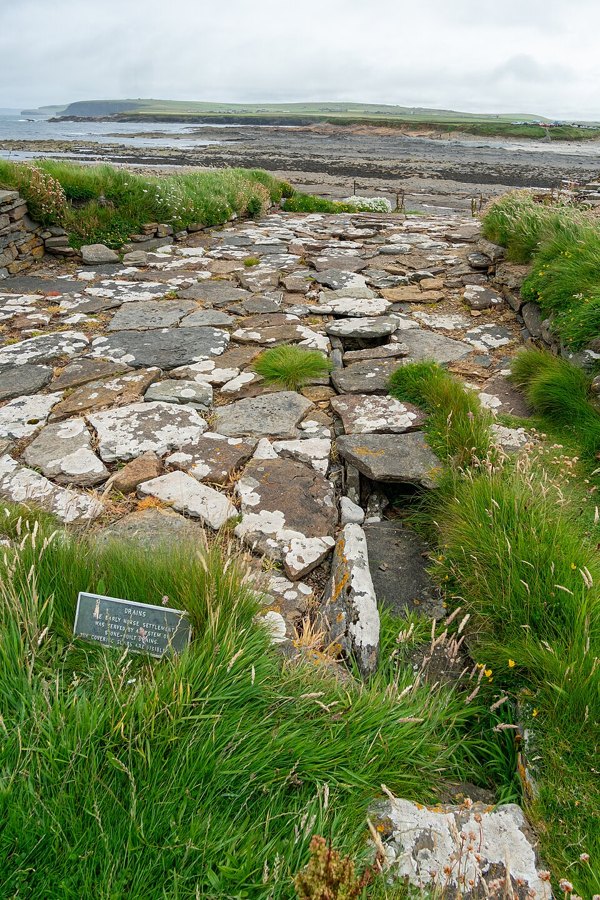
Norse occupation began at Birsay in the early ninth century. Repeated construction produced walls that overlap and replace one another. Houses and barns survive as archaeological remains, alongside proposed identifications of a smithy and other specialized spaces. Pictish objects found in Norse houses raise a harder question: did they pass through peaceful exchange, continued occupation, inheritance, or force? The finds establish contact between material traditions more securely than they establish the circumstances of that contact.

The boat burial at Scar
On Sanday, coastal erosion exposed a very different context: a boat grave excavated in 1991. The vessel’s wood had decayed, but more than 300 iron rivets helped outline a boat approximately 6.5 meters long. A stone-lined pit contained the remains of a man, a woman, and a child. Objects and radiocarbon evidence placed the burial between about 875 and 950. This was a particular funerary event, not a model for how all Norse inhabitants of Orkney were buried.
Objects arranged around the dead
The Scar burial contained a sword, arrows, gaming pieces, combs, textile equipment, and an elaborately carved whalebone plaque. Their placement allows careful study of the burial’s organization. It does not by itself prove the precise relationships among the three people or explain why they died. Compared with Birsay’s rebuilt houses, Scar shows the difference between evidence left during repeated daily activity and objects deliberately selected for a grave. Both are necessary, but they answer different questions about island society.
The Evidence
The sources below support this article. Interpretations and limits are explained in the text; this is not an exhaustive research review.