
Journeys & Encounters · Deep dive
The Scar Burial: Three People in a Boat
In Brief
A carefully arranged grave on Sanday brings together an older woman, an adult man, a child, and objects with histories of their own.
On this page
Recognizing a grave before the coast took itTurning a boat into a burial chamberThree individuals, incomplete biographiesA plaque with an earlier historyObjects selected for remembranceThe landscape around the graveSourcesRecognizing a grave before the coast took it
The Scar burial on Sanday entered archaeological investigation through the recognition of a few exposed remains. Orkney Islands Council's account of archaeologist Julie Gibson's work recalls human bones eroding from the shore and a boat rivet that helped identify their setting. Her earlier experience with Viking burials at Westness on Rousay was important in recognizing what the fragmentary evidence might represent.
The resulting rescue excavation recovered a sword, arrows, an elaborate brooch, and the carved whalebone object now known as the Scar plaque. The urgency proved justified: storms subsequently destroyed that section of coastline. Without timely investigation, the surviving objects would have lost both their physical integrity and their relationships to the grave. Scar is therefore a case in which archaeological knowledge depended on interpreting modest clues quickly. The importance of the burial became clear through recording its arrangement, not simply through collecting its most visually impressive object.
Sources for this section: 1
Turning a boat into a burial chamber
Magnar Dalland's excavation account describes a boat approximately six and a half meters long, represented principally by rivets marking its planks. It lay east–west along the shoreline. Around half had already disappeared through erosion, leaving the southern portion behind the beach face. The surviving outline nevertheless allowed investigators to reconstruct the vessel's size and arrangement with much greater confidence than an isolated collection of fastenings would permit.
A vertical flagstone divided the interior. Stones filled the eastern compartment, approximately one-third of the vessel's length, leaving a chamber in the west for three bodies. The man lay at the western end with bent legs; the woman and child lay beside one another farther east. The physical partition shows deliberate adaptation of a working vessel for burial. Its role was more specific than providing a large wooden container: the mourners organized an internal space and arranged people and objects within it.
Sources for this section: 2

Three individuals, incomplete biographies
A. C. Johnson's Oxford study of diet and health in early medieval Orkney summarizes the Scar group as a middle-adult male, an older-adult female, and a child approximately ten years old. Coastal erosion had removed parts of each skeleton, while otter activity disturbed the woman's remains. These different forms of loss affect how confidently objects and skeletal elements can be assigned to individuals.
The adult assemblages included distinct combinations of equipment. Weapons, a comb, and gaming pieces accompanied the man; the woman was associated with a whalebone plaque, a spindle whorl, shears, needles, and fittings from a wooden box. Johnson's wider examination also identified joint disease in the woman's surviving knees. Such evidence adds bodily experience to the formal display of the funeral, but it cannot reconstruct a complete working life. Burial equipment and skeletal changes answer different questions, and neither provides the names or precise relationships of the people placed together in the boat.
Sources for this section: 3
A plaque with an earlier history
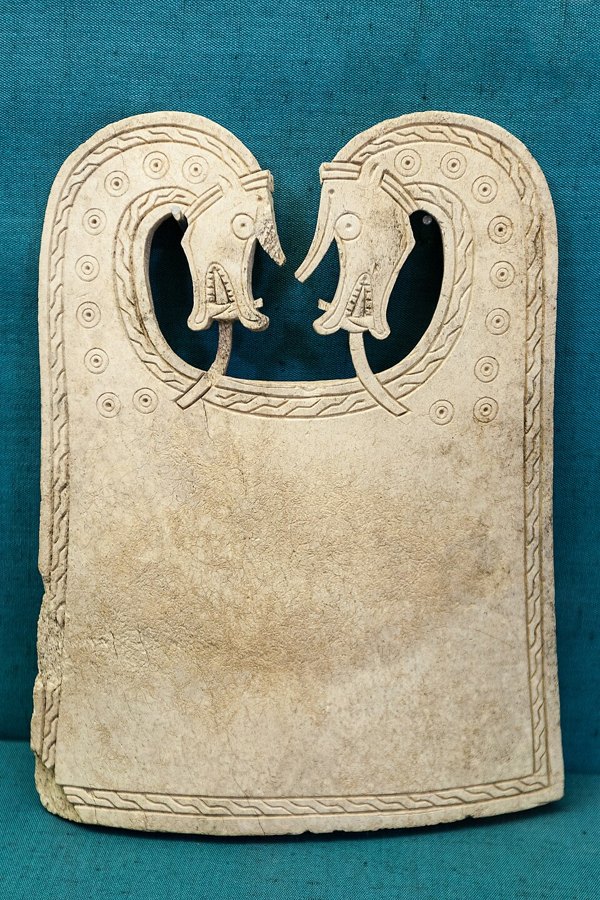
Orkney Museum dates the Scar whalebone plaque's manufacture to approximately 750–850 and considers it almost certainly Norwegian work. Two stylized animal heads turn inward at the top. Geometric bands run around the edges, while ring-and-dot decoration fills spaces between the ornament and the animals' curving necks. The precision of the carving identifies a skilled maker working a material that could carry elaborate decoration.
Plaques of this type have often been interpreted as boards for smoothing small textiles with a glass tool. The Scar example shows little wear, however, leading the museum to emphasize possible symbolic value over frequent practical use. This distinction makes the object's biography particularly interesting. Its manufacture need not coincide with the funeral in which it was eventually deposited, and an apparent household implement might also communicate standing or inherited connections. The proposed Norwegian origin concerns the object; it does not independently establish the woman's birthplace.
Sources for this section: 4
Objects selected for remembrance
Olwyn Owen's reassessment draws attention to details that complicate a straightforward inventory of wealth. The man's sword was already broken when buried, yet its pieces had been carefully held together in a light wooden scabbard bound with textile and lined with fleece. Owen argues that this arrangement may have concealed the break rather than displaying the destruction of a weapon during a public ritual.
Other objects also raised questions about age, condition, or completeness. The weaving batten was short and broken, the gaming pieces perhaps an incomplete set, and the plaque showed little evidence of use. Owen proposed that the assemblage could express attachment to older customs or possessions, while explicitly acknowledging alternative explanations. These are interpretations of a deliberately selected group, not proof of a known religious role. Scar's burial goods may tell us as much about remembrance and the choices of mourners as about equipment used together in everyday life.
Sources for this section: 5
The landscape around the grave
The Northern Isles maritime heritage project describes 310 recovered nails and rivets as the surviving trace of the boat's overlapping planking. It also examines a separate stone feature beside the burial. The grave pit cut into a spread of stones with a clear eastern edge, and parallel wall remnants were visible after excavation. This has been suggested as a boat shelter, or noust.
A later visit in 2018 found the feature difficult to identify after further erosion. The project also questions the interpretation because the rocky approach would have made hauling a boat into that location awkward. This surrounding evidence matters because the grave occupied an existing coastal landscape rather than an abstract ceremonial space. Yet an earlier structure cannot be assigned a maritime function solely because a boat burial lay beside it. Scar preserves an unusually rich funeral while leaving the associated settlement, the relationships among the dead, and the circumstances of their deaths open to further investigation.
Sources for this section: 6
For the introductory context, read Norse Orkney: Houses, Earlier Neighbors, and a Boat Grave.
The Evidence
The sources below support this article. Interpretations and limits are explained in the text; this is not an exhaustive research review.
- Orkney Islands Council: Julie Gibson and the recognition of Scar ↗
- Dalland excavation account in Historic Environment Scotland’s Scar record ↗
- Johnson 2021: Diet and health in a time of transition, Oxford thesis ↗
- Orkney Museum: Scar whalebone plaque collection record ↗
- Owen 2003: Curiouser and Curiouser—Mysteries of Tuquoy and Scar ↗
- New Connections Across the Northern Isles: Scar boat and possible noust ↗