
Journeys & Encounters · Place profile
Alt-Lübeck and Liubice: The Slavic Settlement before Lübeck
In Brief
Alt-Lübeck, medieval Liubice, occupied a river junction distinct from the later city center of Lübeck. Its ninth-century beginnings place it within the Viking-Age Baltic, although its best-known urban development and destruction belong to later centuries. Keeping those phases separate is essential.
Present-day location: Germany · Schleswig-Holstein
Names and search variants: Alt-Lübeck and Liubice · Alt Lübeck · Alt Lubeck · Liubice · Old Lübeck
Browse places by country →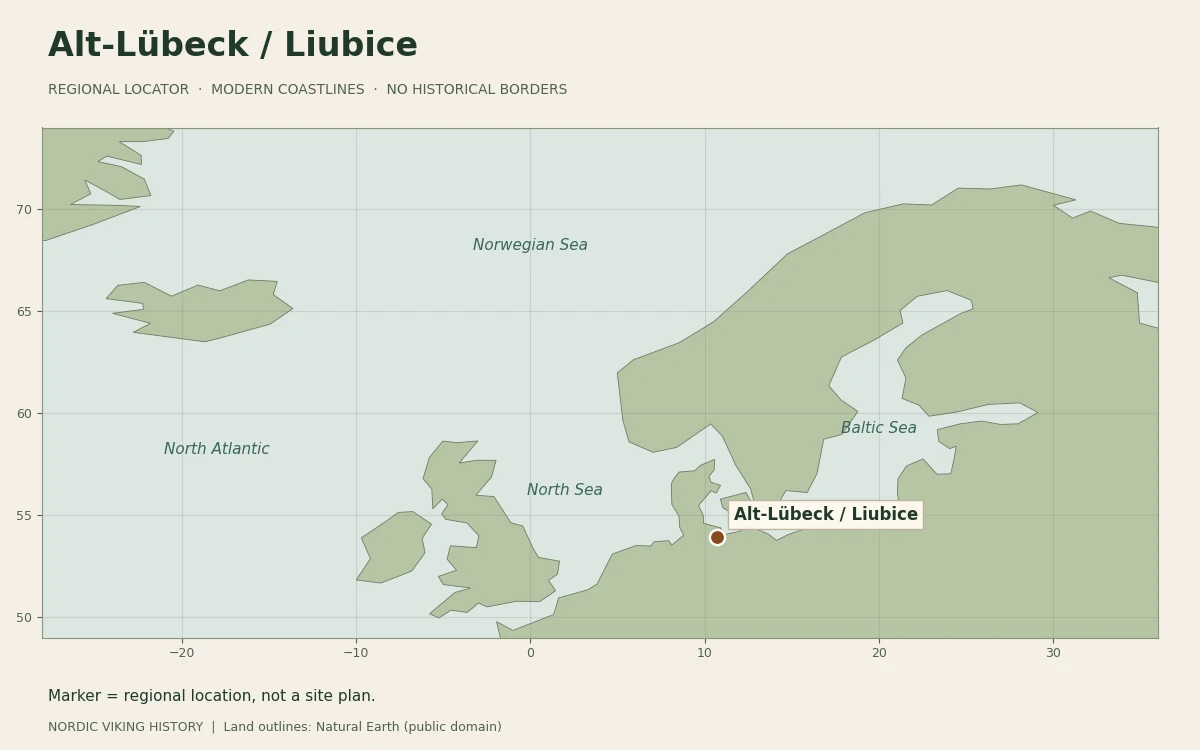
The historical setting
The settlement lay where the Schwartau meets the Trave. Archaeological evidence includes a ninth-century rampart, gate, and bridge to an outer settlement. Later Liubice developed into a prominent center with a stronghold, church, and merchant community. The modern city’s conventional foundation date of 1143 concerns a different location.
What the evidence shows
Lübeck’s archaeological service highlights material reflecting wide trade connections and a mixture of influences. The heritage foundation documents the surviving fortified site and later church foundations. These remains demonstrate a long history of settlement and institutional change, not a complete Viking town preserved exactly as it looked in the ninth century.
How to read this place
The comparison between Alt-Lübeck and later Lübeck helps explain why place-names can move. Commercial importance does not guarantee that one urban site remains dominant forever. Ask what shifted in access, political support, and settlement organization, while resisting a simple narrative in which one people vanished and another instantly replaced them. Archaeological sequences are usually more complicated than the transfer of a name.
Explore more Viking-Age places →
The Evidence
The sources below support this article. Interpretations and limits are explained in the text; this is not an exhaustive research review.