
Journeys & Encounters · Place profile
Anklam and the Peene Region: An Early Silver Hoard and Baltic Connections
In Brief
The early medieval Anklam region belonged to a network of settlements along the Peene, connected with Scandinavian trade through nearby Menzlin. A silver hoard discovered in 2008 offers a precise material starting point for exploring those connections without projecting the later town backward into the Viking Age.
Present-day location: Germany · Mecklenburg-Vorpommern
Names and search variants: Anklam and the Peene Region · Anklam · Peene · Anklam silver hoard
Browse places by country →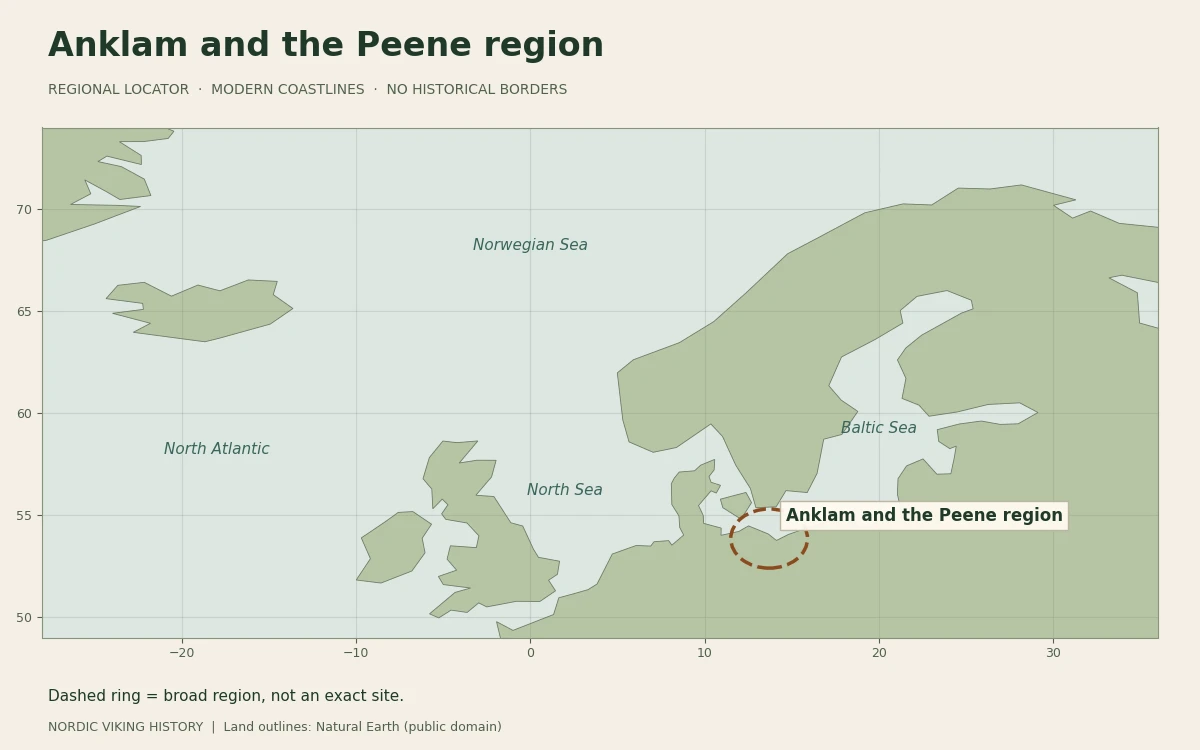
The historical setting
University of Greifswald research describes a deposit containing complete and cut Arabic coins, silver-bar fragments, and a substantial arm ring of a type associated with more easterly networks. Further investigation in 2010 recovered additional pieces. The combination illustrates silver moving across great distances before being stored in a local landscape.
What the evidence shows
The youngest coin identified in the initial discovery was minted in 817. That supplies an earliest possible date for deposition, not the exact year when the hoard entered the ground. Coins can circulate for years, and fragments may be valued by metal weight rather than by the political authority whose inscription they carry.
How to read this place
This is a good place to ask what a hoard can and cannot say about movement. A coin’s origin does not prove that its final owner visited the minting region. An arm ring may pass through exchange, gifts, inheritance, or seizure before deposition. The silver establishes connections across networks, while the depositor’s identity and reason for leaving it remain separate questions.
Explore more Viking-Age places →
The Evidence
The sources below support this article. Interpretations and limits are explained in the text; this is not an exhaustive research review.