
Journeys & Encounters · Place profile

Åsum: A Community Revealed by Its Cemetery

In Brief

Åsum east of Odense has yielded a substantial Viking-Age cemetery with unusually well-preserved skeletons. The discovery shifts attention from a few celebrated rulers to the people who lived in the countryside around an emerging town. Human remains can answer questions that rich objects alone cannot.

On this page

The historical settingWhat the evidence showsHow to read this placeSources

Present-day location: Denmark · Funen

Names and search variants: Åsum · Asum · Aasum

Browse places by country →
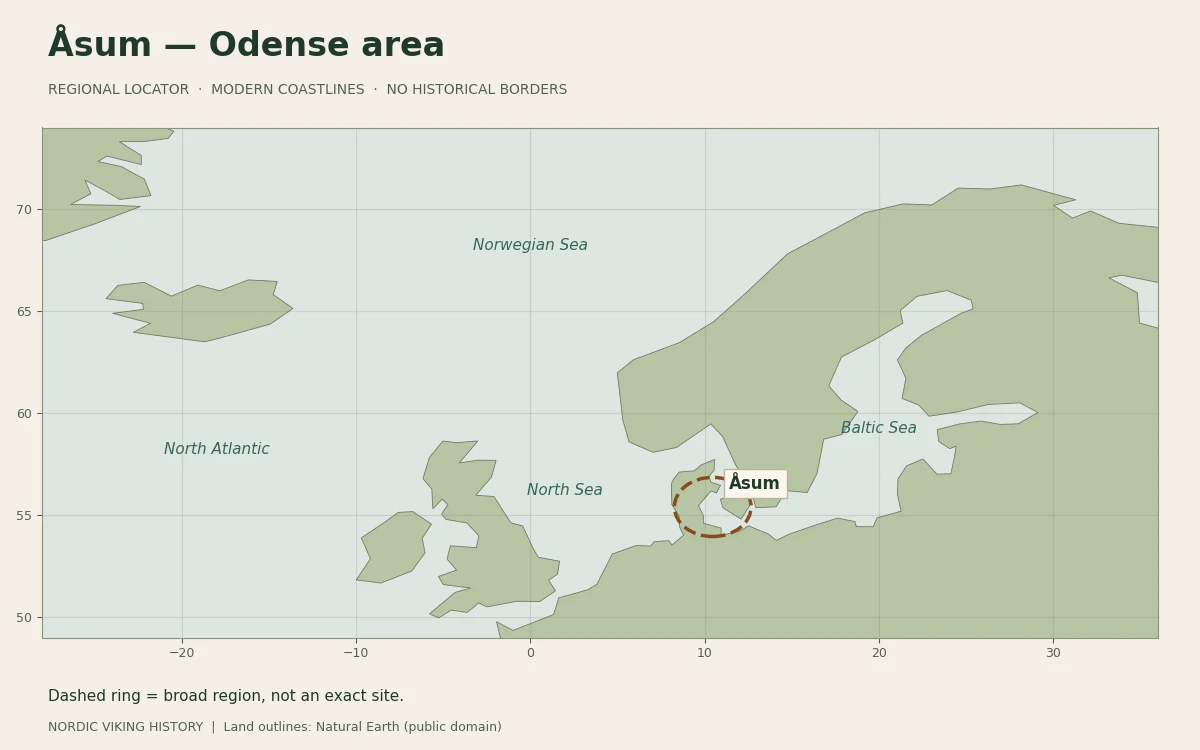
Regional locator map highlighting Åsum — Odense area against generalized modern coastlines.
Original geographic locator diagram with generalized modern land outlines; not a photograph, historical reconstruction or navigation map. The Åsum village area east of Odense, not the cemetery's individual graves or a namesake in Sweden. The Åsum village area east of Odense, not the cemetery's individual graves or a namesake in Sweden.Image: Nordic Viking History; base geography: Natural Earth · Base land data: public domain

The historical setting

Museum Odense reported fifty inhumation graves and five cremations in the investigated area, broadly dated to the ninth and tenth centuries. The cemetery was excavated ahead of infrastructure work. Those numbers describe the reported investigation, not a claim that every burial belonging to the community has been found.

What the evidence shows

The preservation offers opportunities to study health, diet, and geographic origins. Grave goods indicate connections extending beyond the immediate district. These are research possibilities and archaeological observations, not a completed genetic family tree or proof that every person traveled overseas. Imported material can move through several hands before reaching a grave.

How to read this place

Åsum is particularly useful for comparing neighboring communities with the growth of Odense. A rural burial ground need not be isolated simply because it lay outside the town. Ask how food production, exchange, kinship, and movement might connect them, then distinguish those questions from results actually established by analysis. The site’s importance comes partly from what careful future work can test, not just what can already be confidently stated.

Explore more Viking-Age places →

The Evidence

The sources below support this article. Interpretations and limits are explained in the text; this is not an exhaustive research review.

  1. Museum Odense: Åsum cemetery discovery ↗
FacebookPinterestXEmail

Places & evidence

Locations and coordinate sources

These points identify the places described in the source notes. A regional, historical or museum reference is not a surveyed entrance, parking place or guarantee of public access. Check the linked institution or visitor information before traveling.

Åsum

Exact location unknown

No exact archaeological feature coordinate is verified here. The existing broad locality illustration is not an object position, surveyed entrance or permission to enter.

No verified coordinate is supplied. No map pin or navigation destination has been invented.

Original findspot: No exact archaeological feature coordinate is verified here. The existing broad locality illustration is not an object position, surveyed entrance or permission to enter. Museum Odense

Current location: Museum excavation preceded power-grid works. The published archaeological report establishes the graves but not current public exposure or access. Museum Odense

Access information: No exact current archaeological visitor destination or specific-find display was verified. A tourism village route is not proof of access to excavated graves. Museum Odense

Location-source review: 2026-10-30. This is a source check, not a field survey.

Visitor / navigation point: Not yet verified. The reference coordinate above must not be treated as a current visitor destination.

Coordinate source: Museum Odense — Museum Odense: Åsum cemetery discovery ↗

Open Åsum in Interactive Viking Map →