
Journeys & Encounters · Place profile
Lindholm Høje: A Cemetery Preserved by Sand
In Brief
Lindholm Høje above the Limfjord is one of the clearest places to see burial monuments in a Danish landscape. Its hundreds of stone settings belong to a long sequence extending from the Late Iron Age into the Viking Age, not to a single simultaneous cemetery.
Present-day location: Denmark · North Jutland
Names and search variants: Lindholm Høje · Lindholm Hoje · Nørresundby · Norresundby
Browse places by country →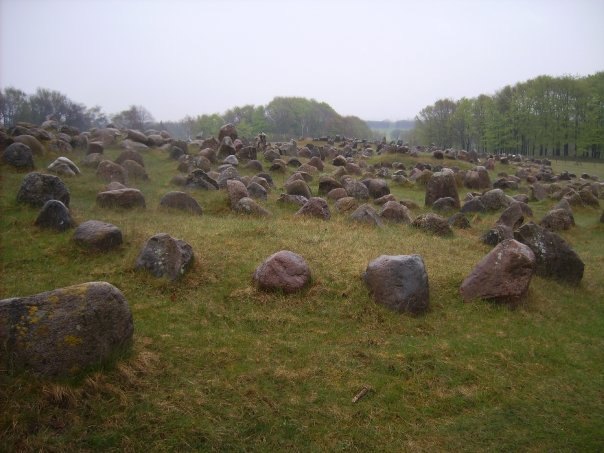

The historical setting
The location connects agricultural settlement with an important waterway. Museum interpretation emphasizes the people who cultivated nearby land and buried their dead here over generations. This was a community with a history, not simply a collection of warriors’ graves waiting to be turned into a dramatic Viking scene.
What the evidence shows
Excavation revealed nearly seven hundred cremation graves as well as inhumations. The stone settings take several forms, including triangular, oval, and ship-shaped arrangements. Windblown sand eventually covered the area and helped preserve both graves and settlement traces. Investigators also identified a cultivated field with wheel tracks, an unusually vivid survival of ordinary activity.
How to read this place
Read the monument forms together with their dates and excavated contents. A ship-shaped outline is not the same as an actual buried wooden ship, and its meaning cannot be assigned to one deity with certainty. The preserved field is a useful counterweight to the cemetery: the same landscape records both remembrance of the dead and the work required to support the living.
Explore more Viking-Age places →
The Evidence
The sources below support this article. Interpretations and limits are explained in the text; this is not an exhaustive research review.