
Journeys & Encounters · Place profile
Tissø: Halls, Wealth, and a Lake with Ritual Associations
In Brief
Tissø in western Zealand combines an elite settlement with a lake rich in archaeological and religious associations. Its long occupation runs from before the conventional Viking Age into the early eleventh century, making it a valuable place to investigate continuity and change in powerful households.
Present-day location: Denmark · Zealand
Names and search variants: Tissø · Tisso · Tyrs sø · Fugledegård · Fugledegaard
Browse places by country →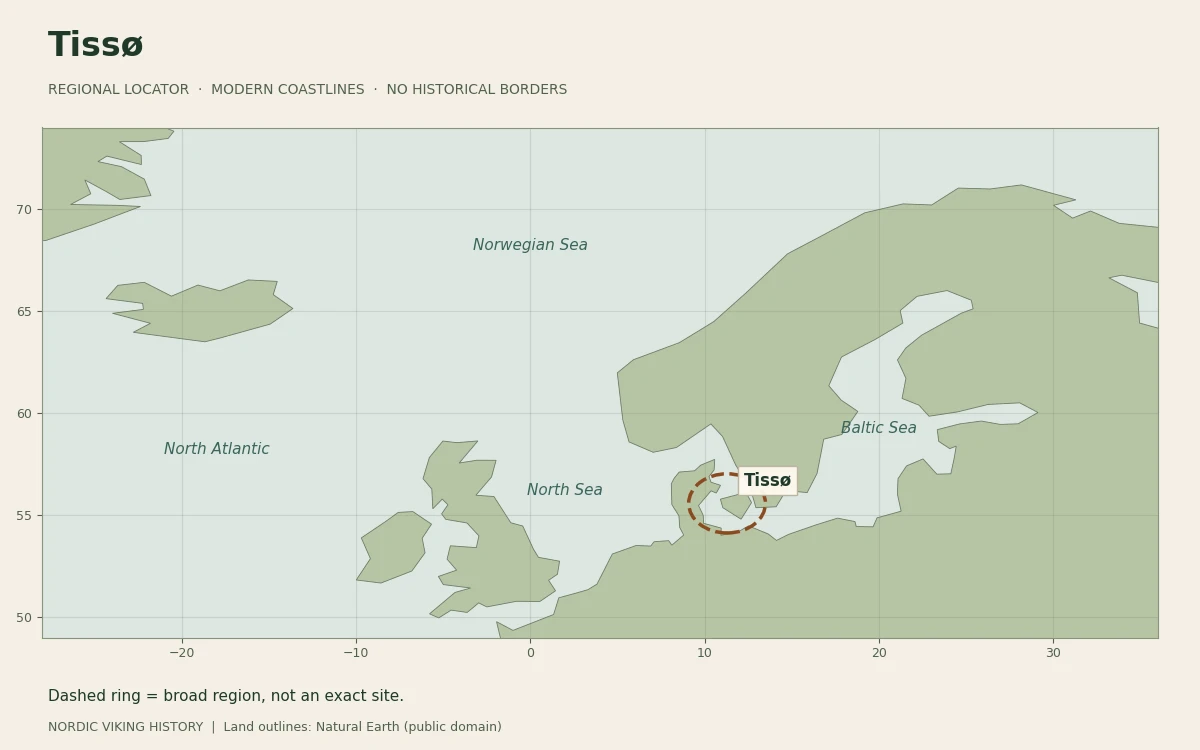
The historical setting
Large buildings and an enclosed estate suggest a residence capable of organizing substantial resources. A remarkable gold neck ring, found in 1977 and dated to the tenth century, helped bring attention to the area. Its wealth is striking, but the settlement’s structures and sequence are necessary for understanding the society behind the object.
What the evidence shows
Excavations identified buildings interpreted as connected with ritual activity. Weapons recovered from the lake and the place-name, traditionally linked with the god Tyr, contribute to discussion of the sacred landscape. Those strands are suggestive rather than a complete explanation of every deposit: neither an object in water nor a divine name gives us the words spoken at a ceremony.
How to read this place
The key question is how residence, assembly, exchange, and ritual could reinforce one another. An elite household might host gatherings without every building being a temple or every visitor a worshipper. Compare the evidence for each activity separately before combining them. This approach preserves the extraordinary character of Tissø while resisting the temptation to invent a fully documented sanctuary with a known priesthood and fixed ritual calendar.
Explore more Viking-Age places →
The Evidence
The sources below support this article. Interpretations and limits are explained in the text; this is not an exhaustive research review.