
Journeys & Encounters · Place profile
Baghdad: Rus Merchants in the Abbasid World
In Brief
Baghdad belongs at the far end of the Viking world's eastern connections because an Arabic geographical text describes Rus merchants bringing goods there. This is a stronger link than merely finding an eastern coin in Scandinavia, but it still does not establish a permanent Viking quarter in the city.
On this page
A capital with a much wider horizonWhat the geographical account saysDo not make a coin do too muchSourcesPresent-day location: Iraq · Caucasus and Caspian
Names and search variants: Baghdad · Bagdad · Madinat al-Salam · Abbasid Baghdad
Browse places by country →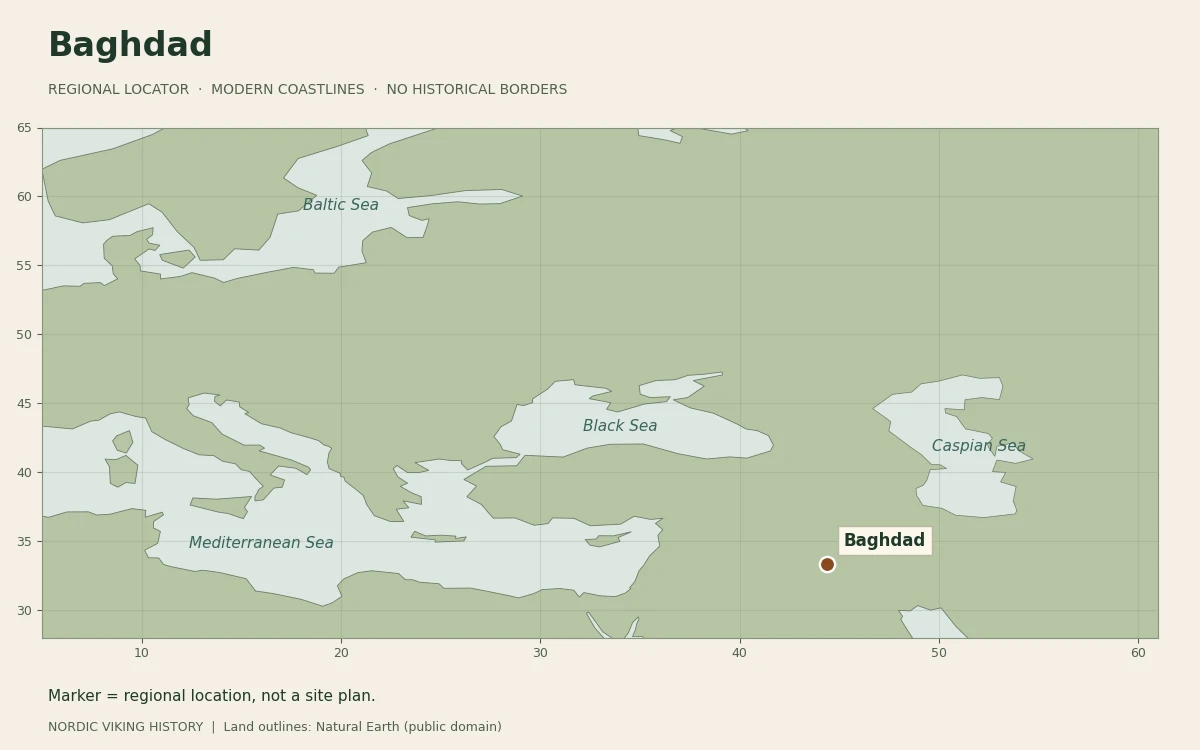
A capital with a much wider horizon
Founded as the Abbasid capital in 762, Baghdad was a major center of cultural and commercial activity. The Metropolitan Museum of Art emphasizes its importance alongside Samarra. Northern visitors entered an existing, sophisticated political and economic world; they did not discover a place previously isolated from international connections.
What the geographical account says
Encyclopaedia Iranica summarizes Ibn Khurradadhbih's description of Rus traders carrying furs and swords, crossing the Caspian network and continuing overland with their merchandise to Baghdad. Interpreters feature in the account. Those details make the journey a sequence of negotiated connections rather than an uninterrupted longship voyage from Sweden to the city.
Do not make a coin do too much
A coin's mint and its eventual findspot do not identify the complete route between them. Written itineraries, dated objects and archaeological contexts must be compared rather than treated as interchangeable proof. Uppsala University's research on the Rus specifically highlights the challenge of reconciling such texts with material evidence for journeys farther east.
Explore more Viking-Age places →
The Evidence
The sources below support this article. Interpretations and limits are explained in the text; this is not an exhaustive research review.