
Journeys & Encounters · Deep dive
Ibn Rustah: How Reports of the North Reached a Geographer
In Brief
His account of the Rus preserves information carried through other people and texts. That chain of transmission is part of the evidence.
On this page
A compiler with a wide intellectual horizonHe recognized differences in information qualityThe Jayhani tradition is a relationship to investigateChronology complicates a simple chain of borrowingThe island of the Rus is not a modern map coordinateRepeated descriptions preserve both knowledge and conventionThe surviving book is also an editorial objectA useful source without a fictional journeySourcesA compiler with a wide intellectual horizon
Ibn Rustah was a Persian author associated with Isfahan, active in the early tenth century. His surviving geographical work formed part of a much larger encyclopedia. Encyclopaedia Iranica describes a book ranging from astronomy and the holy cities to seas, rivers, political communities, and roads. The Rus appear within this broad effort to organize knowledge about the world. They were not the sole subject of a northern travel diary. This setting matters because the author’s priorities included noteworthy customs and relationships between places, alongside information useful for travel. A passage about distant people must be read as one contribution to that larger intellectual project.
Sources for this section: 1
He recognized differences in information quality
The same scholarly account notes that Ibn Rustah distinguished his knowledge of Isfahan from reports about other regions. For his home city he could draw on experience and informants he considered reliable; elsewhere he depended on material that could be difficult to obtain or check. That distinction is unusually helpful. It shows that uncertainty did not begin with modern criticism. The author already faced unequal access to information. His reported journey to Medina in 903 establishes travel in one direction, but does not demonstrate that he visited the Rus. We should preserve the difference between a writer who traveled somewhere and a witness to every society he described.
Sources for this section: 1
The Jayhani tradition is a relationship to investigate
Thorir Jonsson Hraundal’s doctoral research places Ibn Rustah among early tenth-century writers drawing on information associated with the so-called Jayhani tradition. Jayhani’s geographical work is lost, although later authors indicate its importance. Ibn Rustah also used material connected with Ibn Khurradadhbih. These relationships mean that a surviving author’s name is not necessarily the starting point of a report. Information could pass through earlier books, inquiries, travelers, and courtly networks before reaching the version now available. The analytical task is to reconstruct those connections where possible. Calling a passage secondhand identifies a problem to examine, not a verdict that it contains no usable knowledge.
Sources for this section: 2
Chronology complicates a simple chain of borrowing
John Latham-Sprinkle’s research on the northern Caucasus highlights a difficulty with assuming that Ibn Rustah directly copied Jayhani. The dates usually assigned to their activity may instead permit a common source. Similar wording in later accounts can arise through several routes: direct borrowing, shared predecessors, or different versions of a lost work. The distinction affects how independent the apparent witnesses really are. Three writers repeating related material do not automatically supply three separate confirmations. At the same time, disagreement over the precise chain does not erase the common material. It identifies a textual family whose internal history needs careful comparison.
Sources for this section: 3
The island of the Rus is not a modern map coordinate
Irina Konovalova’s study examines the geographical image of an island of the Rus transmitted through Islamic writing. In Ibn Rustah’s account, the internal landscape lacks named towns, rivers, and mountains, while external trading destinations are more recognizable. This imbalance is itself revealing. Informants could know where merchants appeared without possessing precise knowledge of their distant home region. A geographical image may therefore be stable in literature yet difficult to place on a map. Selecting a modern island because it resembles one descriptive feature risks giving the text a precision it never had. The first question is what kind of geographical knowledge the passage actually contains.
Sources for this section: 4
Repeated descriptions preserve both knowledge and convention
William Watson’s reexamination and translation compares Ibn Rustah with other accounts containing related descriptions of the Rus. Shared elements include their relationship with neighboring Slavic populations, political leadership, and practices connected with burial and wealth. These parallels help locate the passage within a corpus of circulating information. They also require caution when details are assembled into a comprehensive picture of one community. A compiler could combine reports collected at different times or places. The most useful comparison therefore identifies which elements recur, which change, and which depend on a shared source. Agreement is strongest when its independence can be demonstrated rather than assumed.
Sources for this section: 5
The surviving book is also an editorial object
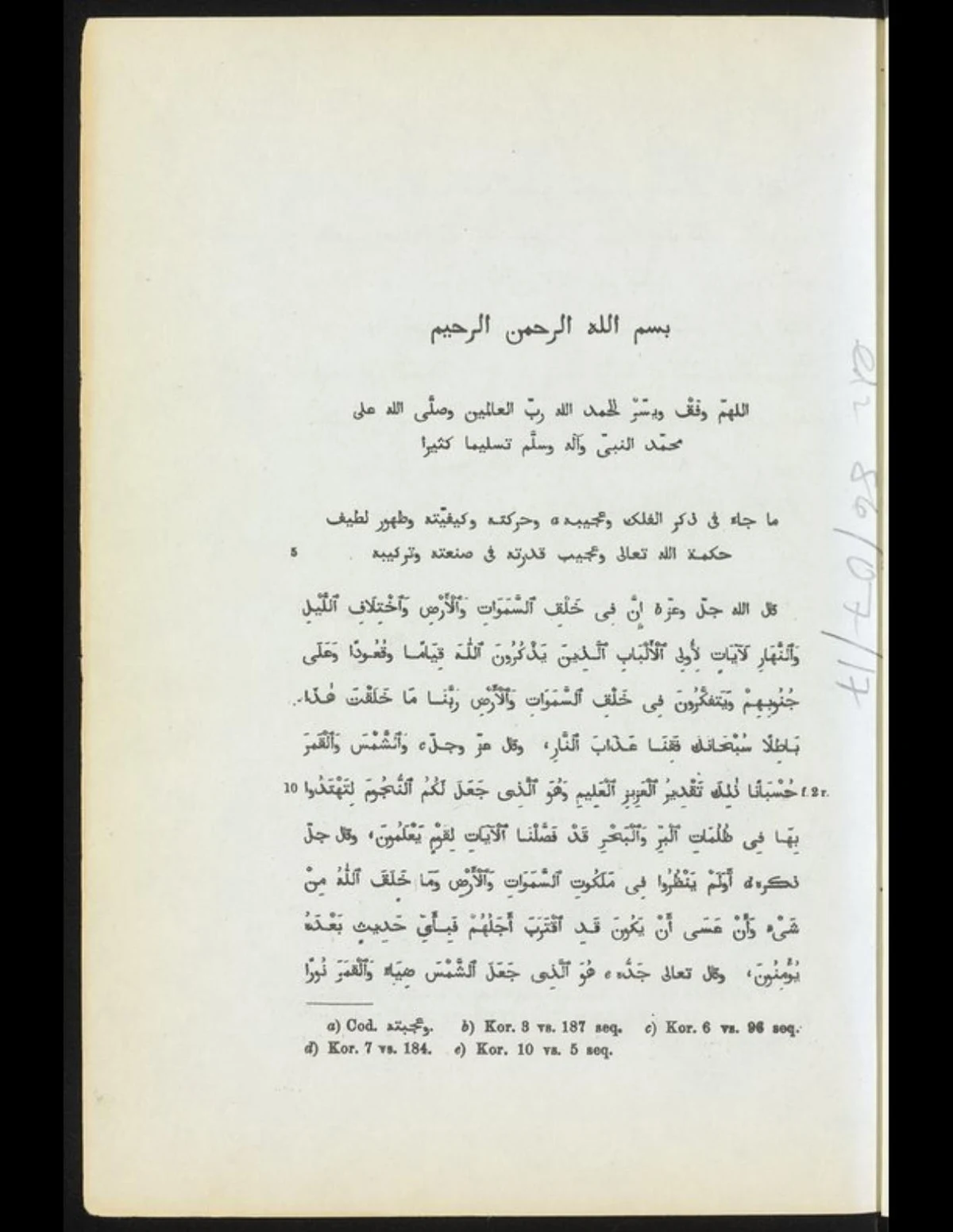
The digitized Arabic edition made available through New York University’s Arabic Collections Online places Ibn Rustah alongside al-Yaqubi in the Bibliotheca Geographorum Arabicorum. Its catalog identifies the editor, publication setting, and relationship between the works. Such bibliographical information is not incidental. Modern readers usually encounter an edited text or translation, not the author’s own manuscript. Choices about transcription, division, and rendering unfamiliar terms stand between the medieval witness and the readable page. A responsible citation should identify which edition or translation is being used. Otherwise a difference between modern translators may be mistaken for a disagreement between medieval informants.
Sources for this section: 6
A useful source without a fictional journey
Ibn Rustah’s importance does not require inventing a personal expedition to the north. His work records how distant societies became knowable through mobile people and circulating texts. Its strengths include details preserved nowhere else in quite the same form and opportunities to compare related geographical traditions. Its limits include uncertain routes of transmission, uneven spatial precision, and the possibility that similar reports are not independent. Reading those features together produces a more exact history of contact. Goods traveled through networks, but so did descriptions of rulers, customs, and places. The geographer’s desk was one point where those journeys became a written account.
Sources for this section: 1, 2, 3, 4, 5, 6
The Evidence
The sources below support this article. Interpretations and limits are explained in the text; this is not an exhaustive research review.
- Clifford Edmund Bosworth: Ibn Rustah in Encyclopaedia Iranica ↗
- Thorir Jonsson Hraundal: The Rus in Arabic Sources ↗
- John Latham-Sprinkle: Political Authority in North Caucasian Alania ↗
- Irina Konovalova: Rus on the world map of Islamic geographers ↗
- William Watson: reexamination and translation of Ibn Rustah ↗
- NYU Arabic Collections Online: edited geographical texts ↗