
Journeys & Encounters · Place profile
Balladoole: A Place in the Viking World
In Brief
Balladoole’s Chapel Hill contains a Viking-Age boat burial within a much older and repeatedly reused landscape. Its position above the coast made the funeral conspicuous, but the surrounding graves and structures prevent the hill from being interpreted as an exclusively Scandinavian monument.
Present-day location: Isle of Man · Britain and Ireland
Browse places by country →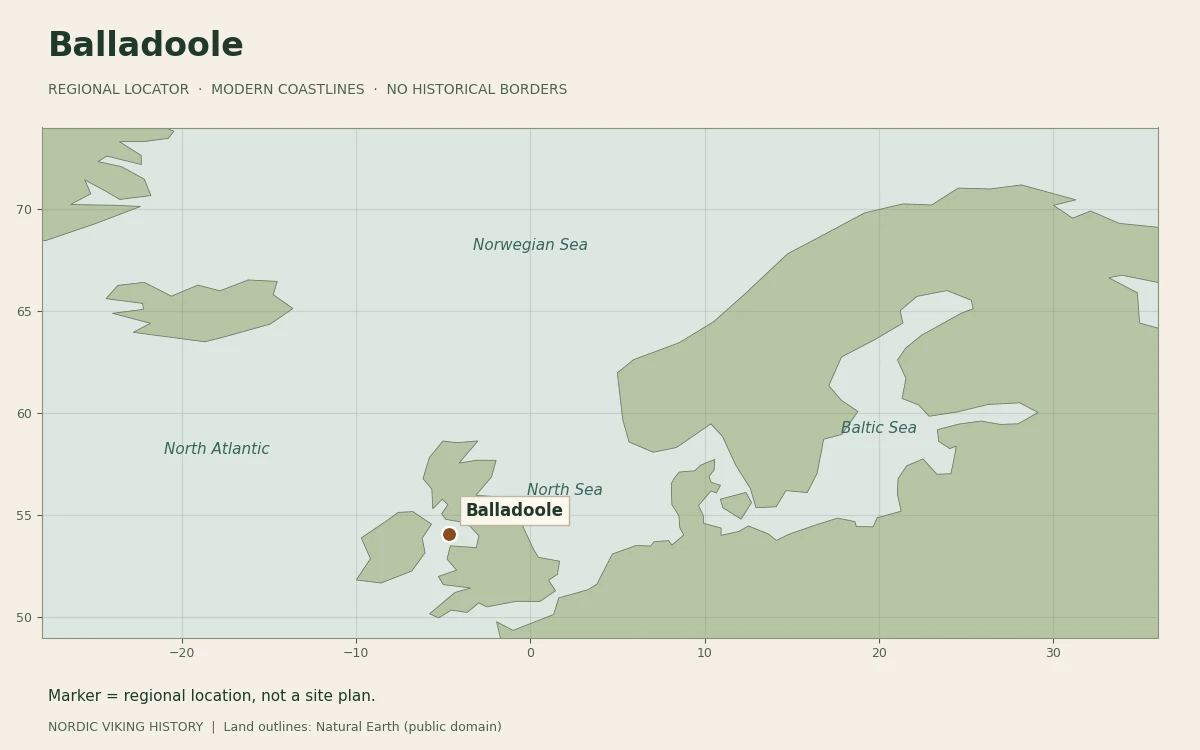
The Viking-Age connection
The burial, broadly dated between the ninth and tenth centuries, was discovered in 1945 during Gerhard Bersu’s excavation. Iron nails survived where the approximately eleven-meter vessel had decayed. The museum interprets it as a smaller boat rather than a conventional longship. Bringing it uphill for burial required substantial work and coordination.
Reading the evidence
An adult man was accompanied by belongings including riding equipment, tools and a shield. The elaborate bridle fittings help reveal the resources invested in the funeral. No offensive weapon was found, a useful warning against assuming that every richly equipped Scandinavian-style burial must commemorate a professional fighter.
Understanding the place
Earlier Christian lintel graves complicate interpretations of the boat’s placement. It has been read as an assertion of power and as evidence of relationships between incoming and established communities. Neither explanation can simply be recovered from the grave’s position. Manx National Heritage’s later discussion of forensic reconstruction also reminds us that the buried person was an individual, not just a collection of impressive objects.
Explore more Viking-Age places →
The Evidence
The sources below support this article. Interpretations and limits are explained in the text; this is not an exhaustive research review.