
Journeys & Encounters · Place profile
Ballateare: A Place in the Viking World
In Brief
Ballateare in Jurby is important for both Viking-Age weapon equipment and the difficult interpretation of violent death. Its burial mound contained a furnished male grave and additional human remains whose relationship has generated strong claims about sacrifice and social status.
Present-day location: Isle of Man · Britain and Ireland
Browse places by country →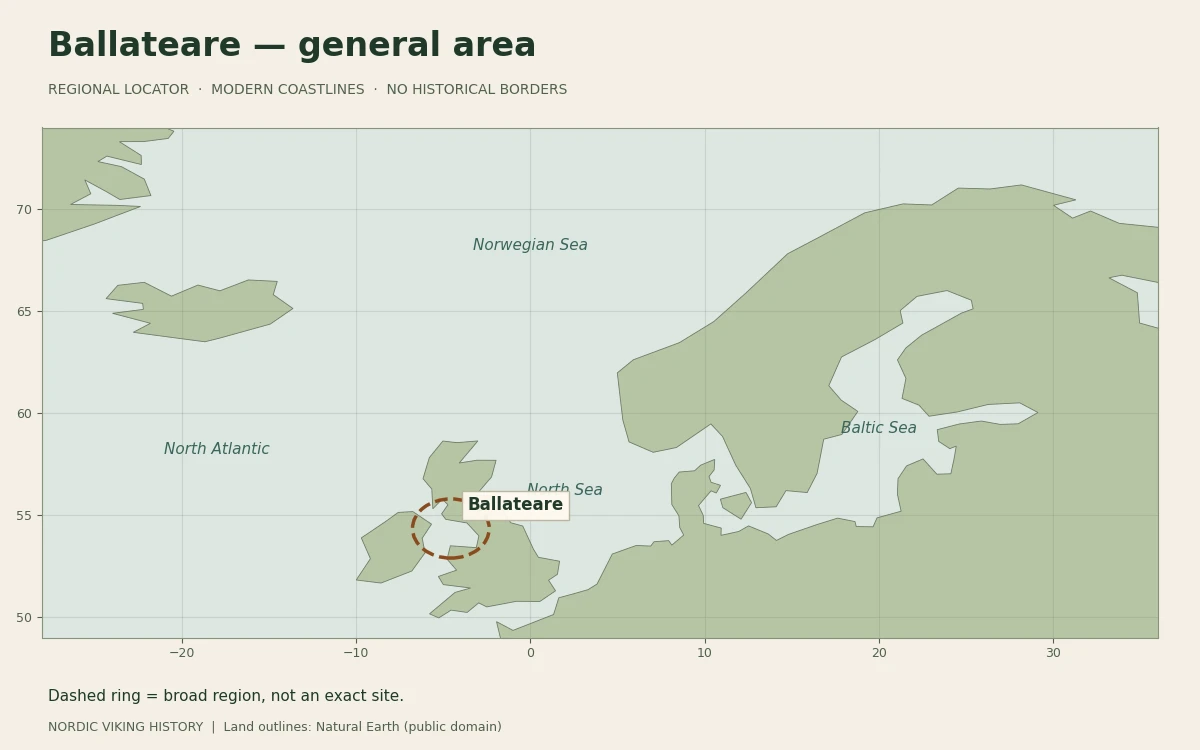
The Viking-Age connection
Excavated in 1946, the mound covered a grave containing a young adult man and weapons including a sword, shield and spearheads. The sword’s surviving fittings also preserve evidence for the equipment used to carry it. Manx National Heritage illustrates the sling components, showing how small fragments can contribute to a reconstruction of everyday practical arrangements.
Reading the evidence
A woman’s remains associated with the mound showed severe head trauma. Older museum explanations described her as an enslaved sacrifice. More recent research examines how such interpretations are constructed and warns against allowing a familiar narrative to supply an undocumented identity. Violent injury is evidence; the person’s legal status and the exact ceremony require separate arguments.
Understanding the place
The damaged weapons raise another interpretive problem. Deliberate destruction has been understood as ritual action or as a way to make valuable grave goods unusable. These explanations need not produce the same account of the funeral. Compare the object’s actual condition with the suggested motive, and distinguish both from what can be known about the person buried with it.
Explore more Viking-Age places →
The Evidence
The sources below support this article. Interpretations and limits are explained in the text; this is not an exhaustive research review.