
Journeys & Encounters · Place profile
Barda: The Rus Attack Far beyond the Black Sea
In Brief
Barda in present-day Azerbaijan provides one of the clearest documented examples of Rus activity far into the southern eastern-route world. Medieval accounts describe a violent occupation in 943. The episode belongs in Viking-Age history, but it is not evidence for a permanent Scandinavian city in the Caucasus.
On this page
An expedition up the riverA city with its own historyTextual events and excavated layersSourcesPresent-day location: Azerbaijan · Caucasus and Caspian
Names and search variants: Barda · Bardha'a · Bardhaa · Bardhaʿa · Barḏaʿa · Bərdə · Berdaa
Browse places by country →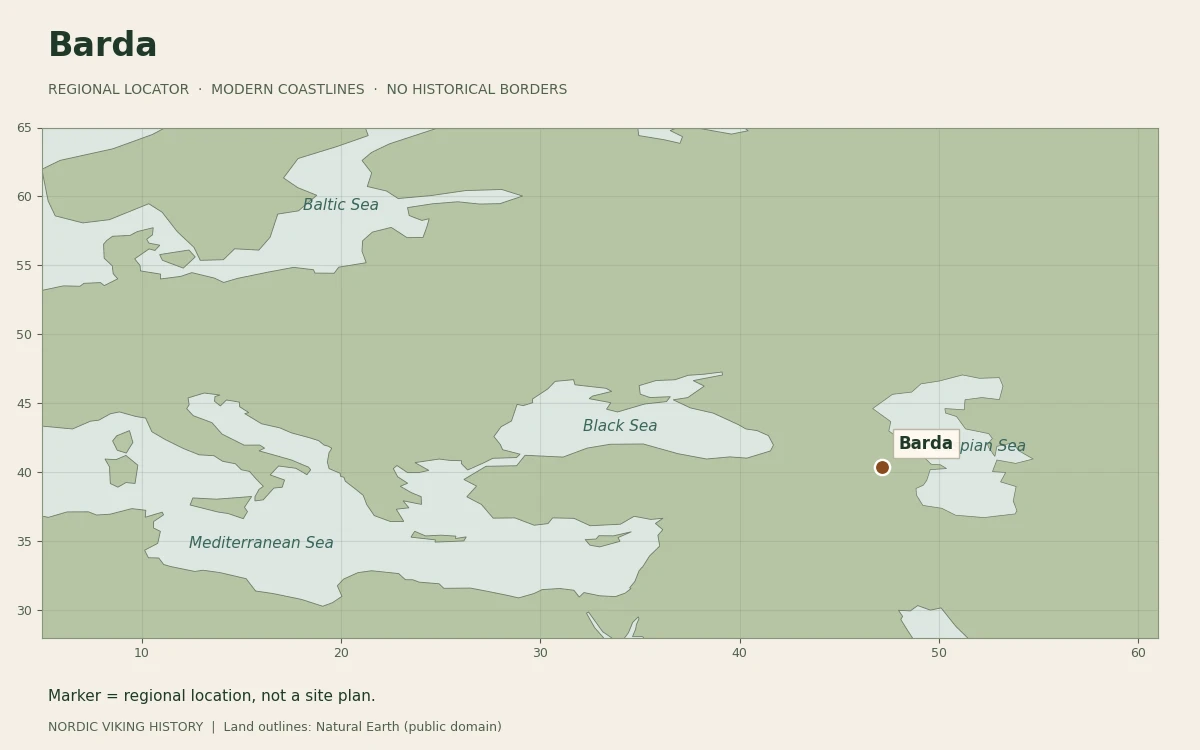
An expedition up the river
Encyclopaedia Iranica describes the attackers reaching the region from the Caspian by the Kura River and occupying Barda for months. Disease weakened them during the conflict. These accounts illuminate the reach and violence of Rus expeditions, while giving only limited information about the individual origins of the participants.
A city with its own history
The Oxford Nizami Ganjavi Centre supervised archaeological seasons at medieval Barda between 2015 and 2018, followed by laboratory research. Studying the city's wider occupation is essential. A place attacked by outsiders did not exist merely as the stage for their adventure, and its residents, economy and built environment deserve their own attention.
Textual events and excavated layers
A chronicle's dramatic episode cannot automatically explain every burned layer or damaged object. Establishing a connection requires secure dating and contextual evidence from the excavation itself. Until that connection is demonstrated, an archaeological photograph should be identified as medieval Barda rather than advertised as the exact scene of the Rus attack.
Explore more Viking-Age places →
The Evidence
The sources below support this article. Interpretations and limits are explained in the text; this is not an exhaustive research review.