
Journeys & Encounters · Place profile
Borgund on Sunnmøre: A Small Town at the Viking–Medieval Transition
In Brief
Borgund near Ålesund was a coastal settlement that grew into one of medieval Norway’s small towns. Its beginnings reach toward the Viking Age, but much of the excavated urban life belongs to later centuries. That transition is the central subject, not a reason to label everything Viking.
Present-day location: Norway · Møre og Romsdal
Names and search variants: Borgund on Sunnmøre · Borgund · Borgund kaupang · Aalesund · Ålesund
Browse places by country →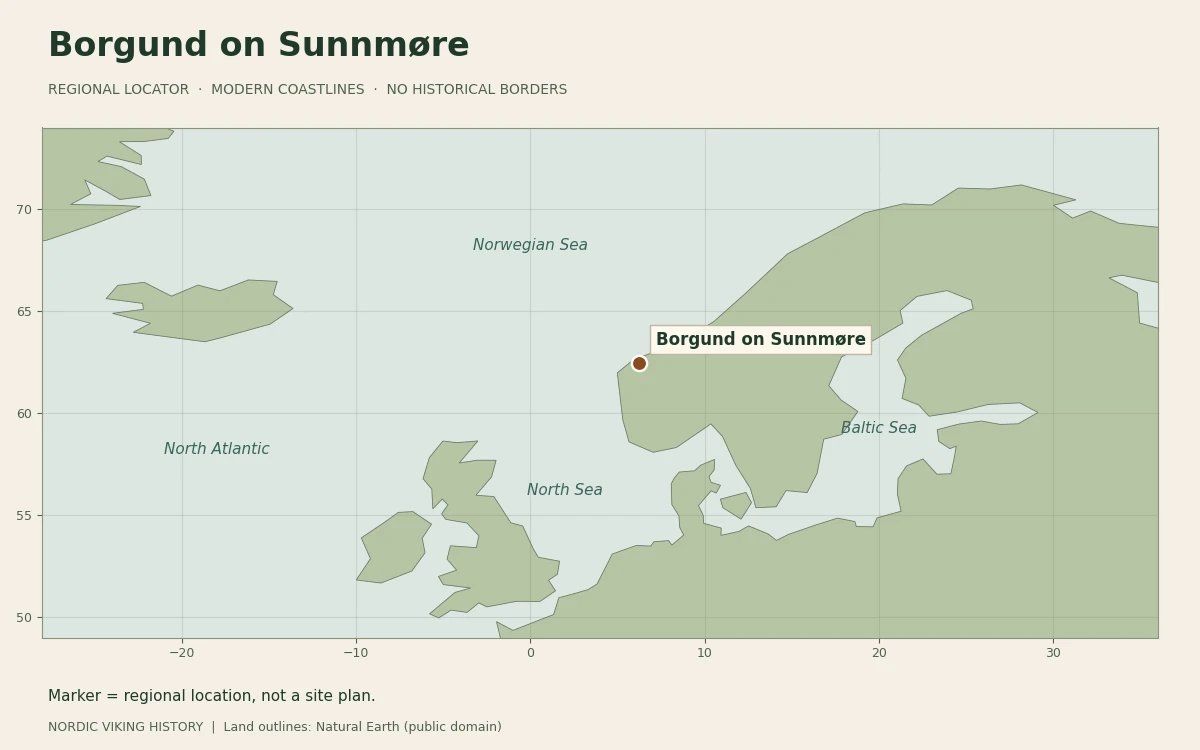
The historical setting
University of Bergen research studies the settlement’s emergence, economic connections, and eventual abandonment. Written references and archaeological evidence need to be compared carefully: sagas describing earlier events were composed much later. A mention of a famous visitor is not sufficient by itself to establish the size or character of the contemporary settlement.
What the evidence shows
Extensive excavation produced a large collection of artifacts and structural evidence. Recent topographical research also emphasizes that the shoreline around the year 1000 differed from today’s: sea level and accumulated occupation deposits changed the relationship between land and water. A harbor landscape cannot simply be reconstructed by tracing the present shore.
How to read this place
Borgund is valuable for exploring the difference between a coastal place and a town. Look for evidence of concentrated housing, exchange, specialized work, and institutions, and ask when each appears. Its later decline is equally instructive: important places do not inevitably become modern cities. The surviving archaeology makes a small settlement visible within wider economic networks without requiring it to have been a great royal capital.
Explore more Viking-Age places →
The Evidence
The sources below support this article. Interpretations and limits are explained in the text; this is not an exhaustive research review.