
Journeys & Encounters · Place profile
Brandstrup: Riders, Chamber Graves and Changing Burial Choices
In Brief
Brandstrup near Rødkærsbro belongs to the Danish evidence for wealthy Viking-Age burial away from the best-known royal monuments. Weapons and riding equipment connect the place with elite display, while separate nearby graves reveal that one impressive assemblage is not the whole history of a burial landscape.
Present-day location: Denmark · Central Jutland
Names and search variants: Brandstrup · Brandstrup rider grave · Brandstrup III
Browse places by country →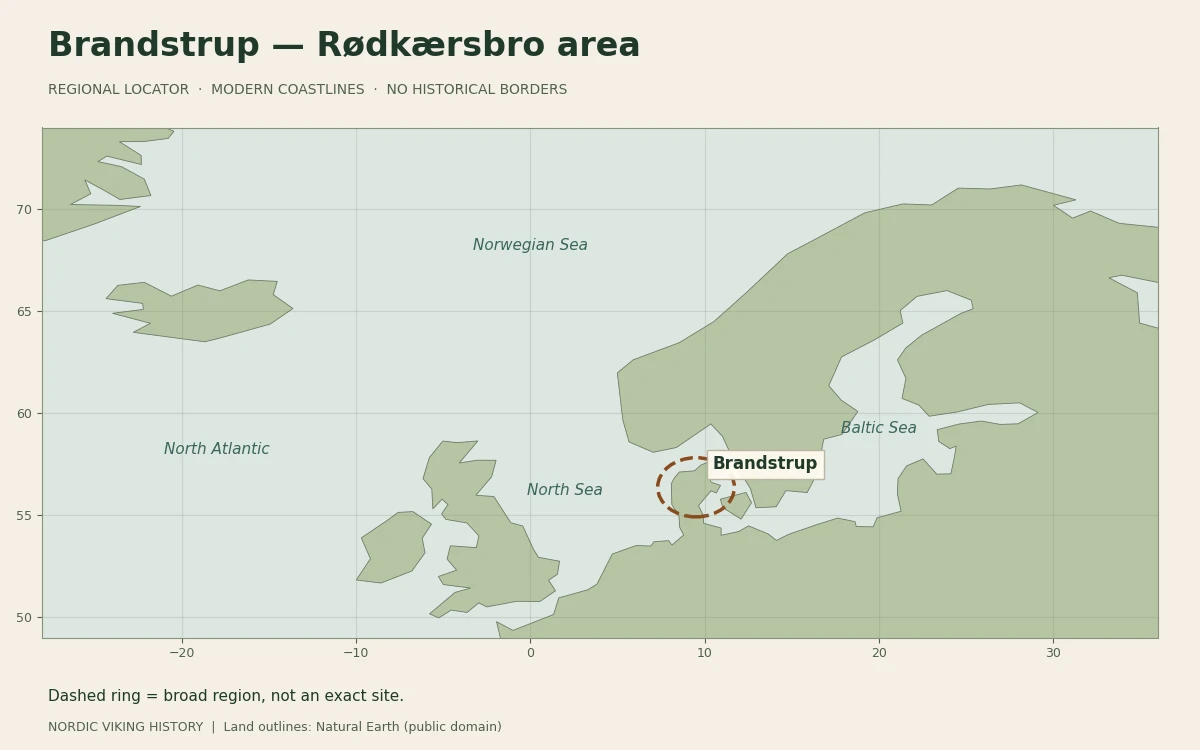
The historical setting
The National Museum describes a Brandstrup rider burial furnished with a silver-covered sword, decorated stirrups, spurs, a bridle and horse-harness fittings. Such objects concern movement as well as warfare. A horse and its equipment could communicate position and wealth at a funeral; they do not, by themselves, provide a precise military rank or the name of a battlefield.
What the evidence shows
Archaeological reporting also records renewed work after unusual crop growth drew attention to nearby ground. The investigation found graves from more than one period, including Viking-Age burials approaching the year 1000. A specialist publication treats an axe and taper from two chamber graves. These discoveries should not be merged into one enormous burial or confused with the earlier Roman-period deposits in the same locality.
How to read this place
The useful comparison is between individually recorded graves: what was placed with each person, how the grave was built, and which dating evidence belongs to it. A photograph of a famous ship burial elsewhere would conceal the site’s distinctive contribution. Regional orientation or carefully identified finds are better illustrations until a verified photograph of the actual excavated context is available.
Explore more Viking-Age places →
Explore this record and its sources in the map collection →
This entry is searchable by place and country. No verified burial-site coordinate is supplied, so it has no map marker or directions.
The Evidence
The sources below support this article. Interpretations and limits are explained in the text; this is not an exhaustive research review.