
Journeys & Encounters · Place profile
Chersonesus: A Byzantine City in the Story of Rus Conversion
In Brief
Chersonesus, on the Crimean peninsula, was an ancient Greek city that continued into the Byzantine period. Its place in Viking-Age history comes through contact with Rus and traditions surrounding Prince Vladimir's conversion. It was not a Viking foundation, and its long archaeological history must not be compressed into that one episode.
On this page
A city older than the Viking AgeVladimir and the conversion traditionA meeting of political worldsSourcesPresent-day location: Ukraine · Black Sea
Names and search variants: Chersonesus · Chersonese · Tauric Chersonese · Korsun · Khersones
Browse places by country →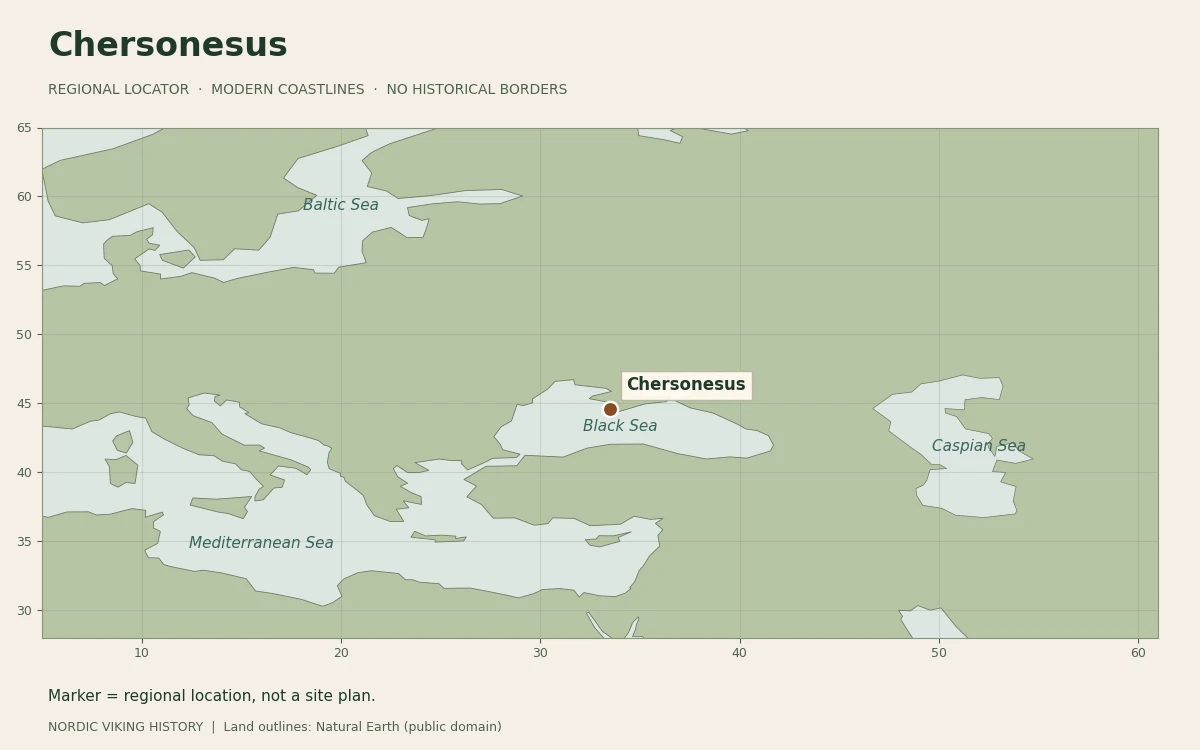
A city older than the Viking Age
UNESCO describes a settlement founded in the fifth century BCE and a surviving urban landscape containing remains from many later centuries. Streets, buildings and agricultural divisions tell a much longer story of Black Sea exchange. A photograph of classical columns is not automatically a photograph of the city as Vladimir encountered it.
Vladimir and the conversion tradition
The site's UNESCO nomination associates Chersonesus with Vladimir's baptism in 988 and the Christianization of Rus. This is a major historical tradition rather than a license to treat every detail of later conversion narratives as contemporary documentation. The distinction matters when identifying a specific baptismal location or linking a surviving structure to the prince.
A meeting of political worlds
Chersonesus helps explain why the eastern journeys were more than voyages for silver. Diplomatic marriage, religion and relations with Byzantine power also shaped the world of Rus. Following that connection does not make Vladimir's subjects uniformly Scandinavian: a ruler's links with the northern world are only one strand in a much broader political society.
Explore more Viking-Age places →
The Evidence
The sources below support this article. Interpretations and limits are explained in the text; this is not an exhaustive research review.