
Journeys & Encounters · Place profile
Fregerslev: Horse Equipment and an Elite Funeral
In Brief
Fregerslev near Hørning and Skanderborg is known for a richly furnished tenth-century chamber burial. Its exceptional horse equipment makes it a major source for understanding elite display and riding technology. It is not the Hørning church burial near Randers, which belongs to a different site.
Present-day location: Denmark · East Jutland
Names and search variants: Fregerslev · Vikingen fra Fregerslev · Fregerslev rider grave · Hørning Skanderborg
Browse places by country →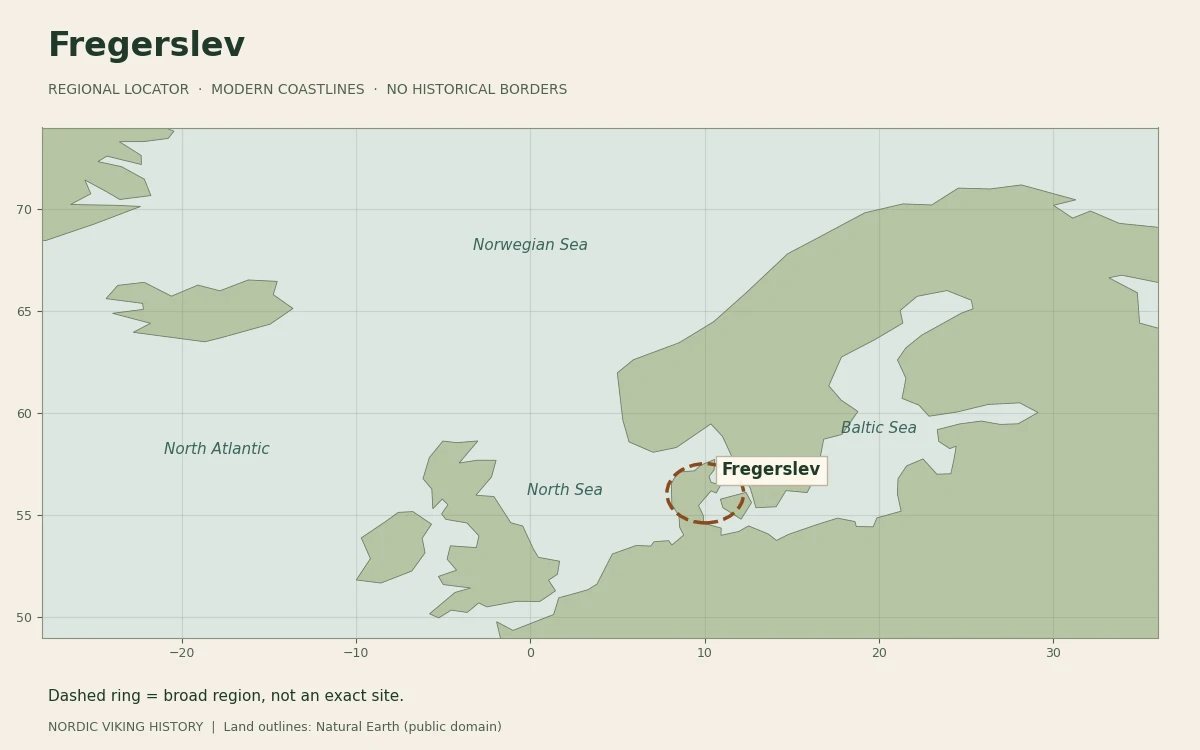
The historical setting
The grave was identified in 2012, and a research excavation began in 2017. Museum Skanderborg describes a substantial timber chamber with roof-bearing posts, lavish fittings, and animal offerings. The burial is generally placed around the middle of the tenth century, in the period associated with the Jelling kings.
What the evidence shows
Conservation and laboratory excavation recovered large numbers of small metal components from the riding equipment. Reconstruction and practical testing helped researchers investigate how they fitted together. Such work is valuable because scattered fittings do not explain their own arrangement, but the resulting mounted display remains a research reconstruction rather than an intact surviving saddle.
How to read this place
The funeral’s investment suggests high status, yet labels such as jarl, thegn, royal ally, or local administrator are hypotheses rather than recovered job titles. Ask what the burial establishes directly: access to skilled work, expensive materials, horses, and people able to organize the ceremony. Those observations are substantial without attaching the deceased to a particular ruler’s personal entourage.
Explore more Viking-Age places →
Explore this record and its sources in the map collection →
This entry is searchable by place and country. No verified burial-site coordinate is supplied, so it has no map marker or directions.
The Evidence
The sources below support this article. Interpretations and limits are explained in the text; this is not an exhaustive research review.