
Journeys & Encounters · Place profile
Fæsted and Harreby: Gold, Halls, and a Ritual Landscape
In Brief
The Fæsted–Harreby area near Sønder Hygum has produced unusually rich evidence for elite and ritual activity. A Viking-Age gold hoard drew public attention, but subsequent investigation places the finds within a much longer sequence of buildings, deposits, and changing uses of the landscape.
Present-day location: Denmark · South Jutland
Names and search variants: Fæsted and Harreby · Faested · Harreby · Sønder Hygum · Sonder Hygum
Browse places by country →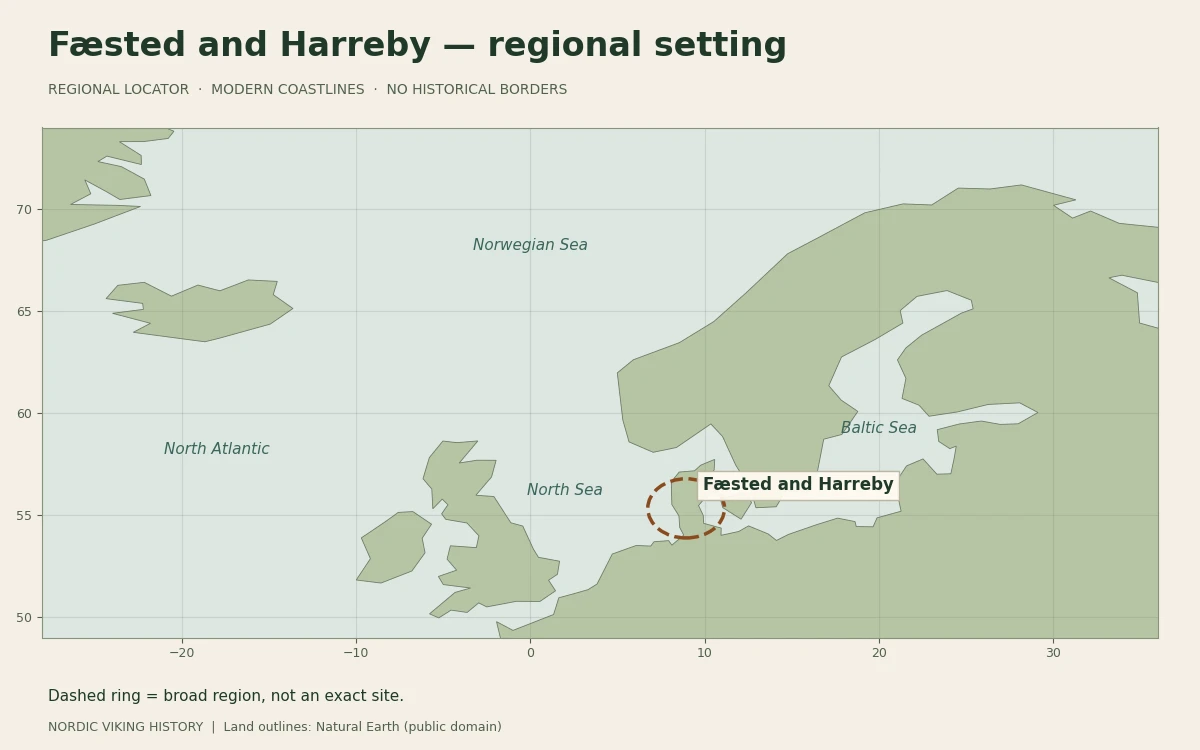
The historical setting
The large gold discovery was made in 2016. Research in the surrounding area identified a hall and a distinctive stone accumulation assigned broadly to the period around 600–975. This chronology crosses the boundary between the later Germanic Iron Age and the Viking Age, rather than describing one isolated tenth-century event.
What the evidence shows
The researchers discuss the possibility of a hørg and compare the site with other Scandinavian central places. The interpretation rests on the combination of structures, deposits, and landscape associations. It should not be simplified into a claim that archaeologists have recovered an intact temple with a known dedication or a complete sequence of ceremonies.
How to read this place
The important analytical move is to keep individual finds in context. A gold object, a concentration of stones, and a hall need separate dates before they become one historical story. Ask whether they represent the same generation or successive practices in a place already considered significant. This makes Fæsted more interesting, not less: the research concerns how authority and sacred associations could develop across centuries.
Explore more Viking-Age places →
The Evidence
The sources below support this article. Interpretations and limits are explained in the text; this is not an exhaustive research review.