
Journeys & Encounters · Place profile
Grønhaug: An Early Ship Burial with a Disturbed Interior
In Brief
Grønhaug on northern Karmøy contains one of the early ship burials that help explain the emergence of Viking-Age elite funerals. It is less famous than Oseberg, but its vessel, textiles and disturbed chamber preserve a different perspective on the same broad tradition.
Present-day location: Norway · Karmøy, Rogaland
Names and search variants: Grønhaug · Gronhaug · Grønhaugen
Browse places by country →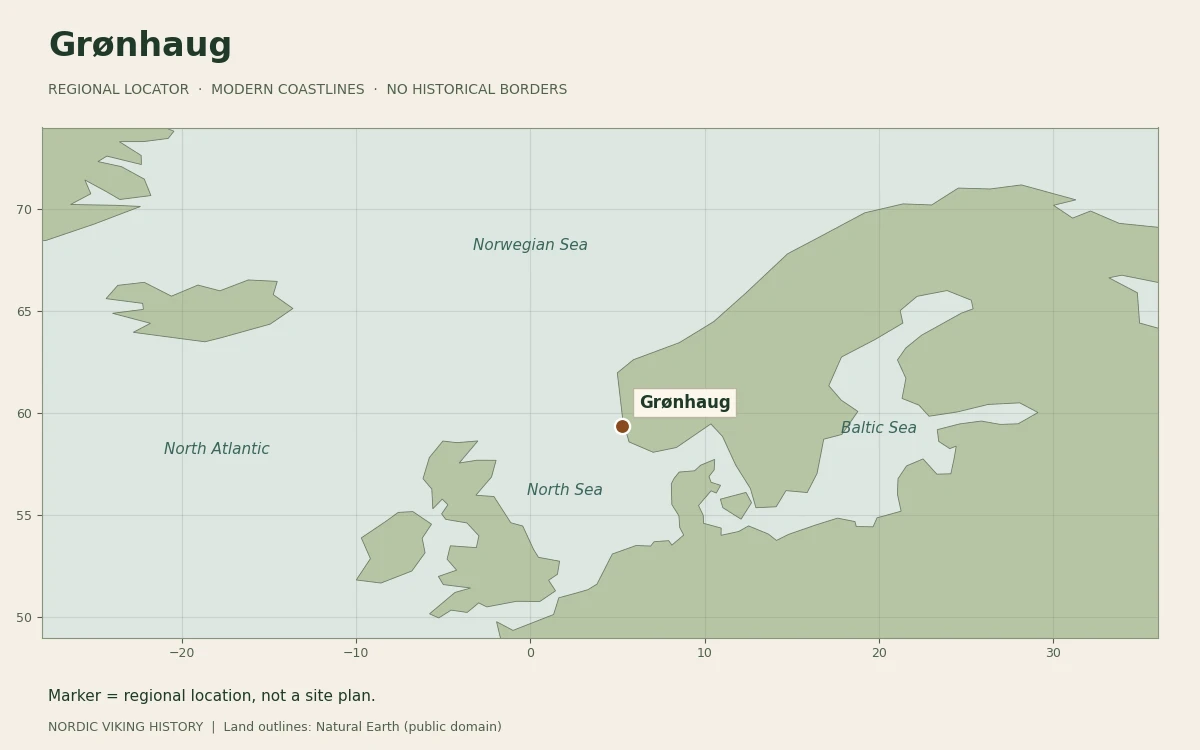
The historical setting
Excavation in 1902 revealed an oak ship about fifteen meters long. Tree-ring analysis estimates its construction around 780. The proposed burial date around 790–795 comes from comparison with the working lives of other dated burial ships, rather than a direct date for the funeral. The mound belongs beside the maritime landscape around Avaldsnes, rather than in an isolated category of spectacular objects.
What the evidence shows
The burial contained remains of an adult man and fragments of fine textiles. Its interior had been disturbed in antiquity. Scattered human remains and feathers from bedding, together with missing equipment, make the surviving assemblage incomplete. An absent sword is consequently not straightforward evidence that weapons were deliberately excluded from the original ceremony. The university museum also notes connections between the ship’s timber and the west-coast provenance of other vessels.
How to read this place
Consider the mound as three different historical problems: the building of a ship, the staging of a funeral, and the later disturbance of a grave. Those episodes need not share one motive or date. A reconstruction should distinguish recovered material from restored furnishings. The much later excavation photographs document archaeological work, not an untouched Viking funeral.
Explore more Viking-Age places →
Explore this burial record and its sources in the map collection →
No precise burial-site coordinate or current visitor access has been verified. This entry supports reading and search.
The Evidence
The sources below support this article. Interpretations and limits are explained in the text; this is not an exhaustive research review.