
Journeys & Encounters · Place profile
Gulating: Negotiating Law on the Western Coast
In Brief
Gulating was a regional assembly and legal institution serving western Norway. Its coastal setting at Gulen connects it with communities whose communication depended heavily on waterways. The Viking-Age roots are important, but the institution continued changing long after the period conventionally ends.
Present-day location: Norway · Vestland
Names and search variants: Gulating · Gulathing · Gulaþing · Gulen · Flolid
Browse places by country →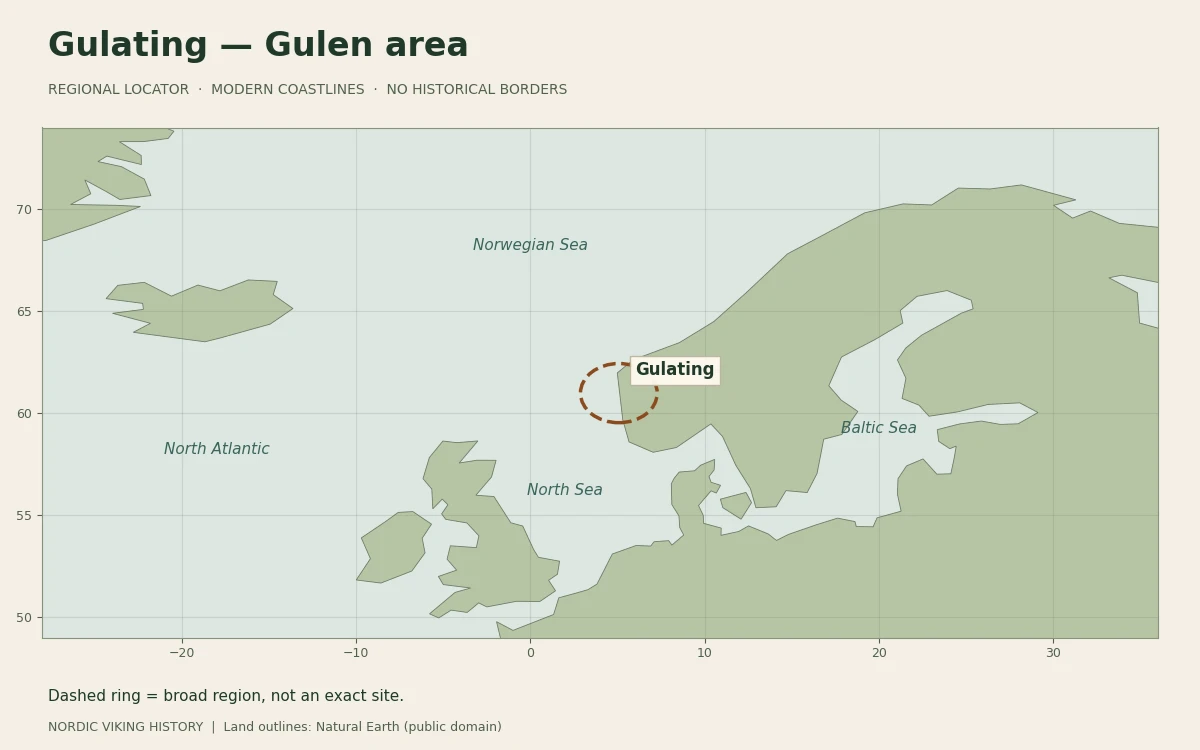
The historical setting
No contemporary document fixes the date of the first meeting. Later tradition connects the assembly with early kings and with the legal arrangements known to Norse settlers in the Atlantic. Surviving law texts show rules for society, religion, property, and public obligations, but their preserved forms belong to later medieval transmission.
What the evidence shows
The landscape around Guløy and Flolid is associated with the assembly’s memory. Modern monuments interpret that history rather than reproducing a documented Viking layout. Medieval records also reveal changing numbers of representatives and increasing royal influence. Eventually the assembly’s institutional life moved toward Bergen, demonstrating that the place and the court were not permanently inseparable.
How to read this place
Read Gulating as a meeting between interests, not as an uncomplicated birth certificate for a modern nation. Who could speak, who supplied resources, and who enforced decisions? Those are more revealing questions than whether the assembly was simply democratic or royal. The naval obligations in the legal tradition also connect courtroom language with ships, provisions, households, and the work of communities along the coast.
Explore more Viking-Age places →
The Evidence
The sources below support this article. Interpretations and limits are explained in the text; this is not an exhaustive research review.