
Journeys & Encounters · Place profile
Hillesøy: Two Boat Burials at a Northern Crossroads
In Brief
Hillesøy outside Tromsø produced two early Viking-Age boat burials, excavated in 2017 and 2018. A man and a woman were laid in separate boats with distinctive equipment. The finds illuminate northern communities whose relationships connected Norse and Sámi worlds rather than fitting a simple cultural boundary.
Present-day location: Norway · Troms
Names and search variants: Hillesøy · Hillesoy · Nordvegen Hillesøy
Browse places by country →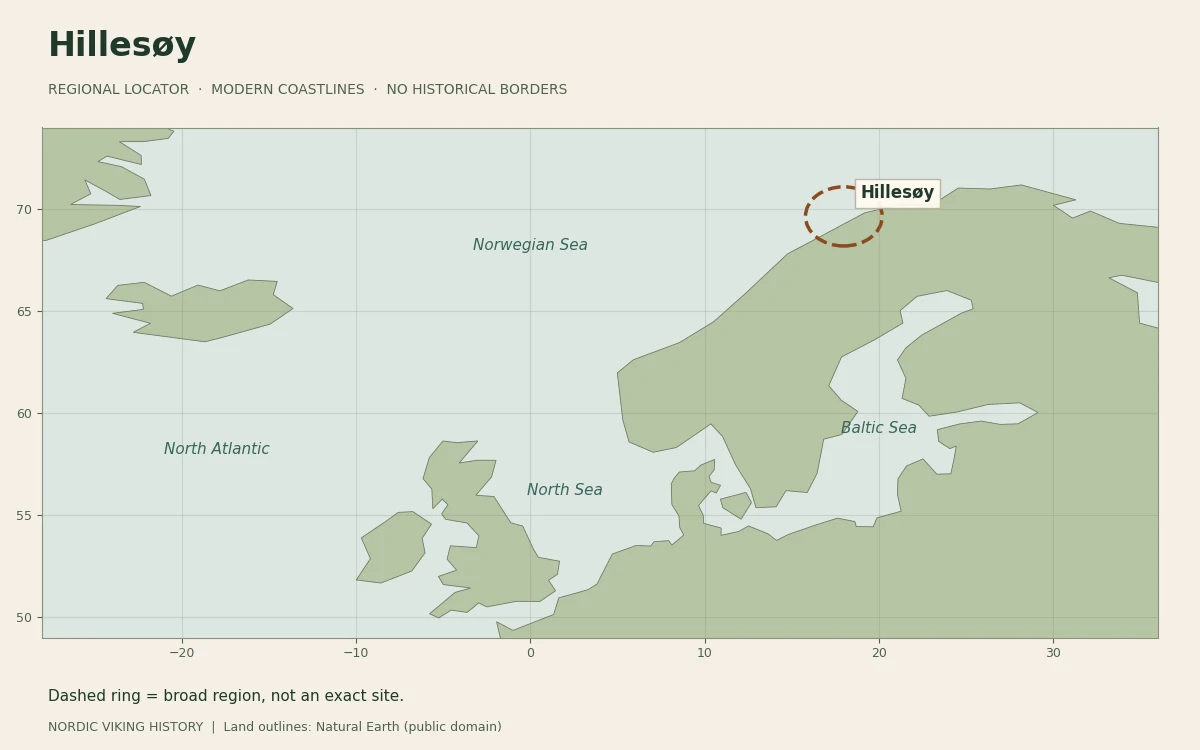
The historical setting
The woman’s burial was dated to approximately 770–840 through radiocarbon and artifact evidence. Her boat used a combination of organic stitching, wooden fastenings, and iron rivets. Jewelry, textile remains, containers, tools, and animal bones add information about both the funeral and the material connections of its participants.
What the evidence shows
The nearby male burial contained weapons and evidence interpreted as a bearskin. Researchers suggest that the two individuals belonged to a high-status local milieu with connections southward into Norse exchange networks and northward or eastward toward Sámi communities. Their proximity does not demonstrate that they were spouses, died together, or were biologically related.
How to read this place
Hillesøy is especially valuable because boat construction and personal equipment can be studied alongside skeletal evidence. Ask what each category actually establishes. A borrowed technique may reflect practical knowledge moving between communities, while an imported object may have traveled without its final owner. The combination is richer than an ethnic label assigned from a single brooch or fastening method.
Explore more Viking-Age places →
Explore this burial record and its sources in the map collection →
No precise burial-site coordinate or current visitor access has been verified. This entry supports reading and search.
The Evidence
The sources below support this article. Interpretations and limits are explained in the text; this is not an exhaustive research review.